This site includes links from a number of different display ads/affiliate programs. When you click on a link and make a purchase, we may earn a commission. Please be aware that some of the display ads may not be appropriate for Christians.

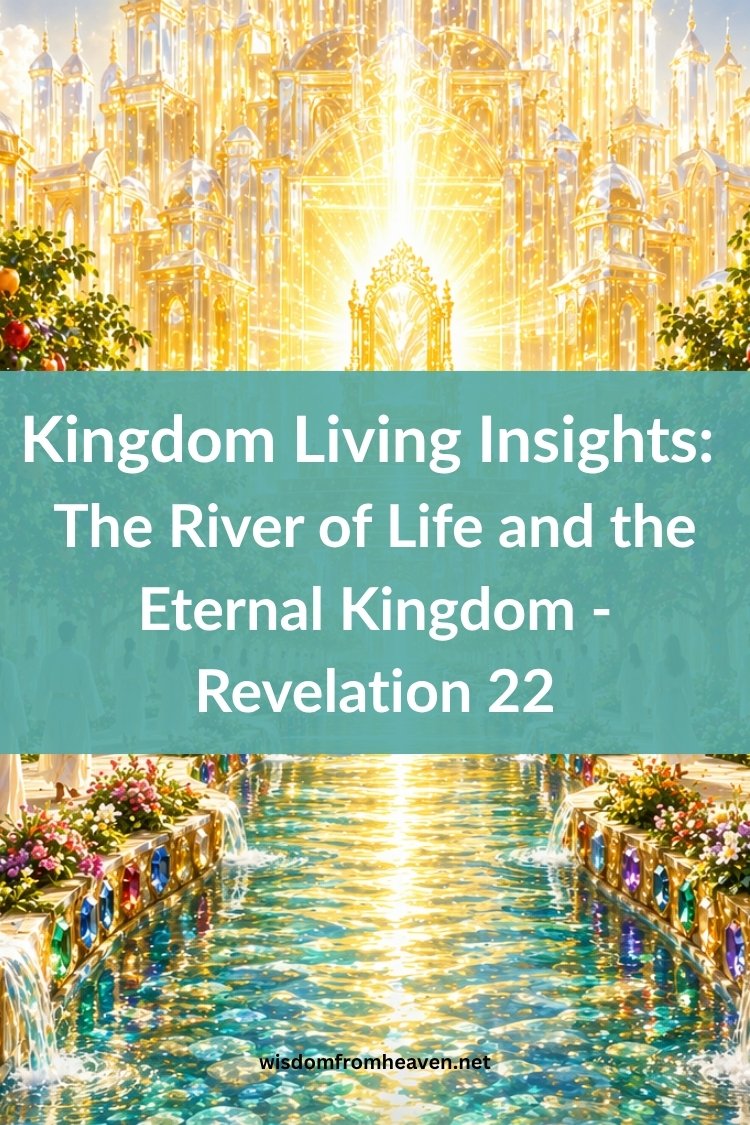
End Time Series Part 27: The River of Life and the Eternal Kingdom – Revelation 22
Introduction: The Final Chapter of God’s Revelation
1. The River of Life (Revelation 22:1-2 WEB)
“He showed me a river of water of life, clear as crystal, proceeding out of the throne of God and of the Lamb, in the middle of its street. On this side of the river and on that was the tree of life, bearing twelve kinds of fruits, yielding its fruit every month. The leaves of the tree were for the healing of the nations.”Explanation:
“He showed me a river of water of life”: The angel continues the tour of the New Jerusalem, now revealing its most central feature – a river flowing with the water of life. This river echoes several Old Testament passages:- Genesis 2:10: A river flowed out of Eden to water the garden
- Ezekiel 47:1-12: A river flows from the temple, bringing life wherever it goes
- Zechariah 14:8: Living waters flow from Jerusalem
- Psalm 46:4: “There is a river, the streams of which make the city of God glad, the holy place of the tents of the Most High.”
- Eternal life flowing from God
- The Holy Spirit (John 7:38-39)
- Complete spiritual satisfaction
- Unending refreshment and vitality
- The purity of eternal life
- The holiness of what flows from God’s throne
- Complete transparency – nothing hidden, nothing impure
- The throne of God: The seat of divine authority and sovereignty
- The Lamb: Jesus Christ, who purchased our salvation
- A single tree so large it spans the river
- Multiple trees of the same kind lining both banks
- An avenue of trees of life throughout the city
- Twelve kinds of fruit: Variety, abundance, complete provision
- Every month: Continuous, unending fruitfulness
- The twelve tribes of Israel
- The twelve apostles
- The twelve gates and foundations
- Completeness and fullness
- Healing from disease
- Health maintenance
- Well-being and wholeness
2. The Curse Removed and God’s Servants Reign (Revelation 22:3-5 WEB)
“There will be no curse any more. The throne of God and of the Lamb will be in it, and his servants will serve him. They will see his face, and his name will be on their foreheads. There will be no night, and they need no lamp light or sun light, for the Lord God will give them light. They will reign forever and ever.”Explanation:
“There will be no curse any more”: This single statement reverses the tragedy of Genesis 3. When Adam and Eve sinned:- The ground was cursed (Genesis 3:17)
- Thorns and thistles came forth (Genesis 3:18)
- Work became toil (Genesis 3:19)
- Death entered the world (Genesis 3:19)
- Humanity was expelled from Eden (Genesis 3:23-24)
- No more thorns, no more decay
- No more painful toil, no more frustration
- No more death, no more separation from God
- No more consequences of sin
- The deity of Christ
- The unity of Father and Son
- The completed work of redemption (the Lamb on the throne)
- Serve God joyfully and perfectly
- Worship without distraction or weariness
- Fulfill our created purpose completely
- Work without the curse – meaningful, satisfying, fruitful service
- Without sin to hinder us
- Without fatigue to exhaust us
- Without failure to discourage us
- Pure joy and perfect fulfillment
- Complete knowledge: We will know God fully, even as we are fully known (1 Corinthians 13:12)
- Intimate fellowship: Face-to-face relationship, nothing hidden
- Unveiled glory: We will behold His beauty without barrier
- Perfect communion: The deepest longing of the human heart fulfilled
- The 144,000 sealed with God’s name (7:3; 14:1)
- The beast’s followers marked with 666 (13:16-17)
- Ownership: We belong to God completely
- Identity: We are His children, His people
- Protection: We are eternally secure
- Intimacy: We bear His family name
- No darkness of any kind
- No fear, no danger, no evil
- No need for rest from weariness
- Continuous, unending day
- God Himself is the light (1 John 1:5)
- His glory illuminates everything
- The Lamb is the lamp of the city (21:23)
- Daniel 7:27: “The kingdom and the dominion, and the greatness of the kingdoms under the whole sky, will be given to the people of the saints of the Most High. His kingdom is an everlasting kingdom, and all dominions will serve and obey him.’”
- 2 Timothy 2:12: “If we endure, we will also reign with him”
- Revelation 5:10: “and made us kings and priests to our God; and we will reign on the earth.””
- No curse – Complete freedom from sin’s effects
- God’s throne present – His authority and presence central
- We serve Him – Meaningful, joyful worship-service
- We see His face – Intimate, direct fellowship with God
- His name on us – We belong to Him completely
- No night – No darkness of any kind
- God is our light – He illuminates everything
- We reign forever – Sharing in His eternal Kingdom
3. The Certainty of These Things (Revelation 22:6-7 WEB)
“He said to me, ‘These words are faithful and true. The Lord God of the spirits of the prophets sent his angel to show to his bondservants the things which must happen soon. Behold, I come quickly. Blessed is he who keeps the words of the prophecy of this book.'”Explanation:
“He said to me, ‘These words are faithful and true'”: As the vision concludes, the angel emphasizes the absolute reliability of everything John has seen. This echoes 21:5, where God Himself said, “These words are faithful and true.” “Faithful” (pistoi – πιστοί): Trustworthy, reliable, dependable “True” (alēthinoi – ἀληθινοί): Genuine, real, certain This isn’t mythology, allegory, or wishful thinking. These are God’s promises, and God cannot lie (Titus 1:2; Hebrews 6:18). “The Lord God of the spirits of the prophets”: This phrase identifies God as the one who inspired all the prophets throughout history. The same God who spoke through Isaiah, Jeremiah, Ezekiel, Daniel, and all the prophets has now given this final revelation through John. The “spirits of the prophets” refers to the prophetic gift – the ability to receive and communicate divine revelation. God is the source of all true prophecy. “Sent his angel to show to his bondservants”: This connects back to Revelation 1:1, where the book began: “The revelation of Jesus Christ, which God gave him to show to his servants.” The entire book is God’s revelation, delivered through angelic mediation, for the benefit of His servants. “The things which must happen soon”: The Greek word for “soon” is tachos (τάχος), meaning “quickly” or “speedily.” This has been debated throughout church history:- Does it mean these events will happen in the near future?
- Does it mean when they begin, they will happen rapidly?
- Does it mean from God’s perspective, where a thousand years is like a day?
- Soon in time
- Suddenly, without warning
- Swiftly, when it happens
- Certain: “I am coming” – not “I might come”
- Imminent: “Soon” – always potentially near
- Personal: “I” – Jesus Himself returns
- 1:3 – Blessed is he who reads and hears
- 14:13 – Blessed are the dead who die in the Lord
- 16:15 – Blessed is he who stays awake
- 19:9 – Blessed are those invited to the wedding supper
- 20:6 – Blessed is he who has part in the first resurrection
- 22:7 – Blessed is he who keeps the words of this prophecy
- 22:14 – Blessed are those who wash their robes
- Believe its message
- Obey its commands
- Live in light of its warnings
- Hope in its promises
4. John’s Response and the Angel’s Correction (Revelation 22:8-9 WEB)
“Now I, John, am the one who heard and saw these things. When I heard and saw, I fell down to worship before the feet of the angel who had shown me these things. He said to me, ‘See you don’t do it! I am a fellow bondservant with you and with your brothers, the prophets, and with those who keep the words of this book. Worship God.'”Explanation:
“Now I, John, am the one who heard and saw these things”: John personally testifies to what he experienced. This is eyewitness testimony. John:- Heard the voices, the songs, the thunders
- Saw the visions, the throne, the city
- Experienced the revelation firsthand
- The visions were so overwhelming
- The angel was so glorious
- The line between divine messenger and divine being seemed blurred
- Human tendency is to worship what amazes us
- Created beings (Colossians 1:16)
- Servants of God (Hebrews 1:14)
- Not to be worshiped (Colossians 2:18)
- John himself
- The prophets (Old and New Testament)
- All believers who obey God’s Word
- Angel worship
- Saint veneration that becomes worship
- Elevating any created thing to God’s place
- Being so impressed by the messenger that we forget the One who sent him
5. The Book Unsealed and Final Destinies Fixed (Revelation 22:10-11 WEB)
“He said to me, ‘Don’t seal up the words of the prophecy of this book, for the time is at hand. He who acts unjustly, let him act unjustly still. He who is filthy, let him be filthy still. He who is righteous, let him do righteousness still. He who is holy, let him be holy still.'”Explanation:
“Don’t seal up the words of the prophecy of this book”: This contrasts sharply with Daniel 12:4, where Daniel was told to “shut up the words and seal the book until the time of the end.” Daniel’s prophecy was sealed because its fulfillment was far in the future. But Revelation is not to be sealed because:- The time is near
- The message is urgent
- The church needs this revelation now
- “He who acts unjustly” (adikōn – ἀδικῶν) – the one practicing injustice
- “He who is filthy” (rhyparos – ῥυπαρός) – the one who is morally defiled
- “He who is righteous” (dikaios – δίκαιος) – the one who is just
- “He who is holy” (hagios – ἅγιος) – the one who is set apart
- Urgency: The time to decide is now
- Finality: Death or Christ’s return fixes our eternal state
- Accountability: We will remain in the condition we have chosen
6. Christ’s Return and Reward (Revelation 22:12-13 WEB)
“Behold, I am coming quickly. My reward is with me, to repay to each man according to his work. I am the Alpha and the Omega, the First and the Last, the Beginning and the End.”Explanation:
“Behold, I am coming soon”: Jesus speaks again (the second of three declarations in this chapter). The word “behold” (idou – ἰδού) demands attention. This is urgent, important, certain. “Soon” (tachy – ταχύ) again emphasizes imminence. Every generation of Christians should live as if Christ could return today. “My reward is with me”: When Christ returns, He brings rewards. The Greek word for “reward” is misthos (μισθός), meaning wages, recompense, or payment. “To repay to each man according to his work”: This is a consistent biblical principle:- Psalm 62:12: “Also to you, Lord, belongs loving kindness, for you reward every man according to his work.”
- Proverbs 24:12: “If you say, “Behold, we didn’t know this,” doesn’t he who weighs the hearts consider it? He who keeps your soul, doesn’t he know it? Shall he not render to every man according to his work?”
- Romans 2:6: “who “will pay back to everyone according to their works:”
- 2 Corinthians 5:10: “For we must all be revealed before the judgment seat of Christ that each one may receive the things in the body according to what he has done, whether good or bad.”
- Faithful stewardship
- Perseverance under trial
- Good works done for God’s glory
- Sacrificial service
- The beginning and end of all things
- The source and goal of history
- The eternal one who encompasses all
- The origin of creation (John 1:3; Colossians 1:16)
- The goal toward which all things move (Colossians 1:16 – “all things were created… for him”)
- The one who started history and will conclude it
7. The Seventh Beatitude and Warning (Revelation 22:14-15 WEB)
” Blessed are those who do his commandments, that they may have the right to the tree of life, and may enter in by the gates into the city. 15 Outside are the dogs, the sorcerers, the sexually immoral, the murderers, the idolaters, and everyone who loves and practices falsehood.”Explanation:
“Blessed are those who do his commandments”: This is the seventh and final beatitude in Revelation. The blessing is pronounced on those who obey God’s commands – those who live in faithful obedience to His Word. “Do his commandments” (poiountes tas entolas autou – ποιοῦντες τὰς ἐντολὰς αὐτοῦ) means to practice, perform, or carry out God’s commands as a lifestyle. This is not about perfect obedience (which no one can achieve) but about a life characterized by obedience – a heart that desires to follow God and a life that demonstrates that desire through action. What are God’s commandments? Jesus summarized them in Matthew 22:37-40: “Jesus said to him, ‘”You shall love the Lord your God with all your heart, with all your soul, and with all your mind.” This is the first and great commandment. A second likewise is this, “You shall love your neighbor as yourself.” The whole law and the prophets depend on these two commandments.'” And in John 13:34, Jesus gave a new commandment: “A new commandment I give to you, that you love one another. Just as I have loved you, you also love one another.” 1 John 3:23 further clarifies: “This is his commandment, that we should believe in the name of his Son, Jesus Christ, and love one another, even as he commanded.” The relationship between faith and obedience: Some might wonder: If salvation is by grace through faith, why does this beatitude emphasize doing commandments? The answer is that true faith always produces obedience. Faith and works are not opposed, they are inseparably connected. James 2:17-18 explains: “Even so faith, if it has no works, is dead in itself. Yes, a man will say, ‘You have faith, and I have works.’ Show me your faith without works, and I will show you my faith by my works.” John 14:15 records Jesus’s words: “If you love me, keep my commandments.” And 1 John 2:3-4 states: “This is how we know that we know him: if we keep his commandments. One who says, ‘I know him,’ and doesn’t keep his commandments, is a liar, and the truth isn’t in him.” Obedience doesn’t earn salvation – it evidences salvation. Those who truly belong to Christ will desire to obey Him. Their obedience flows from love, not legalism; from gratitude, not guilt. The connection to washed robes: It’s worth noting that some ancient manuscripts read “wash their robes” instead of “do his commandments.” Revelation 7:14 uses this imagery: “I told him, ‘My lord, you know.’ He said to me, ‘These are those who came out of the great suffering. They washed their robes and made them white in the Lamb’s blood.'” Whether we read “do his commandments” or “wash their robes,” the meaning converges: those who are blessed are those who have been cleansed by Christ’s blood and who demonstrate that cleansing through lives of obedience. We are saved by grace through faith, and that saving faith produces a life of obedience to God’s commands. 1 John 1:7 declares: “But if we walk in the light as he is in the light, we have fellowship with one another, and the blood of Jesus Christ his Son cleanses us from all sin.” Walking in the light (obedience) and being cleansed by Christ’s blood (grace) go together. We don’t earn cleansing by obedience, but genuine cleansing always results in a desire to obey. “That they may have the right to the tree of life”: Those who do God’s commandments – those whose lives demonstrate genuine faith – receive exousia (ἐξουσία) – authority, right, or access – to the tree of life. Remember, humanity was barred from the tree of life after the fall. Genesis 3:24 records: “So he drove out the man; and he placed cherubim at the east of the garden of Eden, and a flaming sword which turned every way, to guard the way to the tree of life.” But through Christ’s redemption, for those who believe and obey:- The barrier is removed
- Access is granted
- Eternal life is given
- Unclean animals (dogs were not pets in Jewish culture)
- Those who practiced moral impurity
- False teachers – Philippians 3:2 warns: “Beware of the dogs; beware of the evil workers; beware of the false circumcision.”
- Those who return to their sin – 2 Peter 2:22 states: “But it has happened to them according to the true proverb, ‘The dog turns to his own vomit again,’ and ‘the sow that has washed to wallowing in the mire.'”
- Those inside have repented and been washed in Christ’s blood
- Those outside persist in these sins unrepentantly, refusing Christ’s cleansing
8. Jesus’s Personal Testimony (Revelation 22:16 WEB)
“I, Jesus, have sent my angel to testify these things to you for the assemblies. I am the root and the offspring of David, the Bright and Morning Star.”Explanation:
“I, Jesus”: This is remarkable. Jesus Himself speaks directly, using His personal name. Throughout Revelation, He has been called:- The faithful witness (1:5)
- The firstborn from the dead (1:5)
- The ruler of the kings of the earth (1:5)
- The Alpha and Omega (1:8; 22:13)
- The Son of Man (1:13)
- The Living One (1:18)
- The Lion of Judah (5:5)
- The Lamb (5:6 and throughout)
- King of kings and Lord of lords (19:16)
- The herald of the new day – the eternal day that never ends
- The light that shines in darkness
- The promise that the long night of sin and suffering is almost over
- The hope of glory for all who watch for His appearing
- “I, Jesus” – His humanity, His saving name
- “Root of David” – His eternal deity, existing before David
- “Offspring of David” – His true humanity, born in David’s line
- “Bright and Morning Star” – His glory, His role as the hope of the world
9. The Final Invitation (Revelation 22:17 WEB)
“The Spirit and the bride say, ‘Come!’ He who hears, let him say, ‘Come!’ He who is thirsty, let him come. He who desires, let him take the water of life freely.”Explanation:
This verse contains one of the most beautiful and urgent invitations in all of Scripture. It’s a fourfold call to come to Christ. “The Spirit and the bride say, ‘Come!'”: The Spirit: The Holy Spirit issues the invitation. Throughout Scripture, the Spirit draws people to Christ. John 16:8-11 describes this work: “When he has come, he will convict the world about sin, about righteousness, and about judgment: about sin, because they don’t believe in me; about righteousness, because I am going to my Father, and you won’t see me any more; about judgment, because the prince of this world has been judged.” He convicts of sin, reveals truth, and enables faith. The Spirit’s cry of “Come!” is His work of calling sinners to salvation. The bride: The church, all believers, joins the Spirit in calling others to Christ. We who have experienced salvation invite others to experience it too. Evangelism is the bride saying “Come!” to a lost world. The Spirit and the bride are united in this invitation. The church, empowered by the Spirit, calls the world to Christ. “He who hears, let him say, ‘Come!'”: Everyone who hears the Gospel invitation should pass it on. If you have heard the good news, share it. If you have received the invitation, extend it to others. This creates a chain reaction:- The Spirit and bride say “Come!”
- Those who hear say “Come!”
- More people hear and say “Come!”
- The invitation spreads throughout the world
- Recognizing your need for God
- Feeling the emptiness that nothing else can fill
- Longing for forgiveness, peace, and purpose
- Desiring what only Christ can give
- “He who desires” (ho thelōn – ὁ θέλων) – whoever wants to, whoever wills
- “Let him take” – active reception, personal appropriation
- “The water of life” – eternal life, salvation, all that Christ offers
- “Freely” (dōrean – δωρεάν) – as a gift, without cost, without payment
- Available: To whoever desires it
- Accessible: Just come and take
- Free: No cost, no earning, no deserving required
- Pride: Not wanting to admit need
- Self-righteousness: Thinking they can earn salvation
- Love of sin: Preferring darkness to light
- Unbelief: Not trusting Christ’s offer
10. The Warning Against Tampering with Scripture (Revelation 22:18-19 WEB)
I testify to everyone who hears the words of the prophecy of this book: if anyone adds to them, God will add to him the plagues which are written in this book. 19 If anyone takes away from the words of the book of this prophecy, God will take away his part from the tree of life, and out of the holy city, which are written in this book.”Explanation:
“I testify to everyone who hears the words of the prophecy of this book”: This is a solemn, legal declaration. The word “testify” (martyrō – μαρτυρῶ) is courtroom language – bearing witness under oath. The speaker (likely Jesus, continuing from verse 16) places everyone who hears under this warning. “If anyone adds to them, God will add to him the plagues which are written in this book”: Adding to God’s Word brings severe consequences. The plagues of Revelation – the seals, trumpets, and bowls – will be added to anyone who adds to Scripture. What does it mean to “add” to Scripture?- Claiming new revelations equal to Scripture
- Adding human traditions as if they were God’s commands
- Inserting false teachings into biblical truth
- Claiming authority beyond what Scripture grants
- Denying parts of Scripture as uninspired
- Removing uncomfortable truths
- Ignoring passages that challenge us
- Dismissing prophecy as irrelevant or symbolic when it’s meant literally
- The revelation of His character and will
- The means of salvation – Romans 10:17 WEB: “So faith comes by hearing, and hearing by the word of God.”
- The guide for faith and practice
- Complete and sufficient – 2 Timothy 3:16-17 WEB: “Every Scripture is God-breathed and profitable for teaching, for reproof, for correction, and for instruction in righteousness, that each person who belongs to God may be complete, thoroughly equipped for every good work.”
11. The Final Promise and Response (Revelation 22:20 WEB)
“He who testifies these things says, “Yes, I am coming soon.” Amen! Yes, come, Lord Jesus!”Explanation:
“He who testifies these things says”: Jesus, who has been testifying throughout this chapter, speaks one final time. This is His last recorded word in Scripture. “Yes, I am coming soon”: Three times in this chapter, Jesus has declared His imminent return (verses 7, 12, and 20). Now, for the final time, He affirms it with “Yes” (nai – ναί) – an emphatic affirmation. “I am coming” (erchomai – ἔρχομαι) is present tense, indicating:- Certainty: It’s as good as done
- Imminence: The process is already underway
- Continuity: He is always “coming” until He arrives
- To see Him face to face
- To be freed from sin and suffering
- To experience resurrection and glorification
- To see justice established on earth
- To dwell in the New Jerusalem
- To reign with Him forever
- Attachment to this world
- Fear of judgment
- Concern for unsaved loved ones
- Unfinished business or unfulfilled dreams
- Love for Christ: We want to see Him
- Faith in His promises: We believe He is coming
- Hope for the future: We anticipate glory
- Dissatisfaction with this world: We know something better awaits
- Readiness for His return: We are prepared to meet Him
12. The Benediction (Revelation 22:21 WEB)
“The grace of the Lord Jesus Christ be with all the saints. Amen.”Explanation:
“The grace of the Lord Jesus Christ”: The book of Revelation ends as Paul’s letters typically end – with a benediction of grace. After all the judgments, all the plagues, all the warnings, the final word is grace. “Grace” (charis – χάρις) is:- God’s unmerited favor
- The foundation of our salvation
- The power for Christian living
- The hope of our future glory
- The source of grace
- The channel of grace
- The embodiment of grace
- The seven churches of Asia
- All churches throughout history
- Every believer who reads this book
- You, if you belong to Christ
- Salvation is by grace, not works
- We endure by grace, not our own strength
- We will enter the New Jerusalem by grace, not merit
- Everything is grace from beginning to end
Key Takeaways from Revelation 22
- The river of life flows from God’s throne – All life, refreshment, and blessing come from God Himself, flowing through the center of the eternal city.
- The tree of life is restored – What was lost in Eden is regained in the New Jerusalem. Access to eternal life is freely given to all the redeemed.
- The curse is completely removed – Every effect of sin and the fall is reversed. No more thorns, toil, decay, or death.
- We will see God’s face – The greatest promise of eternity is direct, unveiled fellowship with God Himself.
- We will reign forever – God’s servants will share in His eternal rule, serving and reigning with Christ forever and ever.
- Jesus is coming quickly – Three times in this chapter, Christ declares His imminent return. We must be ready.
- Destinies will be fixed – When Christ returns, there will be no more opportunity for change. The righteous remain righteous; the wicked remain wicked.
- Rewards will be given – Christ brings rewards with Him, repaying each person according to their works.
- Jesus is the Alpha and Omega – He is the First and the Last, the Beginning and the End, the Root and Offspring of David, the Bright and Morning Star.
- The invitation is open – The Spirit and the bride say “Come!” Whoever is thirsty may take the water of life freely.
- Scripture must not be tampered with – Severe warnings are given against adding to or taking away from God’s Word.
- The proper response is “Come, Lord Jesus” – We should eagerly long for Christ’s return.
- Grace is the final word – After all the judgments and warnings, the book ends with a benediction of grace.
The Grand Conclusion: From Genesis to Revelation
As we close this study of Revelation 22 and with it, the entire End Time Series, let us step back and see the grand sweep of Scripture from beginning to end. Genesis 1-2: Paradise Created- God creates heaven and earth
- The tree of life in the garden
- God walks with humanity in fellowship
- No sin, no death, no curse
- Sin enters through disobedience
- Death enters through sin
- The curse falls on creation
- Humanity is expelled from Eden
- The tree of life is guarded
- God calls Abraham and promises blessing
- God delivers Israel and gives the law
- God sends prophets to call people back
- God promises a Messiah, a new covenant, a new creation
- Jesus comes as the promised Messiah
- He lives a perfect life
- He dies for our sins
- He rises from the dead
- He ascends to heaven
- He sends the Holy Spirit
- The Gospel spreads throughout the world
- Churches are established
- Believers are taught to live in hope
- The return of Christ is anticipated
- Christ is revealed in glory
- The church is warned and encouraged
- Judgment falls on the wicked
- Satan is defeated
- Death and Hades are destroyed
- The new heaven and new earth appear
- The New Jerusalem descends
- God dwells with His people forever
- The tree of life is accessible again
- The curse is removed
- Paradise is restored and surpassed
A Final Word: What Should We Do Now?
Having studied the entire book of Revelation and the End Time Series, how should we respond? Here are seven applications:1. Make Sure You Are Saved
The most important question is not “When will Jesus return?” but “Am I ready for His return?” Have you trusted in Jesus Christ as your Lord and Savior? Have your robes been washed in His blood? Romans 10:9-10 WEB: “that if you will confess with your mouth that Jesus is Lord and believe in your heart that God raised him from the dead, you will be saved. For with the heart one believes resulting in righteousness; and with the mouth confession is made resulting in salvation.” If you have never trusted Christ, do so today. The invitation is open: “He who is thirsty, let him come. He who desires, let him take the water of life freely” (Revelation 22:17 WEB).2. Live in Holiness
Knowing that Christ could return at any moment should motivate us to live pure lives. 1 John 3:2-3 WEB: “Beloved, now we are children of God. It is not yet revealed what we will be; but we know that when he is revealed, we will be like him, for we will see him just as he is. Everyone who has this hope set on him purifies himself, even as he is pure.” 2 Peter 3:11-12 WEB: “Therefore, since all these things will be destroyed like this, what kind of people ought you to be in holy living and godliness, looking for and earnestly desiring the coming of the day of God, which will cause the burning heavens to be dissolved, and the elements will melt with fervent heat?”3. Share the Gospel
The invitation in Revelation 22:17 calls us to join the Spirit and the bride in saying “Come!” Time is short. People need to hear the Gospel. 2 Corinthians 5:20 WEB: “We are therefore ambassadors on behalf of Christ, as though God were entreating by us: we beg you on behalf of Christ, be reconciled to God.” Romans 10:14 WEB: “How then will they call on him in whom they have not believed? How will they believe in him whom they have not heard? How will they hear without a preacher?”4. Persevere Under Trial
The book of Revelation was written to encourage believers facing persecution. Whatever trials you face, hold fast to Christ. Revelation 2:10 WEB: “Don’t be afraid of the things which you are about to suffer. Behold, the devil is about to throw some of you into prison, that you may be tested; and you will have oppression for ten days. Be faithful to death, and I will give you the crown of life.” Hebrews 10:35-36 WEB: “Therefore don’t throw away your boldness, which has a great reward. For you need endurance so that, having done the will of God, you may receive the promise.”5. Worship God Alone
In a world full of idols – money, power, pleasure, self – we must worship God alone. Revelation 22:9 WEB: “He said to me, ‘See you don’t do it! I am a fellow bondservant with you and with your brothers, the prophets, and with those who keep the words of this book. Worship God.'” Matthew 4:10 WEB: “Then Jesus said to him, ‘Get behind me, Satan! For it is written, “You shall worship the Lord your God, and you shall serve him only.”‘”6. Handle Scripture with Care
The warning against adding to or taking away from God’s Word should make us careful students of Scripture. 2 Timothy 2:15 WEB: “Give diligence to present yourself approved by God, a workman who doesn’t need to be ashamed, properly handling the Word of Truth.” James 1:22 WEB: “But be doers of the word, and not only hearers, deluding your own selves.”7. Long for Christ’s Return
The proper response to Christ’s promise “I am coming soon” is “Amen! Come, Lord Jesus!” Philippians 3:20-21 WEB: “For our citizenship is in heaven, from where we also wait for a Savior, the Lord Jesus Christ, who will change the body of our humiliation to be conformed to the body of his glory, according to the working by which he is able even to subject all things to himself.” Revelation 22:20 WEB: “He who testifies these things says, ‘Yes, I am coming soon.’ Amen! Yes, come, Lord Jesus!”Closing Prayer
Lord Jesus, we have come to the end of Your revelation. We have seen Your glory, Your judgments, Your victory, and Your kingdom. We have glimpsed the new heaven and new earth, the New Jerusalem, the river of life, and the tree of life. We have heard Your promise: “I am coming soon.”
Our hearts respond: Amen! Come, Lord Jesus!
We long to see Your face. We long to be free from sin and sorrow. We long to dwell in Your presence forever. We long for the day when every tear is wiped away, when death is no more, when the curse is lifted, and when we reign with You forever.
Until that day, keep us faithful. Help us to hold fast to Your Word, neither adding to it nor taking away from it. Help us to overcome by the blood of the Lamb and the word of our testimony. Help us to join the Spirit and the bride in saying “Come!” to a thirsty world.
Thank You for the grace that saves us, sustains us, and will bring us safely home. Thank You that the final word of Scripture is grace – Your unmerited favor poured out on undeserving sinners.
We worship You, Lord Jesus – the Alpha and Omega, the First and the Last, the Beginning and the End, the Root and Offspring of David, the Bright and Morning Star. All glory, honor, and praise belong to You forever and ever.
The grace of the Lord Jesus Christ be with all the saints.
Amen! Yes, come, Lord Jesus!
This concludes the End Time Series and our study of the book of Revelation. May the Lord bless you as you continue to study His Word and live in eager expectation of His return. The Bible begins with paradise created, shows us paradise lost, and ends with paradise restored. And at the center of it all is Jesus Christ – the Lamb of God who takes away the sin of the world, the King of kings who will reign forever, and the Bridegroom who is coming for His bride. Maranatha – our Lord comes!Summary of the Entire Book of Revelation
As we conclude, here is a brief overview of the entire book of Revelation: Chapter 1: The vision of the glorified Christ among the seven lampstands (churches). Chapters 2-3: Letters to the seven churches – Ephesus, Smyrna, Pergamum, Thyatira, Sardis, Philadelphia, and Laodicea – containing commendations, corrections, and promises to overcomers. Chapters 4-5: The throne room of heaven, the scroll with seven seals, and the Lamb who alone is worthy to open it. Chapters 6-7: The opening of the six seals, bringing judgment on the earth, and the sealing of the 144,000. Chapters 8-9: The seventh seal opens, revealing seven trumpet judgments. Chapters 10-11: The little scroll, the two witnesses, and the seventh trumpet announcing God’s Kingdom. Chapters 12-13: The woman, the dragon, the beast from the sea, and the beast from the earth (false prophet). Chapter 14: The Lamb on Mount Zion, angelic announcements, and the harvest of the earth. Chapters 15-16: The seven bowl judgments, the final outpouring of God’s wrath. Chapters 17-18: The judgment of Babylon the Great, the false religious and economic system. Chapter 19: The marriage supper of the Lamb and the return of Christ as King of kings. Chapter 20: The binding of Satan, the millennial reign, the final rebellion, and the Great White Throne judgment. Chapter 21: The new heaven and new earth, the New Jerusalem descending from heaven. Chapter 22: The river of life, the tree of life, the final invitation, and Christ’s promise: “I am coming soon.” The message of Revelation can be summarized in one sentence: Jesus wins. No matter how dark things get, no matter how powerful evil seems, no matter how long we wait – Jesus wins. The Lamb who was slain is the Lion who conquers. The suffering Servant is the reigning King. And one day, every knee will bow and every tongue will confess that Jesus Christ is Lord, to the glory of God the Father. Until that day, we watch, we wait, we work, and we worship. And we pray with all the saints throughout history: “Amen! Yes, come, Lord Jesus!”If you have been blessed by this issue of Kingdom Living Insights, please share it with others. Many thanks. God bless you!
Pin it!
Find more Kingdom Living Insights issues here

Welcome to Wisdom From Heaven, my Kingdom-focused online ministry rooted in Scripture.
My mission is to help you and your family live faithfully in God’s Kingdom through devotionals, Christian creative resources, expressive & therapeutic arts, the classics, Kingdom Ministry training, Christian online income ideas, and creation wonders. Through these devotional-style resources, I support your spiritual growth and provide guidance for Kingdom living in areas such as health and wellness, work, finances, relationships, marriage, family life, and parenting – always in alignment with the Word of God.
I’m a disciple and servant of Jesus Christ (Prophetic and Pastoral Scribe) sharing the Gospel online. I’m also a wife, mom, teacher, author, Christian Life Coach, Creative Entrepreneur, and Online Business Coach.
ABOUT OUR MINISTRY
We are a non-denominational Bible-believing Christian Ministry trained and equipped at the Christian Leaders Institute and Axx Bible College. Even though our Ministry is based on God's Word, the Bible, you need to approach our teachings like the Bereans and always study the Bible yourself to see if what we teach is aligned with what is written in the Bible.
Now the Berean Jews were of more noble character than those in Thessalonica, for they received the message with great eagerness and examined the Scriptures every day to see if what Paul said was true. Acts 17:11 NIV
We are only humans who 'stumble in many ways' (James 3:2) and we only 'know in part and we prophesy in part' (1 Corinthians 13:9).
LEGAL DISCLAIMER
The content provided on this blog is for educational and informational purposes only. The blog owner, Janet Giessl, also known under her anointed pen name Janetta Setherah, is a Certified Christian Life Coach and Ordained Minister with the Christian Leaders Alliance and holds degrees in Education and Christian Leadership, along with credentials in Bible, Ministry, Philosophy, and Theology. However, Janet is not a medical doctor, licensed therapist or health care professional. The information presented on this platform is not intended to treat, cure, diagnose, or prevent any disease. It is essential to understand that the content offered here is not a substitute for professional advice, whether medical, legal, financial, or from any other professional field.
Spiritual matters and personal well-being are deeply personal and can have profound effects on individuals. We strongly recommend seeking guidance from qualified professionals and prayerfully considering your own circumstances when making significant decisions in your life. The content on this blog is meant to offer insights and inspiration based on biblical principles, but it is not a replacement for professional assistance or personalized advice.
Always consult with appropriate professionals for your specific needs and circumstances.
NOTICE OF COPYRIGHT FOR QUOTING BIBLE VERSES FROM ESV
Scripture quotations are from the ESV® Bible (The Holy Bible, English Standard Version®), © 2001 by Crossway, a publishing ministry of Good News Publishers. ESV Text Edition: 2025. The ESV text may not be quoted in any publication made available to the public by a Creative Commons license. The ESV may not be translated in whole or in part into any other language. Used by permission. All rights reserved.
NOTICE OF COPYRIGHT FOR QUOTING BIBLE VERSES FROM WEB
The World English Bible (WEB) is a Public Domain (no copyright) Modern English translation of the Holy Bible. That means that you may freely copy it in any form, including electronic and print formats. The World English Bible is based on the American Standard Version of the Holy Bible first published in 1901, the Biblia Hebraica Stutgartensa Old Testament, and the Greek Majority Text New Testament. It is in draft form, and currently being edited for accuracy and readability.
