Kingdom Living Insights – Our True Origins

  1. Home
  2. /
  3. Blog
  4. /
  5. Kingdom Living Insights
  6. /
  7. Kingdom Living Insights –...

This site includes links from a number of different display ads/affiliate programs. When you click on a link and make a purchase, we may earn a commission. Please be aware that some of the display ads may not be appropriate for Christians.
 

genealogy

Bible Passages (WEB):

But as many as received him, to them he gave the right to become God’s children, to those who believe in his name: who were born, not of blood, nor of the will of the flesh, nor of the will of man, but of God . – John 1:12–13

There is neither Jew nor Greek, there is neither slave nor free man, there is neither male nor female; for you are all one in Christ Jesus. If you are Christ’s, then you are Abraham’s offspring and heirs according to promise. – Galatians 3:28–29


What Is This About?

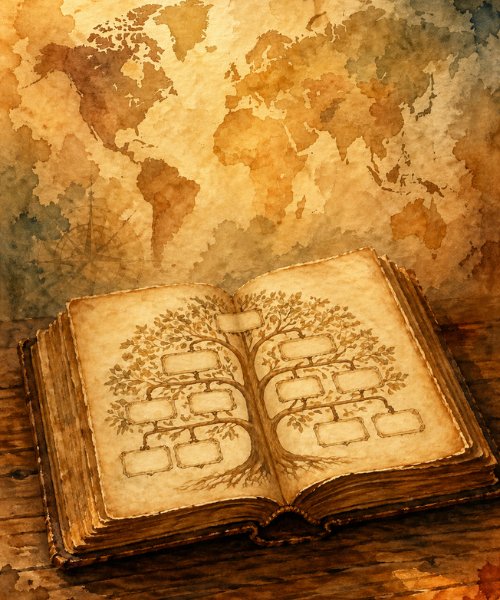
This issue covers three things: where we come from ethnically, why the Bible records family lineages, and why our spiritual ancestry in Christ is what defines us most.


My Own Ancestry

I come from a wide mix of backgrounds. My ancestry includes Germanic roots – specifically Alemannic, Franconian, Bavarian, and Austrian along with Filipino, Spanish, Turkish, and Czech heritage.

That is a lot of history and culture in one person.

And then I married a Georgian man with Ukrainian ancestry, which added even more to the story.

Most people find something similar when they look into their family history. The further back you go, the more complex it gets. Borders shift. Cultures mix. People migrate. Ethnic identity is real and worth knowing, but it is also more fluid across generations than we often realize.

Knowing where you come from can give you a sense of history and connection. There is nothing wrong with that.

But it does not answer the most important question about who you are.


Why the Bible Records Genealogies

The Bible contains a lot of genealogical records. They are there for specific reasons.

In the Old Testament, genealogies served practical and legal purposes. Each of the twelve tribes of Israel was assigned a portion of the land of Canaan. To claim that inheritance, you had to prove your lineage. If you could not, your claim was invalid. Ezra 2:62 records that some men were excluded from the priesthood because they could not find their family records.

Genealogies also traced the covenant God made with Abraham. In Genesis 12 and 17, God promised that His purposes would unfold through Abraham’s line. The genealogies track that line from Abraham through Isaac, Jacob, Judah, and David, and from David to Jesus.

This is why Matthew opens his Gospel the way he does.

The book of the genealogy of Jesus Christ, the son of David, the son of Abraham. – Matthew 1:1 WEB

Matthew was writing to a Jewish audience. He needed to show that Jesus fulfilled the prophetic requirements – that the Messiah would come from the line of Abraham and the house of David. The genealogy was evidence.

Luke’s genealogy in chapter 3 goes further back. He traces Jesus’ line all the way to Adam, and then to God. Luke’s audience included Gentiles, and his point was clear: Jesus is not only the Messiah of Israel. He is the Savior of all humanity.

The genealogies in 1 Chronicles were written after the Babylonian exile. The returning community needed to reestablish their tribal connections and priestly lines. Those long lists served a real purpose for real people at a specific point in history.

Biblical genealogies are doing genuine historical and theological work. They establish continuity, covenant fulfillment, and credibility.


What Genealogies Cannot Do

As important as these lineages were in their context, they have limits.

John the Baptist addressed this when he called people to repentance:

Don’t think to yourselves, ‘We have Abraham for our father,’ for I tell you that God is able to raise up children to Abraham from these stones. – Matthew 3:9 WEB

The religious leaders assumed that physical descent from Abraham guaranteed their standing before God. John made clear it did not. Ancestry does not produce repentance. It does not produce faith. It does not make you right with God.

Jesus said the same thing in John 8. The religious leaders insisted that Abraham was their father. Jesus told them their actions revealed who their true spiritual father was.

They answered him, “Our father is Abraham.” Jesus said to them, “If you were Abraham’s children, you would do the works of Abraham. John 8:39 WEB

Physical lineage and spiritual identity are two different things.


What Counts: Spiritual Ancestry

Through faith in Jesus Christ, believers are born into a new family. Not by bloodline. Not by cultural heritage. Not by ethnic origin. But by God Himself.

But as many as received him, to them he gave the right to become God’s children, to those who believe in his name: who were born not of blood, nor of the will of the flesh, nor of the will of man, but of God. – John 1:12–13 WEB

This new birth, what Jesus called being “born again” in John 3, places every believer into a spiritual lineage that goes beyond every other category. Paul explains this in Romans 8:

For as many as are led by the Spirit of God, these are children of God. For you didn’t receive the spirit of bondage again to fear, but you received the Spirit of adoption, by whom we cry, ‘Abba! Father!’ The Spirit himself testifies with our spirit that we are children of God; and if children, then heirs — heirs of God and joint heirs with Christ. – Romans 8:14–17a WEB

My Germanic, Filipino, Spanish, Turkish, and Czech ancestry tells one story about where I came from. My adoption into God’s family through Christ tells a deeper story – who I am now, and what I will inherit.

Galatians 3 makes this universal:

There is neither Jew nor Greek, there is neither slave nor free man, there is neither male nor female; for you are all one in Christ Jesus. If you are Christ’s, then you are Abraham’s offspring and heirs according to promise. – Galatians 3:28–29 WEB

Every person who is in Christ belongs to the same family. Ethnicity, nationality, social class, and gender do not determine your standing before God or your place in His Kingdom. This is not a denial of those differences. It is a declaration that they do not define you spiritually.

We are co-heirs with Christ. No family tree can give you that.


A Note on 1 Peter

Peter applied the covenant language God once used for Israel to all believers:

But you are a chosen race, a royal priesthood, a holy nation, a people for God’s own possession, that you may proclaim the excellence of him who called you out of darkness into his marvelous light. In the past, you were not a people, but now are God’s people, who had not obtained mercy, but now have obtained mercy. – 1 Peter 2:9–10 WEB

“You were not a people” – before Christ, Gentile nations had no covenant standing before God. Through the Gospel, God has formed a new people drawn from every nation and background. Every believer is part of that family.


Reflection Questions

  1. How much does your ethnic or cultural heritage shape how you see yourself? Does your identity in Christ feel more foundational than your background?
  2. Why do you think God worked through specific family lines in the Old Testament? What does that tell you about how He moves through history?
  3. What does it mean for you personally to be an heir of God and a co-heir with Christ? How does that identity affect how you live day to day?
 

Closing Prayer

Heavenly Father, thank You for the heritage and family You placed me in. Thank You even more for adopting me into Your own family through Jesus. Help me hold my earthly origins loosely and my identity in Christ firmly. I am Your child, not because of anything I earned or inherited, but because of Your grace. In Jesus’ name, Amen.


If you have been blessed by this issue of Kingdom Living Insights, please share it with others. Many thanks. God bless you!

Pin it!

kingdom living insights


Find more Kingdom Living Insights issues here

  1. Home
  2. /
  3. Blog
  4. /
  5. Kingdom Living Insights
  6. /
  7. Kingdom Living Insights –...


ABOUT OUR MINISTRY

We are a non-denominational Bible-believing Christian Ministry trained and equipped at the Christian Leaders Institute and Axx Bible College. Even though our Ministry is based on God's Word, the Bible, you need to approach our teachings like the Bereans and always study the Bible yourself to see if what we teach is aligned with what is written in the Bible.  

Now the Berean Jews were of more noble character than those in Thessalonica, for they received the message with great eagerness and examined the Scriptures every day to see if what Paul said was true. Acts 17:11 NIV  

We are only humans who 'stumble in many ways' (James 3:2) and we only 'know in part and we prophesy in part' (1 Corinthians 13:9).

wisdomfromheaven donation


LEGAL DISCLAIMER

The content provided on this blog is for educational and informational purposes only. The blog owner, Janet Giessl, also known under her anointed pen name Janetta Setherah, is a Certified Christian Life Coach and Ordained Minister with the Christian Leaders Alliance and holds degrees in Education and Christian Leadership, along with credentials in Bible, Ministry, Philosophy, and Theology. However, Janet is not a medical doctor, licensed therapist or health care professional. The information presented on this platform is not intended to treat, cure, diagnose, or prevent any disease. It is essential to understand that the content offered here is not a substitute for professional advice, whether medical, legal, financial, or from any other professional field.

Spiritual matters and personal well-being are deeply personal and can have profound effects on individuals. We strongly recommend seeking guidance from qualified professionals and prayerfully considering your own circumstances when making significant decisions in your life. The content on this blog is meant to offer insights and inspiration based on biblical principles, but it is not a replacement for professional assistance or personalized advice.

Always consult with appropriate professionals for your specific needs and circumstances.


NOTICE OF COPYRIGHT FOR QUOTING BIBLE VERSES FROM ESV

Scripture quotations are from the ESV® Bible (The Holy Bible, English Standard Version®), © 2001 by Crossway, a publishing ministry of Good News Publishers. ESV Text Edition: 2025. The ESV text may not be quoted in any publication made available to the public by a Creative Commons license. The ESV may not be translated in whole or in part into any other language. Used by permission. All rights reserved.

NOTICE OF COPYRIGHT FOR QUOTING BIBLE VERSES FROM WEB

The World English Bible (WEB) is a Public Domain (no copyright) Modern English translation of the Holy Bible. That means that you may freely copy it in any form, including electronic and print formats. The World English Bible is based on the American Standard Version of the Holy Bible first published in 1901, the Biblia Hebraica Stutgartensa Old Testament, and the Greek Majority Text New Testament. It is in draft form, and currently being edited for accuracy and readability.