Introduction
Many women, especially those running businesses, working in ministry, or leading creative ventures, face this question from conservative circles: “Does the Bible say a woman must stay home, care for children only, and cannot have a job or business outside the home?”
The short answer: No. This is not a biblical concept.
The Bible never forbids women from working outside the home. Instead, it teaches about priorities, not prohibition. And Scripture gives us many examples of godly women who ran businesses, led nations, and worked outside the home while fulfilling their family responsibilities.
Proverbs 31: The Virtuous Woman Who Ran a Business
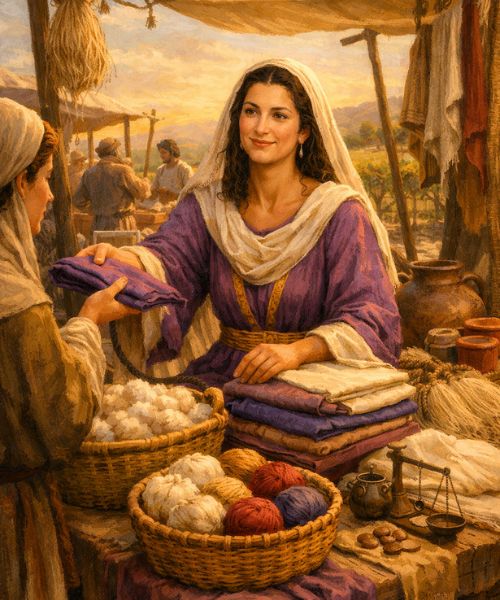
The most famous description of a godly woman in Scripture shows her doing exactly what some say women “can’t” do: running a business while caring for her household.
Proverbs 31:10-31 (World English Bible)
Who can find a worthy woman?
For her value is far above rubies.
The heart of her husband trusts in her.
He shall have no lack of gain.
She does him good, and not harm,
all the days of her life.
She seeks wool and flax,
and works eagerly with her hands.
She is like the merchant ships.
She brings her bread from afar.
She rises also while it is yet night,
gives food to her household,
and portions for her servant girls.
She considers a field, and buys it.
With the fruit of her hands, she plants a vineyard.
She arms her waist with strength,
and makes her arms strong.
She perceives that her merchandise is profitable.
Her lamp doesn’t go out by night.
She lays her hands to the distaff,
and her hands hold the spindle.
She opens her arms to the poor;
yes, she extends her hands to the needy.
She is not afraid of the snow for her household,
for all her household are clothed with scarlet.
She makes for herself carpets of tapestry.
Her clothing is fine linen and purple.
Her husband is respected in the gates,
when he sits among the elders of the land.
She makes linen garments and sells them,
and delivers sashes to the merchant.
Strength and dignity are her clothing.
She laughs at the time to come.
She opens her mouth with wisdom.
Kind instruction is on her tongue.
She looks well to the ways of her household,
and doesn’t eat the bread of idleness.
Her children rise up and call her blessed.
Her husband also praises her:
“Many women do noble things,
but you excel them all.”
Charm is deceitful, and beauty is vain;
but a woman who fears Yahweh, she shall be praised.
Give her of the fruit of her hands!
Let her works praise her in the gates!
Notice what this godly woman does:
-
She buys a field and plants a vineyard (real estate business)
-
She sells garments to merchants (retail business)
-
Her merchandise is profitable
-
She cares for her household while running these businesses
-
Her husband trusts her and has “no lack of gain” because of her work
-
Her children call her blessed and her husband praises her
If staying at home only were biblical, Proverbs 31 would be the biggest contradiction in Scripture.
Biblical Women Who Worked Outside the Home
The Bible gives us numerous examples of godly women who were not just housewives. Many of them ran businesses, led nations, served as prophets, judges, and church leaders:
Lydia was a dealer in purple cloth and a business owner from Thyatira. Acts 16:14 tells us she sold expensive purple dye. She was rich, head of her household, and hosted a church in her home. Lydia was a career woman, wealthy, and a strategic leader in the early Christian faith.
Dorcas (also called Tabitha) was a seamstress and clothing maker for widows. Acts 9:36-42 tells us she made tunics and clothing for widows in her community. She spun fiber into thread, woven on her loom, and likely sold pieces to merchants to support herself. She was known throughout her community as someone who did “good works and gave gifts to the poor.”
Deborah was a prophetess, Judge, and Military Leader. Judges 4-5 tells us she was the only female judge in the Bible. She was a wife AND worked outside the home as judge, prophetess, and military leader who led Israel to victory against the Canaanites. She was called “mother in Israel” while leading a nation.
Priscilla worked as a tentmaker with her husband Aquila. Acts 18:2-3 tells us she worked as a tentmaker alongside her husband, a trade that took them outside the home. She also served the church as a leader and teacher.
Phoebe was a deacon and benefactor/patron. Romans 16:1-2 tells us she was a deacon of the church at Cenchreae and a wealthy patron who financially supported Paul’s missionary travels and served the church in leadership.
Ruth worked as a gleaner in fields. Ruth 2:23 tells us she worked as a gleaner alongside Boaz’s women workers in the fields until the end of harvests.
Rachel was a shepherdess. Genesis 29:9 tells us she worked as a shepherdess, tending her father’s sheep outside the home.
Mary Magdalene was a patron and benefactor. Luke 8:2-3 tells us she followed Jesus and provided for him out of her own resources.
Joanna and Susanna were also patrons and benefactors. Luke 8:3 tells us they provided for Jesus and the disciples out of their own resources.
Junia was called an apostle. Romans 16:7 tells us she was “outstanding among the apostles,” actively involved in spreading the Gospel.
Euodia and Syntyche were Paul’s fellow workers. Philippians 4:3 tells us they were Paul’s “fellow workers” in the Gospel, actively involved in spreading the Gospel and building up the church.
Sheerah was a builder. 1 Chronicles 7:24 tells us she was the daughter of Ephraim who built cities – working as a builder outside the home.
The Egyptian midwives worked as midwives outside the home. Exodus 1:15-21 tells us about their faithful work.
Nympha of Laodicea hosted church gatherings in her home. Colossians 4:15 tells us she was a homeowner who served the church.
The Bible is full of women who worked outside the home!
What Titus 2:4-5 Actually Says
This is the verse often quoted to support “stay-at-home only”:
Titus 2:4-5 (World English Bible)
“that they may train the young wives to love their husbands, to love their children, to be sober minded, chaste, workers at home, kind, being in subjection to their own husbands, that God’s word may not be blasphemed.”
The key phrase is “workers at home” (some translations say “keepers at home”).
This emphasizes:
-
Being industrious and diligent at home
-
Not being idle (Proverbs 31:27: “doesn’t eat the bread of idleness”)
-
Making home a priority
It does not mean:
-
Being confined exclusively to the home
-
Never working outside
Remember: The household is a priority because God designed women to bear children, nurture them, and breastfeed them. This is something God made women to do – it’s beautiful and sacred. But it doesn’t mean she should only do that. A woman can breastfeed, nurture, and care for her children while also running a business, working in ministry, or serving her community outside the home.
And of course, if a woman wants to be a stay-at-home woman and just be a housewife, it’s her free decision. It’s not an obligation or a command from God. It’s a beautiful choice that some women make, and it should be honored. But it should never be presented as the only biblical option or as a requirement for all women.
Also, we must remember that some women are not called to marry or have children. God gives different callings to different people. These women still need provision for themselves, and work is not only acceptable but necessary for their survival. The Bible doesn’t say every woman must marry or have children. Paul even speaks about the gift of singleness. Women like Lydia (who may have been widowed), Dorcas, Priscilla, and many others in the early church served God through their work, whether married or single. Work provides not just food and shelter, but dignity, purpose, and the ability to support others in need.
God gives women freedom to choose how they serve Him – whether that’s working outside the home, staying at home, or both in different seasons of life.
Lydia ran a business and was the head of her household.
Deborah was called “mother in Israel” while leading a nation.
Dorcas cared for widows while making clothing.
The Proverbs 31 woman fed her household at dawn AND sold garments to merchants.
God designed women for both nurturing AND working. The Bible teaches us to honor our children and home as priorities, not to exclude all other work.
1 Timothy 5:14: Managing the Household
1 Timothy 5:14 (World English Bible)
“I desire therefore that the younger widows marry, bear children, rule the household, and give no occasion to the adversary for insulting.”
“Rule the household” speaks to priority and responsibility, not exclusivity of location.
Deborah ruled the household AND ruled Israel as judge.
The Bottom Line: Priorities, Not Prohibition
The Bible teaches women what their priorities should be:
-
Love their husbands
-
Love their children
-
Be sober-minded and chaste
-
Be workers at home (industrious)
-
Care for their household
But the Bible gives us dozens of examples of women who worked outside while still fulfilling these responsibilities:
-
Lydia ran a business AND hosted a church in her home
-
Deborah judged Israel AND was called “mother in Israel”
-
Dorcas made clothing for widows AND cared for her community
-
Priscilla worked as a tentmaker AND served the church
-
The Proverbs 31 woman bought fields, planted vineyards, sold garments, AND cared for her household
If staying at home only were biblical, God would not have called so many women to work outside the home.
For Kingdom Women in Business & Ministry
Whether you have a job outside the home or run a business to fund your ministry or provide for yourself, you are living in the same tradition as:
-
Lydia, the businesswoman who hosted a church in her home
-
Deborah, the prophetess-judge who led a nation
-
Dorcas, who served widows through her craftsmanship
-
Phoebe, the deacon-patron who supported apostles
-
The Proverbs 31 woman, who ran businesses while caring for her household
God calls women to:
-
Fear the LORD (Proverbs 31:30)
-
Do noble things (Proverbs 31:29)
-
Let their works praise them in the gates (Proverbs 31:31)
Your business, your ministry, your creative work – when done in wisdom and faithfulness – can be a powerful expression of Kingdom living.
Whether you work outside the home, stay at home, or both in different seasons, God honors your faithfulness.
Which biblical woman who worked outside the home inspires you most? And what’s your own journey with balancing work and home?