End Time Series Part 26: The New Heaven and New Earth – Revelation 21
Introduction: God Makes All Things New
After the sobering judgment of Revelation 20, we now arrive at the most beautiful chapter in all of Scripture. Revelation 21 unveils the final state of the redeemed – the eternal home God has prepared for His people. Here we see the new heaven and new earth, the New Jerusalem descending from heaven, and God dwelling with humanity in perfect, unbroken fellowship.
This is what all of history has been moving toward. This is the restoration of Eden, the fulfillment of every promise, the answer to every longing. Pain, death, mourning, and crying are gone forever. The dwelling of God is with man. The curse is lifted. Paradise is restored – not just restored, but surpassing the original.
This chapter answers the deepest question of the human heart: What will eternity be like? The answer is glorious beyond imagination.
1. The New Heaven and New Earth (Revelation 21:1-2 WEB)
“I saw a new heaven and a new earth, for the first heaven and the first earth have passed away, and the sea is no more. I saw the holy city, New Jerusalem, coming down out of heaven from God, prepared like a bride adorned for her husband.”
Explanation:
“I saw a new heaven and a new earth”: The Greek word for “new” is kainos (καινός), which means “new in quality” rather than “new in time.” This isn’t just a renovated version of the old creation – it’s completely new, fresh, and perfect. This fulfills the prophecy of Isaiah 65:17 and 66:22.
Why is a new heaven and new earth necessary?
The current creation has been tainted by sin. Romans 8:20-22 tells us that creation was “subjected to futility” and is in “bondage to decay,” groaning and suffering the effects of the fall. Just as our bodies need resurrection (not just healing), creation needs to be made new (not just restored).
“For the first heaven and the first earth have passed away”: The Greek word for “passed away” is parēlthan (παρῆλθαν), meaning “passed by” or “disappeared.” This echoes what we saw in Revelation 20:11 – the old creation flees from the presence of God on the great white throne.
This doesn’t mean annihilation but transformation. Just as believers experience resurrection (our bodies are transformed, not replaced with entirely different bodies), creation experiences renewal. 2 Peter 3:10-13 describes the elements being dissolved by fire, but this is purification, not obliteration. What emerges is pure, perfect, and eternal.
“And the sea is no more”: This statement puzzles many readers. Why specifically mention that there’s no sea?
In ancient Hebrew thought, the sea represented:
- Chaos and danger (Psalm 46:2-3)
- Separation (Revelation 13:1 – the beast rises from the sea)
- The realm of death (Revelation 20:13 – “the sea gave up its dead”)
- Instability and restlessness (Isaiah 57:20 – “the wicked are like the tossing sea”)
The absence of the sea means:
- No more chaos or disorder
- No more separation between peoples
- No more danger or threat
- Perfect peace and stability[spacer height=”15px”]
“I saw the holy city, New Jerusalem, coming down out of heaven from God”: This is humanity’s eternal dwelling place. Notice several crucial things:
“Holy city”: The New Jerusalem is set apart, consecrated, perfectly pure. There’s no sin, no defilement, nothing unclean.
“Coming down out of heaven from God”: This is God’s gift to humanity, not something we build or achieve. Just as salvation is “not of works” (Ephesians 2:9), our eternal home is God’s gracious provision. The direction is significant – it comes DOWN from heaven. We are not going up to haven. Heaven comes down to earth. Heaven and earth are now united. God’s dwelling and human dwelling become one.
“Prepared like a bride adorned for her husband”: This imagery is rich and beautiful. The church is the Bride of Christ (Ephesians 5:25-27), and the New Jerusalem is our eternal home. The city prepared for us reflects the beauty, purity, and joy of a bride on her wedding day.
The preparation is complete. Everything is ready. The wedding feast of the Lamb (Revelation 19:7-9) now continues into eternity in the home God has prepared for His people.
Kingdom insight: The future isn’t an ethereal, disembodied existence floating on clouds. It’s a physical reality – a new creation where resurrected believers live in a real city on a real earth under a real heaven. We will have bodies, relationships, activities, and purpose. God’s plan has always been for heaven and earth to be united, for divine and human to dwell together in perfect harmony.
2. God Dwells with His People (Revelation 21:3-4 WEB)
“I heard a loud voice out of heaven saying, ‘Behold, God’s dwelling is with people; and he will dwell with them, and they will be his people, and God himself will be with them as their God. He will wipe away every tear from their eyes. Death will be no more; neither will there be mourning, nor crying, nor pain any more. The first things have passed away.'”
Explanation:
“I heard a loud voice out of heaven saying, ‘Behold…'”: The word “behold” (idou – ἰδού) is an exclamation demanding attention. This is the most important announcement in all of Scripture: God will dwell with His people.
“God’s dwelling is with people”: The Greek word for “dwelling” is skēnē (σκηνή), meaning “tabernacle” or “tent.” This echoes the Old Testament tabernacle where God’s presence dwelt among Israel (Exodus 25:8).
But there’s a profound difference:
- In the Old Testament, God dwelt in a tent AMONG the people
- In the New Creation, God’s dwelling IS WITH the people – direct, unmediated, permanent fellowship
This is what John 1:14 pointed to: “The Word became flesh and dwelt [literally ‘tabernacled’] among us.” Jesus was God dwelling with humanity. Now that dwelling becomes eternal and universal.
“And he will dwell with them, and they will be his people”: This is covenant language that runs throughout Scripture:
- Genesis 17:7-8 – “I will be their God”
- Exodus 6:7 – “You shall be my people, and I will be your God”
- Jeremiah 31:33 – “I will be their God, and they shall be my people”
- 2 Corinthians 6:16 – “I will dwell in them and walk among them. I will be their God and they will be my people”
Every covenant promise finds its ultimate fulfillment here. The relationship God intended from the beginning – intimate, unbroken fellowship between Creator and creature – is fully realized.
“And God himself will be with them as their God”: Notice the emphasis: God HIMSELF. Not just His blessings, not just angels, not just a beautiful place – God Himself in all His glory will be with us.
This is the greatest promise of all. The ultimate joy of heaven isn’t streets of gold or mansions or even reunion with loved ones. The greatest joy is being in the immediate, unveiled presence of God forever.
“He will wipe away every tear from their eyes”: This tender image shows God’s personal, compassionate care. The almighty Creator will personally wipe away our tears. This echoes Isaiah 25:8.
The tears being wiped away represent:
- All sorrow from this life
- All grief over loss
- All pain from suffering
- All regret over sin
God doesn’t ignore our pain or dismiss it. He personally, gently, completely removes it forever.
“Death will be no more”: Death entered through sin (Romans 5:12). With sin finally and completely removed, death has no place. The last enemy (1 Corinthians 15:26) is defeated. No one will ever die again. No funerals, no graves, no fear of losing loved ones.
“Neither will there be mourning, nor crying, nor pain any more”: Four things that characterize the fallen world are listed:
- Death (thanatos – θάνατος) – physical death
- Mourning (penthos – πένθος) – grief, sorrow, lamenting
- Crying (kraugē – κραυγή) – loud weeping, wailing
- Pain (ponos – πόνος) – physical pain, toil, distress
All of these are gone. Forever. This is comprehensive – no form of suffering remains.
“The first things have passed away”: Everything connected to the fallen world – sin, death, pain, sorrow, Satan, demons, rebellion, war, disease, aging, decay – all of it is gone. The curse is completely lifted.
Kingdom lesson: This passage shows us that God’s ultimate goal isn’t just to save us FROM something (sin, hell, judgment) but to save us FOR something – eternal fellowship with Him. Every pain we have experienced, every tear we have shed, every loss we have mourned will be reversed and redeemed. The God who counts the hairs on our head and collects our tears in a bottle will personally wipe away every tear forever.
3. All Things Made New (Revelation 21:5-8 WEB)
“He who sits on the throne said, ‘Behold, I am making all things new.’ He said, ‘Write, for these words of God are faithful and true.’ He said to me, ‘I have become the Alpha and the Omega, the Beginning and the End. I will give freely to him who is thirsty from the spring of the water of life. He who overcomes, I will give him these things. I will be his God, and he will be my son. But for the cowardly, unbelieving, sinners, abominable, murderers, sexually immoral, sorcerers, idolaters, and all liars, their part is in the lake that burns with fire and sulfur, which is the second death.'”
Explanation:
“He who sits on the throne said, ‘Behold, I am making all things new'”: This is God Himself speaking from the throne. Notice the present continuous tense – “I am making” (poiō – ποιῶ). God is actively creating the new reality.
This isn’t renovation or restoration to original condition. It’s total renewal. Everything is made new:
- New creation (heaven and earth)
- New bodies (resurrection)
- New relationships (perfect fellowship)
- New purpose (serving and reigning with God)
- New experience (joy without end)
“He said, ‘Write, for these words of God are faithful and true'”: This command to write emphasizes the certainty and importance of what’s been revealed. These aren’t wishful thinking or metaphors – these are absolute promises from God Himself.
“Faithful” (pistoi – πιστοί) means reliable, trustworthy, dependable. “True” (alēthinoi – ἀληθινοί) means genuine, real, certain.
God stakes His character on these promises. What He has shown John will absolutely happen.
“I have become the Alpha and the Omega, the Beginning and the End”: God declares His eternal nature. Alpha and Omega are the first and last letters of the Greek alphabet. God existed before all things and will exist after all things. He is:
- The source of all creation
- The goal of all history
- The eternal, unchanging one
Because God is eternal, the new creation He makes will be eternal. Because God is faithful, these promises are certain.
“I will give freely to him who is thirsty from the spring of the water of life”: This echoes Jesus’s words in John 7:37-38: “If anyone is thirsty, let him come to me and drink.”
“Freely” (dōreán – δωρεάν) means “as a gift, without cost.” Eternal life isn’t earned or purchased – it’s received as a gift from God.
“To him who is thirsty”: Spiritual thirst represents:
- Recognizing our need for God
- Longing for righteousness (Matthew 5:6)
- Desiring what only God can provide
“The water of life”: This represents eternal life, the Holy Spirit, complete satisfaction in God. Unlike earthly water that temporarily satisfies, this water quenches thirst forever (John 4:14).
“He who overcomes, I will give him these things”: The “overcomer” (nikōn – νικῶν) is the one who conquers or prevails. Who is the overcomer?
1 John 5:4-5 answers: “This is the victory that has overcome the world: your faith. Who is he who overcomes the world, but he who believes that Jesus is the Son of God?”
The overcomer is the believer – the one who trusts in Christ, endures to the end, and remains faithful despite trials.
“I will be his God, and he will be my son”: This is intimate, familial language. Not just “servant” but “son.” Not just “subjects” but “children.” We become part of God’s family forever.
This echoes 2 Samuel 7:14 and the adoption language throughout the New Testament (Romans 8:15-17; Galatians 4:5-7).
“But for the cowardly, unbelieving, sinners, abominable, murderers, sexually immoral, sorcerers, idolaters, and all liars”: After the beautiful promises to believers, John lists those who will not inherit eternal life. This list describes those who remain in unbelief and unrepentance:
“Cowardly” (deilois – δειλοῖς): Those who deny Christ to save themselves, who value earthly life over faithfulness to God.
“Unbelieving” (apistois – ἀπίστοις): Those who refuse to trust in Christ, who reject the Gospel.
“Sinners” (hamartōlois – ἁμαρτωλοῖς): Those who persist in sin, who have sin as their lifestyle.
“Abominable” (ebdelygmenois – ἐβδελυγμένοις): Those who practice detestable things, especially idolatry.
“Murderers” (phoneusin – φονεῦσιν): Those who take human life unlawfully.
“Sexually immoral” (pornois – πόρνοις): Those who practice sexual immorality.
“Sorcerers” (pharmakois – φαρμακοῖς): Those who practice magic, witchcraft, or drug-related occult practices.
“Idolaters” (eidōlolatrais – εἰδωλολάτραις): Those who worship false gods or anything other than the true God.
“All liars” (pasin tois pseudesin – πᾶσιν τοῖς ψευδέσιν): Those who live in deception and falsehood.
Important clarification: This doesn’t mean Christians who have struggled with these sins are condemned. It describes those who persist in these patterns unrepentantly, who make these things their lifestyle, who refuse to turn to Christ for forgiveness.
“Their part is in the lake that burns with fire and sulfur, which is the second death”: This is the same destination described in Revelation 20:14-15. The lake of fire is:
- Eternal: It’s not temporary or remedial
- Conscious: It involves suffering (“burns”)
- Final: It’s called the “second death” – there’s no escape
This sobering warning is placed right after the beautiful promises to emphasize the urgency of the gospel. Everyone will spend eternity somewhere – either in the presence of God or separated from Him forever.
Kingdom application: God’s invitation is open to all who are thirsty – anyone who recognizes their need and comes to Him in faith will receive eternal life freely. But the invitation requires response. Those who reject Christ, who refuse to repent, who persist in unbelief will face the second death. The same passage that promises “no more tears” for believers warns of eternal suffering for unbelievers. Both truths stand together in Scripture.
4. The New Jerusalem Described – Part 1 (Revelation 21:9-14 WEB)
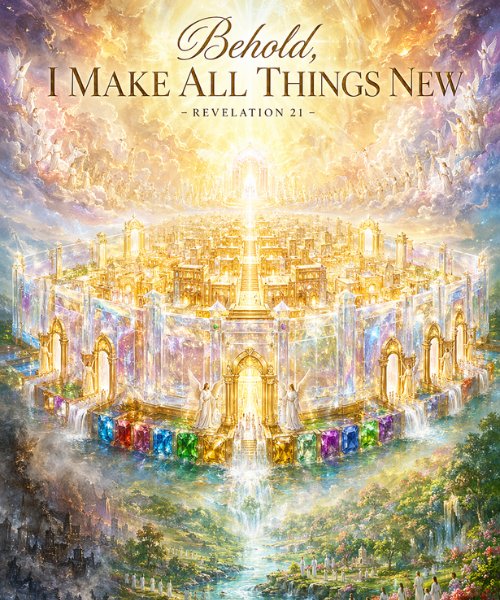
“One of the seven angels who had the seven bowls which were loaded with the seven last plagues came, and he spoke with me, saying, ‘Come here. I will show you the bride, the Lamb’s wife.’ He carried me away in the Spirit to a great and high mountain, and showed me the holy city, Jerusalem, coming down out of heaven from God, having the glory of God. Her light was like a most precious stone, like a jasper stone, clear as crystal; having a great and high wall with twelve gates, and at the gates twelve angels, and names written on them, which are the names of the twelve tribes of the children of Israel. On the east were three gates, on the north three gates, on the south three gates, and on the west three gates. The wall of the city had twelve foundations, and on them twelve names of the twelve Apostles of the Lamb.”
Explanation:
“One of the seven angels who had the seven bowls”: Interestingly, it’s one of the judgment angels who now shows John the Bride. The same God who judges righteously also prepares a glorious home for His people.
“Come here. I will show you the bride, the Lamb’s wife”: The New Jerusalem is called the “Bride” and “wife” of the Lamb (Christ). This shows the intimate relationship between Christ and His church, now dwelling together in the eternal city.
The city isn’t just where the bride lives – the city IS the bride. The community of the redeemed, perfected and glorified, is both the people and their dwelling place united in perfect harmony.
“He carried me away in the Spirit to a great and high mountain”: John is given a panoramic view from a high vantage point to see the city in its full glory. This echoes Ezekiel 40:2, where Ezekiel was shown the temple from a high mountain.
“And showed me the holy city, Jerusalem, coming down out of heaven from God”: The movement is repeated from verse 2. The city descends from heaven – this is God’s gift, not human achievement.
“Having the glory of God”: The city radiates with God’s doxa (δόξα) – His divine radiance, splendor, and majesty. This is the visible manifestation of God’s presence. The city glows with the very glory of God Himself.
“Her light was like a most precious stone, like a jasper stone, clear as crystal”: Jasper in ancient times was likely a clear or translucent stone (different from modern jasper). The city’s radiance is:
- Precious: Invaluable, priceless
- Pure: Clear as crystal, no imperfection
- Brilliant: Radiating light
This likely describes a diamond-like brilliance – perfectly clear, refracting light in all directions.
“Having a great and high wall with twelve gates”: The wall serves not for protection (nothing evil will enter, 21:27) but as:
- A boundary marker defining the city
- A symbol of security and permanence
- A display of architectural magnificence
“And at the gates twelve angels”: Angels stand as honored guardians at each gate, not to keep people out but to welcome the redeemed in and declare God’s glory.
“And names written on them, which are the names of the twelve tribes of the children of Israel”: The gates bear the names of Israel’s twelve tribes:
- Reuben
- Simeon
- Levi
- Judah
- Dan
- Naphtali
- Gad
- Asher
- Issachar
- Zebulun
- Joseph
- Benjamin
This shows that God’s covenant with Israel is eternal. The promises made to Abraham, Isaac, and Jacob find their ultimate fulfillment in the New Jerusalem.
“On the east were three gates, on the north three gates, on the south three gates, and on the west three gates”: The gates are evenly distributed on all four sides (three gates per side), meaning:
- Access from every direction
- No preferred or superior entrance
- Complete openness to all God’s people
- Perfect symmetry and beauty
This echoes the arrangement of the twelve tribes around the tabernacle in the wilderness (Numbers 2).
“The wall of the city had twelve foundations, and on them twelve names of the twelve Apostles of the Lamb”: The foundations bear the names of the twelve apostles:
- Peter
- Andrew
- James (son of Zebedee)
- John
- Philip
- Bartholomew
- Thomas
- Matthew
- James (son of Alphaeus)
- Thaddaeus
- Simon the Zealot
- Matthias (replaced Judas)
This shows that the church is “built on the foundation of the apostles and prophets, Christ Jesus himself being the cornerstone” (Ephesians 2:20).
The Beautiful Unity:
- Gates: Names of the twelve tribes (Old Testament/Israel)
- Foundations: Names of the twelve apostles (New Testament/Church)
Both are essential. Both are honored. This is one city, one people, one covenant fulfilled. The wall that unites Old and New Testament saints stands forever.
Kingdom insight: The architecture of the New Jerusalem declares that God’s plan has always been one – to save a people for Himself from both Israel and the nations, from both Old Testament and New Testament times. Every believer from every age is included. The city belongs to all the redeemed, and all the redeemed belong to the city.
5. The New Jerusalem Described – Part 2 (Revelation 21:15-21 WEB)
“He who spoke with me had for a measure a golden reed to measure the city, its gates, and its walls. The city is square. Its length is as great as its width. He measured the city with the reed: twelve thousand stadia. Its length, width, and height are equal. Its wall is one hundred forty-four cubits, by the measure of a man, that is, of an angel. The construction of its wall was jasper. The city was pure gold, like pure glass. The foundations of the city’s wall were adorned with all kinds of precious stones. The first foundation was jasper, the second sapphire, the third chalcedony, the fourth emerald, the fifth sardonyx, the sixth sardius, the seventh chrysolite, the eighth beryl, the ninth topaz, the tenth chrysoprase, the eleventh jacinth, and the twelfth amethyst. The twelve gates were twelve pearls. Each one of the gates was made of one pearl. The street of the city was pure gold, like transparent glass.”
Explanation:
“He who spoke with me had for a measure a golden reed to measure the city”: The angel measures the city just as the temple was measured in Ezekiel 40-42. The measuring shows:
- Precision and order in God’s design
- That everything is according to God’s perfect plan
- The reality and specificity of the city (not just ethereal symbolism)
“The city is square. Its length is as great as its width”: The city is a perfect square, emphasizing:
- Symmetry and balance
- Perfection in design
- Equality of access from all sides
“He measured the city with the reed: twelve thousand stadia”: A stadion (plural: stadia) was about 607 feet or 185 meters. Twelve thousand stadia equals approximately:
- 1,400 miles (2,200 kilometers) per side
- An area of nearly 2 million square miles
- Large enough to accommodate all the redeemed from all of history
“Its length, width, and height are equal”: The city is a perfect cube (or possibly a pyramid). This is significant because:
- The Holy of Holies in the temple was also a perfect cube (1 Kings 6:20)
- The entire city is now a Holy of Holies – the dwelling place of God
- Perfect proportion symbolizes perfect holiness
The dimensions are staggering. If it’s a cube 1,400 miles in each direction, it’s:
- Taller than our atmosphere
- Larger than half the United States
- Containing multiple levels or tiers where the redeemed can dwell
“Its wall is one hundred forty-four cubits”: A cubit was about 18 inches (45 cm), so the wall is approximately 216 feet (65 meters) high. This is high enough to be impressive but proportionally small compared to the city’s massive size, showing:
- The wall is symbolic, not functional for defense
- It marks boundaries and displays beauty
- 144 = 12 x 12, connecting to the twelve tribes and twelve apostles
“By the measure of a man, that is, of an angel”: Human and angelic measurements are the same, showing harmony between earthly and heavenly dimensions.
“The construction of its wall was jasper”: The wall itself is made of jasper (clear, crystal-like stone), giving the entire city a radiant, brilliant appearance.
“The city was pure gold, like pure glass”: The gold is so refined and pure that it’s transparent like glass. This isn’t the opaque gold we know – it’s perfected gold that allows light to pass through it. Everything is transparent, pure, without flaw.
“The foundations of the city’s wall were adorned with all kinds of precious stones”: Each of the twelve foundations is decorated with a different precious stone. These twelve stones echo the twelve stones on the high priest’s breastplate (Exodus 28:17-20):
- Jasper: Clear crystal-like stone, brilliant and radiant
- Sapphire: Deep blue, symbolizing heaven and royalty
- Chalcedony: Possibly a green or bluish stone
- Emerald: Bright green, symbolizing life and growth
- Sardonyx: Layered stone with red and white bands
- Sardius (Carnelian): Deep red, symbolizing blood and sacrifice
- Chrysolite: Golden-yellow, symbolizing divine glory
- Beryl: Sea-green or pale blue
- Topaz: Golden or yellow
- Chrysoprase: Apple-green
- Jacinth: Violet or deep blue
- Amethyst: Purple, symbolizing royalty
Each stone reflects and refracts light differently, creating a spectacular rainbow display of God’s glory. The city isn’t just golden – it’s a symphony of colors, each foundation contributing to the overall beauty.
“The twelve gates were twelve pearls. Each one of the gates was made of one pearl”: Each gate is a single, massive pearl. This is significant because:
- Pearls are formed through suffering (an oyster responding to irritation)
- Christ suffered to provide entrance into the Kingdom
- The gates of pearl remind us that we enter through His sacrifice
- The beauty of the pearl reflects the value of what Christ purchased
“The street of the city was pure gold, like transparent glass”: Even the streets are made of pure, transparent gold. The most valuable material on earth is so common in heaven that it’s used for pavement.
This shows:
- The infinite wealth and glory of God
- That earthly values are reversed in heaven
- Complete purity – even the ground is spotless
Kingdom lesson: The extravagant beauty of the New Jerusalem isn’t about materialism or showing off wealth. It’s about revealing that God’s glory, beauty, and value infinitely surpass anything we can imagine. The most precious things on earth are mere building materials in heaven. And all of this splendor is freely given to God’s children. We inherit a city beyond our wildest dreams, not because we earned it, but because of God’s grace.
6. No Temple Needed – The Glory of the City (Revelation 21:22-27 WEB)
“I saw no temple in it, for the Lord God the Almighty and the Lamb are its temple. The city has no need for the sun or moon to shine, for the very glory of God illuminated it and its lamp is the Lamb. The nations will walk in its light. The kings of the earth bring the glory and honor of the nations into it. Its gates will in no way be shut by day (for there will be no night there), and they will bring the glory and the honor of the nations into it. There will in no way enter into it anything profane, or one who causes an abomination or a lie, but only those who are written in the Lamb’s book of life.”
Explanation:
“I saw no temple in it”: This is startling. Throughout biblical history, the temple was central:
- The tabernacle in the wilderness
- Solomon’s temple
- The second temple
- Ezekiel’s vision of a millennial temple
But in the eternal state, there is no temple building. Why?
“For the Lord God the Almighty and the Lamb are its temple”: We don’t need a temple because:
- God Himself is present everywhere in the city
- We have direct, unmediated access to God
- No separation exists between God and His people
- The whole city is filled with His presence
The purpose of the temple was to provide a dwelling place for God among His people. In the new creation, God dwells with His people directly. The entire city is His temple. Every street, every home, every space is filled with His glory.
“The city has no need for the sun or moon to shine”: This echoes Isaiah 60:19-20. Physical light sources are unnecessary because:
“The very glory of God illuminated it and its lamp is the Lamb”: The city is lit by:
- The glory of God: His radiant presence
- The Lamb: Jesus Christ, the light of the world (John 8:12)
There’s no darkness, no night, no shadows. The glory of God provides constant, perfect illumination. This isn’t just physical light – it’s the revelation of truth, the warmth of love, the joy of His presence.
“The nations will walk in its light”: The redeemed from every nation, tribe, and tongue (Revelation 7:9) will dwell in the light of God’s glory. “Nations” here refers to the peoples of the earth who have been saved.
“The kings of the earth bring the glory and honor of the nations into it”: This is beautiful imagery showing:
- Whatever was good, true, and beautiful in human culture is preserved
- The achievements and contributions of redeemed humanity are brought into the eternal city
- Nothing good is wasted – all is redeemed and brought into God’s presence
This doesn’t mean unregenerate kings or sinful human achievements, but the cultural treasures of redeemed humanity – art, music, literature, discovery – all purified and brought as offerings to God.
“Its gates will in no way be shut by day (for there will be no night there)”: The gates stand perpetually open because:
- There’s no threat, no enemy, no danger
- Complete security exists in God’s presence
- Perfect welcome and access for all the redeemed
- No darkness or evil to protect against
Ancient cities closed their gates at night for protection. The New Jerusalem never needs to close its gates because nothing evil exists to threaten it.
“And they will bring the glory and the honor of the nations into it”: This repeats verse 24, emphasizing that the redeemed bring their contributions as worship and tribute to God. Everything of value from human history that glorifies God is preserved in the new creation.
“There will in no way enter into it anything profane, or one who causes an abomination or a lie”: The New Jerusalem is absolutely holy. Nothing impure can enter:
- Profane (koinon – κοινόν): Common, unclean, defiled
- Abomination (bdelygma – βδέλυγμα): Detestable things, especially idolatry
- Lie (pseudos – ψεῦδος): Falsehood, deception
This isn’t about keeping people out – it’s about the nature of the city. Sin simply cannot exist there. It’s like saying “darkness cannot enter light” or “death cannot enter life.” They are incompatible.
“But only those who are written in the Lamb’s book of life”: This is the determining factor for entrance. The Book of Life contains the names of all who:
- Have trusted in Jesus Christ alone for salvation
- Have been washed in the blood of the Lamb
- Have overcome by faith (1 John 5:4-5)
- Have persevered to the end
How does a name get written in the Book of Life?
- By grace through faith in Jesus Christ (Ephesians 2:8-9)
- By being born again (John 3:3-7)
- By confessing Jesus as Lord and believing God raised Him from the dead (Romans 10:9)
- By having sins forgiven through Christ’s blood (Revelation 7:14)
Kingdom application: The New Jerusalem is holy, but not exclusive in the wrong sense. It’s open to all who come to God through Christ. The gates stand open. The invitation is universal: “Whoever is thirsty, let him come; and whoever wishes, let him take the free gift of the water of life” (Revelation 22:17). But entrance requires what entrance has always required – faith in Jesus Christ, the Lamb of God who takes away the sin of the world.
Key Takeaways from Revelation 21
- God creates a new heaven and a new earth – the old order passes away, and everything is made perfectly new.
- The New Jerusalem descends from heaven – our eternal home is God’s gift, not human achievement.
- God dwells with His people – the greatest joy of eternity is direct, unmediated fellowship with God Himself.
- All sorrow ends forever – no more death, mourning, crying, or pain. God wipes away every tear.
- God makes all things new – not just repaired or restored, but completely renewed and perfected.
- Eternal life is a free gift – given to all who are thirsty, to all who overcome through faith in Christ.
- Two eternal destinies exist – the New Jerusalem for those in the Book of Life, or the lake of fire for those who reject Christ.
- The city is unimaginably glorious – massive, radiant, adorned with precious stones, with streets of gold.
- Both Israel and the Church are honored – the gates bear the names of the twelve tribes, the foundations bear the names of the twelve apostles.
- No temple is needed – God and the Lamb are the temple. Their presence fills the entire city.
- No sun or moon needed – the glory of God and the Lamb provide all the light necessary.
- The gates never close – perfect security, perfect welcome, perfect access for all the redeemed.
- Only the pure can enter – nothing defiled can come in, only those whose names are written in the Lamb’s Book of Life.
Closing Prayer
Heavenly Father, thank You for the breathtaking vision of Revelation 21. Thank You for preparing a home for us more glorious than we can imagine. Thank You that this isn’t wishful thinking but Your faithful and true promise.
We long for the day when You will wipe away every tear, when death and mourning and crying and pain will be no more. We long to dwell in Your presence forever, in the New Jerusalem where Your glory is the light and Your presence fills everything.
Thank You that You are making all things new. Thank You for the free gift of eternal life, offered to all who are thirsty, to all who come to You in faith. Help us live in light of these eternal realities. Keep us faithful to the end. Make sure our names are secure in the Lamb’s Book of Life.
Give us hearts that long for that city whose architect and builder is God. Help us hold loosely to this passing world and invest in the world to come. Use us to point others to Jesus, the only way to have eternal life, the only way to enter the New Jerusalem.
We worship You, the Alpha and Omega, the Beginning and the End, the One who sits on the throne and makes all things new. Come quickly, Lord Jesus. Even so, come. In Your name we pray, Amen.