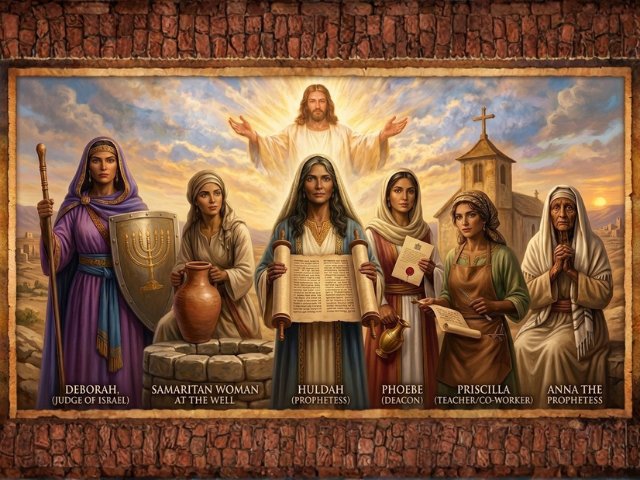
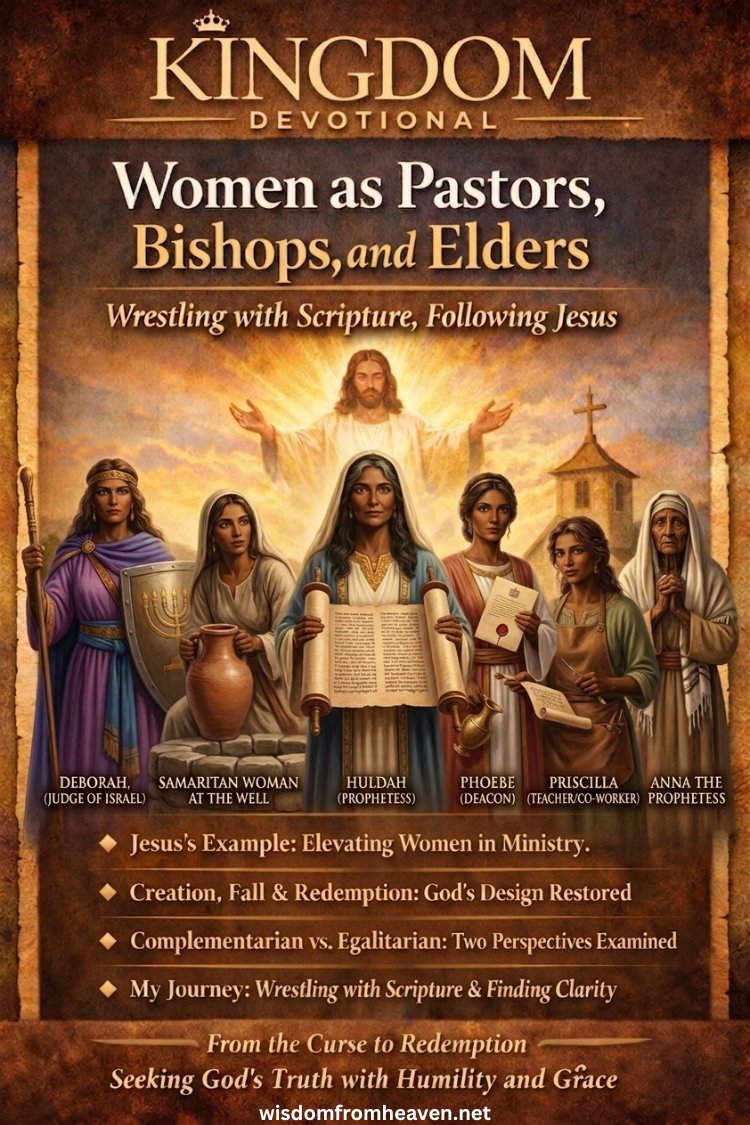
Introduction: An Honest Conversation About a Complex Question
In this issue of Kingdom Living Insights, I’m taking a different approach. Instead of our usual pairing of a Kingdom devotional with the End Times series, I’m dedicating this entire issue to one crucial topic: the question of women serving as pastors, bishops, and elders in the church.
This topic deserves the space and careful attention I’m giving it here. Because this examination is extensive and requires thoroughness, I will continue with our Revelation series (Part 25: Revelation 20) in the next issue.
I need to be honest with you from the start: this is one of the most difficult questions I have wrestled with in Scripture. For years, I held a complementarian view – believing that women could serve in many ministry capacities but not as pastors, bishops, or elders over men. But as I have studied Jesus’s ministry, examined the cultural context of Paul’s letters, looked at the creation-fall-redemption pattern, and watched how the Spirit empowers women throughout Scripture, I find myself leaning toward an egalitarian understanding – that qualified, Spirit-filled women can serve in any ministry role, including as pastors and elders.
I’m not 100% certain. These are genuinely difficult passages, and I want to be faithful to Scripture above all else. But I also want to be faithful to the example and teaching of Jesus, who consistently elevated, empowered, and commissioned women in ways that shattered the cultural norms of His time.
So in this devotional, I’m going to do several things:
- Show you Jesus’s position – how He treated, taught, and commissioned women
- Examine the creation-fall-redemption pattern – understanding how patriarchy entered the world and how Christ redeems us
- Consider the biblical context – how Scripture was written IN patriarchy while pointing TOWARD redemption
- Present both major interpretations fairly – the complementarian and egalitarian views
- Share my personal journey – where I’m landing and why, while acknowledging uncertainty
- Emphasize our unity in the Gospel – regardless of where we land on this secondary issue
My hope is that this honest exploration will help you think deeply about this question, study Scripture carefully, and most importantly, follow Jesus’s example in how we honor and empower the women God has gifted for ministry.
1. Jesus’s Example: The Foundation for Our Understanding
Before we examine Paul’s letters or debate church governance, we must start with Jesus. What was His position on women in ministry?
Jesus Broke Every Cultural Barrier
Luke 10:38-42 (WEB)
“As they went on their way, he entered into a certain village, and a certain woman named Martha received him into her house. She had a sister called Mary, who also sat at Jesus’ feet and heard his word. But Martha was distracted with much serving, and she came up to him, and said, ‘Lord, don’t you care that my sister left me to serve alone? Ask her therefore to help me.’ Jesus answered her, ‘Martha, Martha, you are anxious and troubled about many things, but one thing is needed. Mary has chosen the good part, which will not be taken away from her.'”
What This Reveals:
In Jesus’s time, rabbis did not teach women. The common saying was “Better to burn the Torah than teach it to a woman.” But Jesus welcomed Mary as a disciple, sitting at His feet – the posture of a student learning from a rabbi. When Martha objected, Jesus defended Mary’s right to learn, saying she had “chosen the good part.”
John 4:7-9, 27-29 (WEB)
“A woman of Samaria came to draw water. Jesus said to her, ‘Give me a drink.’… The Samaritan woman therefore said to him, ‘How is it that you, being a Jew, ask for a drink from me, a Samaritan woman?’ (For Jews have no dealings with Samaritans.)… At this, his disciples came. They marveled that he was speaking with a woman; yet no one said, ‘What are you looking for?’ or, ‘Why do you speak with her?’ So the woman left her water pot, went away into the city, and said to the people, ‘Come, see a man who told me everything that I did. Can this be the Christ?'”
What This Reveals:
Jesus broke three massive taboos: He spoke publicly with a woman (rabbis didn’t), with a Samaritan (Jews didn’t), and with a woman of questionable reputation. Then He used her as an evangelist – she went and proclaimed Him to her entire city, and many believed because of her testimony. Jesus commissioned a woman to be the first missionary to the Samaritans.
Jesus Made Women the First Proclaimers of the Resurrection
Matthew 28:9-10 (WEB)
“As they went to tell his disciples, behold, Jesus met them, saying, ‘Rejoice!’ They came and took hold of his feet, and worshiped him. Then Jesus said to them, ‘Don’t be afraid. Go tell my brothers that they should go into Galilee, and there they will see me.'”
John 20:17-18 (WEB)
“Jesus said to her, ‘Don’t hold me, for I haven’t yet ascended to my Father; but go to my brothers and tell them, “I am ascending to my Father and your Father, to my God and your God.”‘ Mary Magdalene came and told the disciples that she had seen the Lord, and that he had said these things to her.”
What This Reveals:
In Jewish culture, women’s testimony wasn’t considered legally valid. Yet Jesus chose women – Mary Magdalene and the other women – to be the first witnesses of the resurrection, the first to receive the commission to “go and tell,” the first proclaimers of the good news. If Jesus wanted to restrict women from proclaiming and teaching, why make them the first apostles (sent ones) of the resurrection?
Jesus Never Restricted Women’s Ministry
Here’s what’s remarkable: Jesus never once said:
- “Women cannot teach”
- “Women should be silent”
- “Women cannot lead”
- “Women should not proclaim the Gospel”
Instead, Jesus consistently:
- Elevated women beyond cultural norms
- Taught women when rabbis refused
- Commissioned women to proclaim the Gospel
- Defended women publicly
- Accepted women’s financial support for His ministry
- Made women heroes in His parables and teachings
- Empowered women to serve and minister
The Pattern Is Clear: The trajectory of Jesus’s ministry was toward liberation, empowerment, and full participation of women in Kingdom work.
Kingdom Insight:
When we ask “What does the Bible say about women in ministry?” we must start with Jesus. He is the Word made flesh, the perfect revelation of the Father, the fulfillment of all Scripture. If Jesus consistently elevated, taught, commissioned, and empowered women – never restricting or silencing them – this must inform how we read everything else in Scripture.
2. The Creation-Fall-Redemption Pattern: Understanding God’s Original Design
This is one of the most important theological frameworks for understanding women’s roles. We need to understand: What did God originally design? What did sin break? What does Christ redeem?
Before the Fall: Perfect Equality in Creation
Genesis 1:27-28 (WEB)
“God created man in his own image. In God’s image he created him; male and female he created them. God blessed them. God said to them, ‘Be fruitful, multiply, fill the earth, and subdue it. Have dominion over the fish of the sea, over the birds of the sky, and over every living thing that moves on the earth.'”
Genesis 2:18 (WEB)
“Yahweh God said, ‘It isn’t good that the man should be alone. I will make him a helper comparable to him.'”
Explanation:
“Male and female he created them”: Both man and woman are created equally in God’s image. There’s no hierarchy, no superiority, no subordination in the original creation.
“God blessed THEM… God said to THEM”: The dominion mandate is given to both equally. Both are commanded to rule over creation together. No mention of man ruling over woman.
“A helper comparable to him”: The Hebrew phrase is ezer kenegdo (עֵזֶר כְּנֶגְדּוֹ). This is crucial:
- Ezer (helper) is the same word used for God Himself as our helper (Psalm 33:20; 121:1-2; Deuteronomy 33:7). It doesn’t imply subordination – it implies strength and support.
- Kenegdo means “corresponding to” or “equal to” – a perfect match, face-to-face, equal counterpart.
What We See Before the Fall:
- Perfect equality between man and woman
- No hierarchy, no male rule, no subordination
- Both created in God’s image
- Both given dominion over creation together
- Perfect partnership in stewarding God’s world
This is God’s original design: equality, partnership, mutual honor.
The Fall: Patriarchy Enters as Part of the Curse
Genesis 3:16 (WEB)
“To the woman he said, ‘I will greatly multiply your pain in childbirth. You will bear children in pain. Your desire will be for your husband, and he will rule over you.'”
Explanation:
This verse is absolutely critical to our understanding. After Adam and Eve sinned, God pronounced the consequences of the fall. To the woman, He said:
- Pain in childbirth (a distortion of her life-giving role)
- “He will rule over you” (a distortion of the equal partnership)
Here’s what’s crucial: “He will rule over you” is part of the CURSE, not part of God’s original design.
Just as:
- Painful childbirth is a result of the fall (not God’s original design)
- Thorns and thistles are a result of the fall (Genesis 3:18 – not God’s original design)
- Toil and sweat are results of the fall (Genesis 3:19 – not God’s original design)
- Death is a result of the fall (Genesis 3:19 – not God’s original design)
Male dominance over women is ALSO a result of the fall – it’s part of what sin broke.
God is not prescribing what should happen. He is describing what will happen because of sin. The curse describes the broken state of humanity, not God’s ideal. Patriarchy – male rule over women – entered the world through sin, just like death, pain, and thorns.
Kingdom Insight:
If we argue that male leadership over women is God’s timeless design, we are making the curse into creation ordinance. We are saying that what sin broke is actually what God wanted all along. That’s theologically backwards!
Think about it:
- We don’t say “painful childbirth is God’s ideal design” – we use medicine to alleviate it
- We don’t say “thorns and thistles are God’s plan” – we pull weeds from our gardens
- We don’t say “death is God’s will” – we fight it with medicine and hope for resurrection
So why would we say “male rule over women is God’s design” when it’s listed right there alongside the other consequences of the fall?
In Christ: Redemption and Restoration
Galatians 3:28 (WEB)
“There is neither Jew nor Greek, there is neither slave nor free man, there is neither male nor female; for you are all one in Christ Jesus.”
2 Corinthians 5:17 (WEB)
“Therefore if anyone is in Christ, he is a new creation. The old things have passed away. Behold, all things have become new.”
Ephesians 2:14-15 (WEB)
“For he is our peace, who made both one, and broke down the middle wall of separation, having abolished in his flesh the hostility… that he might create in himself one new man of the two, making peace.”
Explanation:
What Christ came to do: Redeem us from the curse. ALL of the curse, not just parts of it.
If Christ came to redeem us from the curse, then He redeems us from:
- Death → Resurrection life
- Pain → Comfort and healing
- Toil → Rest in Him
- Thorns → Crown of glory
- Male dominance → Restored equality
In Christ, we are “new creations” – not staying in the broken patterns of the fall, but being restored to God’s original design of equality and partnership.
The Kingdom Pattern: Reversing the Curse
Look at what Jesus’s Kingdom does to each aspect of the curse:
| The Curse (Genesis 3) |
Christ’s Redemption |
| Pain in childbirth |
Children are blessed (Mark 10:14-16) |
| Thorns and thistles |
Crown of thorns defeats the curse (John 19:5) |
| Toil and sweat |
“Come to me… and I will give you rest” (Matthew 11:28) |
| Death |
Resurrection life (1 Corinthians 15:54-57) |
| Male rule over woman |
Equality restored (Galatians 3:28) |
Jesus came to reverse the curse, not to enforce it!
Kingdom Application:
God’s original design = Equality and partnership (Genesis 1-2)
The fall introduced = Patriarchy and male dominance (Genesis 3 – part of the curse)
Christ redeems us to = Restored equality and partnership (Galatians 3:28)
To insist on male-only leadership is to live under the curse rather than in redemption. It’s to make permanent what Christ came to undo.
3. The Biblical Context: Written IN Patriarchy, Pointing TOWARD Redemption
This is a critical insight that changes how we read Scripture, and it’s essential we understand it.
The Entire Bible Was Written in a Fallen, Patriarchal World
The Context We Must Remember:
Every book of the Bible was written in a culture shaped by Genesis 3:16 – where “he will rule over you” (the curse) had become the norm. Patriarchy wasn’t God’s original design, but by the time Scripture was being written, male dominance had been the reality for thousands of years.
This means:
- The Bible was written TO people living under the curse
- It addresses situations shaped by the fall
- It uses language and structures that reflect patriarchal culture
- It works WITHIN that context while pointing TOWARD redemption
Paul Writes to a Male-Dominated World
Why Paul Addresses Men:
When Paul writes instructions to the church, he often addresses men directly because:
- Men held all the formal power and leadership in that culture
- Men controlled the household (the basic unit of the early church)
- Men were the educated ones who could read
- Men were the legal heads of households
This doesn’t mean male dominance is God’s will – it means Paul is working within the cultural reality of the fall.
Examples:
Ephesians 5:22-25 (WEB)
“Wives, be subject to your own husbands, as to the Lord… Husbands, love your wives, even as Christ also loved the assembly and gave himself up for her.”
Ephesians 6:1, 4 (WEB)
“Children, obey your parents in the Lord, for this is right… You fathers, don’t provoke your children to wrath, but nurture them in the discipline and instruction of the Lord.”
Notice:
- Paul addresses “husbands” and “wives” – he’s working within the patriarchal marriage structure
- He addresses “fathers” specifically about raising children – because fathers had legal authority
But this doesn’t mean:
- Only husbands should love their wives (wives should love too!)
- Only fathers should raise children (mothers nurture too!)
- The patriarchal structure is God’s ideal (it’s the result of the fall!)
The Bible Addresses Slavery – But Points Beyond It
This is the perfect parallel to help us understand:
Ephesians 6:5-9 (WEB)
“Servants, be obedient to those who according to the flesh are your masters, with fear and trembling, in singleness of your heart, as to Christ… You masters, do the same things to them, and give up threatening, knowing that he who is both their Master and yours is in heaven.”
Colossians 3:22-4:1 (WEB)
“Servants, obey in all things those who are your masters according to the flesh… Masters, give to your servants that which is just and equal, knowing that you also have a Master in heaven.”
What Paul Does:
- He addresses the reality of slavery in his culture
- He tells slaves to obey and masters to be kind
- He works WITHIN the system while planting seeds for its destruction
What Paul Also Says:
Galatians 3:28 (WEB) – “There is neither… slave nor free… for you are all one in Christ Jesus.”
Philemon 1:16 (WEB) – “no longer as a slave, but more than a slave, a beloved brother”
The Trajectory:
- Paul addresses slavery (the cultural reality)
- But points toward freedom and equality (the redemption)
- The seeds he planted led to the abolition movement centuries later
- We don’t say “the Bible supports slavery” – we recognize Paul was working within a fallen system while undermining it
The Same Pattern with Patriarchy
What Paul Does with Women:
- He addresses the reality of patriarchy in his culture
- He tells women to learn (radical!) but in submission (accommodation)
- He works WITHIN the system while planting seeds for equality
What Paul Also Says:
Galatians 3:28 (WEB) – “There is neither… male nor female… for you are all one in Christ Jesus.”
Acts 2:17-18 (WEB) – “Your sons and daughters will prophesy… on my servants and handmaidens I will pour out my Spirit.”
The Trajectory:
- Paul addresses patriarchy (the reality shaped by the curse)
- But points toward equality and full empowerment (the redemption)
- The seeds he planted are now bearing fruit in women’s full participation in ministry
- We shouldn’t say “the Bible requires male dominance” – we should recognize Paul was working within a fallen system while undermining it
Why Paul’s Male-Focused Language Doesn’t Settle the Question
The Argument We Often Hear: “Paul says ‘the husband of one wife’ and uses masculine pronouns, so elders must be men.”
The Response:
Paul uses male language because he is writing in a male-dominated culture where:
- Men were the household heads
- Men were the educated ones
- Men held all formal positions
- Male-focused language was the norm
This is like saying:
- “Paul addresses slave owners, so slavery is God’s will”
- “Paul tells fathers to raise children, so mothers shouldn’t parent”
- “Paul writes in Greek, so we must speak Greek”
The male-focused language reflects Paul’s CONTEXT (fallen, patriarchal culture), not God’s eternal DESIGN (equality and partnership).
The Bible Works Within Fallen Structures While Pointing Beyond Them
This is the pattern throughout Scripture:
| Fallen Reality Paul Addresses |
Redemptive Trajectory He Points Toward |
| Slavery exists |
“Neither slave nor free in Christ” |
| Patriarchy exists |
“Neither male nor female in Christ” |
| Ethnic division exists |
“Neither Jew nor Greek in Christ” |
| Economic inequality exists |
All are “heirs according to the promise” |
Paul doesn’t immediately abolish every fallen structure. Why not?
- The Gospel would have been seen as socially revolutionary and banned
- The young churches weren’t ready for complete upheaval
- Change takes time, and Paul was planting seeds
But Paul plants seeds that grow toward full redemption:
- Seeds that led to abolition of slavery
- Seeds that led to ethnic equality
- Seeds that led to economic justice
- Seeds that are leading to gender equality in ministry
We Live on THIS Side of the Resurrection
This is crucial:
Paul wrote to churches that were:
- Just decades from the resurrection
- Still deeply embedded in pagan culture
- Struggling with basic Gospel truths
- Working out what redemption meant practically
We live 2,000 years later:
- Women are educated (they can read Scripture!)
- Women can own property and have legal rights
- Society has moved beyond some curse-structures
- We can live more fully into the redemption Christ purchased
This doesn’t mean we are “more progressive than the Bible.” It means:
- We are further along in applying the redemptive trajectory Scripture points to
- We can live more fully into “neither male nor female” than Paul’s culture could
- We can embrace more of what Christ redeemed us to than the early church could immediately implement
Just as we:
- Abolished slavery (living out “neither slave nor free”)
- Pursue ethnic reconciliation (living out “neither Jew nor Greek”)
We can:
- Embrace full equality in ministry (living out “neither male nor female”)
The Question Is Not “What Did Paul’s Culture Require?” But “Where Does Scripture Point?”
Wrong Question: “What structures did Paul work within in the first century?”
- Answer: Patriarchal, male-dominated structures shaped by the curse
Right Question: “Where is the Holy Spirit leading us as we understand redemption from the curse?”
- Answer: Toward the equality and partnership of Genesis 1-2, now restored in Christ
Kingdom Application:
The fact that the Bible was written in a patriarchal context doesn’t mean we should perpetuate patriarchy. That would be like saying:
- The Bible was written in a slavery context, so we should keep slavery
- The Bible was written in a monarchy context, so we should reject democracy
- The Bible was written when women couldn’t read, so we shouldn’t educate women
Instead, we ask: What is the redemptive trajectory? Where is Scripture pointing?
The answer: From curse toward redemption. From patriarchy toward equality. From “he will rule over you” back to “let them have dominion together.”
4. The Complementarian View: Women in Ministry But Not as Pastors and Elders
Now let me present the complementarian position fairly, because many faithful, Bible-believing Christians hold this view and interpret these passages differently.
The Core Argument
The complementarian view holds that:
- Women and men are equal in value, dignity, and worth before God
- Women can serve in most ministry capacities – as prophets, deacons, teachers of women, evangelists, missionaries
- The specific office of elder/bishop/pastor in the local church is reserved for qualified men
- This is based on creation order (Adam created first) and the qualifications given in 1 Timothy and Titus
- Male leadership is God’s good design for both family and church, not a result of the curse
Key Scriptures
1 Timothy 2:11-14 (WEB)
“Let a woman learn in quietness with full submission. But I don’t permit a woman to teach, nor to exercise authority over a man, but to be in quietness. For Adam was formed first, then Eve. Adam wasn’t deceived, but the woman, being deceived, has fallen into disobedience.”
1 Timothy 3:1-2, 4-5 (WEB)
“This is a faithful saying: someone who seeks to be an overseer seeks a good work. The overseer therefore must be without reproach, the husband of one wife, temperate, sensible, modest, hospitable, good at teaching… one who rules his own house well, having children in subjection with all reverence (but if a man doesn’t know how to rule his own house, how will he take care of the assembly of God?).”
Titus 1:5-6 (WEB)
“I left you in Crete for this reason, that you would set in order the things that were lacking and appoint elders in every city, as I directed you— if anyone is blameless, the husband of one wife, having children who believe…”
The Complementarian Interpretation
Argument 1: Creation Order, Not the Curse
Complementarians argue that Paul appeals to creation order (“Adam was formed first”) not to the curse. They believe the order of creation (Adam first, then Eve) establishes a leadership principle that predates the fall and reflects God’s design for complementary roles.
Argument 2: The Qualifications Assume Male Leadership
The elder must be “the husband of one wife” and “manage his household well.” These qualifications describe a married man with children, suggesting the office is designed for men.
Argument 3: Parallel with Family Structure
Just as husbands have headship in the family (Ephesians 5:22-23), elders have authority in the church. Complementarians see this as a good and complementary difference that reflects God’s design for order in both institutions, not as a result of the curse.
Argument 4: The Restriction is Specific to Authoritative Teaching
Paul doesn’t forbid all teaching – Priscilla taught Apollos (Acts 18:26), and older women teach younger women (Titus 2:3-5). The restriction is specifically about exercising governing authority and doctrinal teaching over men in the church assembly.
What Women CAN Do (Complementarian View)
The complementarian view affirms that women can:
- Prophesy (speak God’s word)
- Serve as deacons
- Evangelize and make disciples
- Teach women and children
- Write biblical and theological content
- Serve as missionaries
- Exercise all spiritual gifts
- Lead ministries that don’t involve governing authority over men
- Have tremendous influence and impact in the Kingdom
The Strength of This View
This position takes Paul’s words at face value and seeks to honor what appears to be his clear instruction. It values God’s design for order while affirming women’s full participation in ministry. Complementarians believe they are honoring Scripture by maintaining the distinction Paul describes.
5. The Egalitarian View: Women Can Serve as Pastors and Elders
Now let me present the egalitarian position, which is where I find myself leaning as I study Scripture.
The Core Argument
The egalitarian view holds that:
- Women and men are equal in value, dignity, and calling before God
- The Spirit empowers both sons and daughters for all ministry
- Paul’s restrictions were addressing specific cultural problems, not establishing universal timeless rules
- Qualified, Spirit-filled women can serve in any ministry role, including pastor/elder/bishop
- Patriarchy is part of the curse (Genesis 3:16), not God’s design (Genesis 1-2)
- The trajectory of Scripture moves from curse toward redemption – from patriarchy toward equality in Christ
Key Scriptures
Galatians 3:28 (WEB)
“There is neither Jew nor Greek, there is neither slave nor free man, there is neither male nor female; for you are all one in Christ Jesus.”
Acts 2:17-18 (WEB)
“‘It will be in the last days,’ says God, ‘that I will pour out my Spirit on all flesh. Your sons and your daughters will prophesy. Your young men will see visions. Your old men will dream dreams. Yes, and on my servants and on my handmaidens in those days, I will pour out my Spirit, and they will prophesy.'”
Romans 16:1-2, 7 (WEB)
“I commend to you Phoebe, our sister, who is a servant of the assembly that is at Cenchreae… for she herself also has been a helper of many, and of my own self… Greet Andronicus and Junia, my relatives and my fellow prisoners, who are notable among the apostles, who were also in Christ before me.”
The Egalitarian Interpretation
Argument 1: Paul Was Addressing Specific Cultural Problems
In first-century Ephesus (where Timothy was), women were largely uneducated and prohibited from formal learning. False teaching was rampant. Paul’s instruction for women to “learn in quietness” was actually radical – he is saying women SHOULD learn (revolutionary!), but they shouldn’t teach until they are educated.
The restriction was contextual, not universal.
Context matters:
- Women couldn’t read or study Scripture in most of that culture
- Allowing uneducated people (women or men) to teach would spread error
- Paul is establishing temporary order while the church grows and women gain education
Argument 2: Paul Appeals to Creation, But He is Working Within a Patriarchal Context
Yes, Paul mentions Adam and Eve, but:
- He is writing to people shaped by the curse (Genesis 3:16)
- He uses creation language just as he does for other cultural issues (head coverings, etc.)
- The fact that Adam was created first doesn’t establish hierarchy any more than animals being created before humans makes them superior
Paul appeals to creation because that is how theological arguments were made in his context, but he is working within a patriarchal framework while planting seeds for liberation.
“Husband of One Wife” Reflects Patriarchal Context, Not Gender Requirement
The Greek phrase mias gynaikos andra doesn’t necessarily mean “male only” – it can mean “faithful to one spouse” or “one-spouse person.” The focus is on marital faithfulness, not gender.
Critically, this phrase was addressed to men because Paul was writing in a patriarchal system where:
- Men were the recognized household heads
- Men held all formal leadership positions
- Men controlled property and legal matters
- Only men would have been considered for such roles in that culture
Paul uses male language because he is working within the cultural reality of the fall (Genesis 3:16 – “he will rule over you”), not because he is establishing God’s eternal design.
This is exactly like how Paul addresses:
- “Masters” in instructions about slavery – because only men were masters in that system
- “Fathers” in instructions about parenting – because fathers had legal authority in that system
- “Husbands” as heads of households – because that was the patriarchal structure of that culture
The male-focused language reflects the fallen world Paul was addressing, not the redeemed reality Christ calls us to.
If Phoebe was a diakonon (deacon) using the same Greek word used for male deacons, why can’t a woman be an episkopos (overseer/bishop)? The answer: she can. The male language was cultural accommodation, not theological prescription.
Argument 4: Paul Celebrated Women in Leadership
If women absolutely couldn’t hold leadership positions, why does Paul:
- Call Phoebe a deacon (diakonon) – the exact same word used for male deacons?
- Celebrate Priscilla as a teacher who instructed Apollos “more accurately”?
- Call Junia “notable among the apostles”?
- Say women “labored side by side” with him in the Gospel (Philippians 4:2-3)?
- Greet numerous women as co-workers, leaders, and ministers?
Paul clearly valued and affirmed women in ministry leadership. His restrictions in 1 Timothy seem to be addressing a specific problem, not establishing a universal prohibition.
Argument 5: The Trajectory of Scripture Moves Toward Equality in Christ
Look at the redemptive movement through Scripture:
Old Testament:
- Women had limited roles, shaped by the curse and patriarchal culture
- Notable exceptions: Deborah (judge), Huldah (prophet), Miriam (worship leader)
Jesus’s Ministry:
- Radically elevated women
- Taught them when rabbis refused
- Made them first proclaimers of the resurrection
- Never restricted their ministry
Pentecost:
- “Sons AND daughters will prophesy” (Acts 2:17)
- The Spirit poured out equally on men and women
Early Church:
- Women prophets (Acts 21:9)
- Women deacons (Romans 16:1)
- Women apostles (Romans 16:7)
- Women teachers (Acts 18:26)
The New Creation:
- “Neither male nor female” in Christ (Galatians 3:28)
- All serve God equally in the New Jerusalem (Revelation 22:3)
The arc of Scripture bends toward liberation in Christ, not restriction. We are moving from curse toward redemption, from patriarchy toward equality, from the fall toward restoration.
Argument 6: The Bible Was Written IN Patriarchy While Pointing TOWARD Redemption
The entire Bible was written in a patriarchal context (shaped by the curse), but it points toward redemption:
- Just as Paul addressed slavery while planting seeds for abolition
- Just as Paul worked within patriarchy while pointing toward “neither male nor female”
- The male-focused language reflects Paul’s context, not God’s eternal design
Argument 7: Perpetuating Male-Only Leadership Perpetuates the Curse
If male dominance (“he will rule over you”) entered through the curse, and Christ came to redeem us from the curse, then maintaining male-only leadership actually perpetuates what sin broke rather than embracing what Christ redeemed.
We don’t say:
- “Pain in childbirth is God’s permanent will” – we use medicine
- “Death is God’s design” – we fight it and hope for resurrection
- “Thorns are God’s plan” – we pull weeds
So why would we say “male rule is God’s design” when it’s part of the same curse?
The Strength of This View
This position:
- Takes seriously the cultural context of Paul’s letters
- Follows Jesus’s example of elevating women
- Recognizes that patriarchy is part of the curse, not God’s original design
- Understands that the Bible was written IN a patriarchal context while pointing TOWARD redemption
- Recognizes that the Spirit empowers both men and women equally
- Sees the redemptive trajectory moving toward full equality in Christ
- Allows the church to benefit from the gifts of all Spirit-filled believers
6. My Personal Journey: Where I’m Landing and Why
Let me share honestly where I am in this journey.
What I Used to Believe
For years, I held the complementarian view. I believed:
- Women could minister in many ways but not as pastors/elders
- Paul’s instructions were universal and timeless
- The creation order argument settled the question
- Women like me could write, teach, prophesy, and evangelize – just not hold the office of pastor and elder
I taught this position, and I believed it was the most faithful reading of Scripture.
What Made Me Reconsider
Several things have made me wrestle with and ultimately move away from this position:
1. Jesus’s Example
The more I studied Jesus, the more I saw a consistent pattern of liberation, not restriction. He never silenced women, never restricted their ministry, never questioned their capacity to lead or teach. He made them the first proclaimers of the resurrection – the most important message in history.
How can I restrict what Jesus empowered?
2. The Creation-Fall-Redemption Pattern
When I realized that “he will rule over you” is part of the curse (Genesis 3:16), not part of God’s original design (Genesis 1-2), everything shifted.
Patriarchy isn’t God’s ideal – it’s what sin broke. And if Christ came to redeem us from the curse, that includes redeeming us from patriarchal dominance and restoring the equality God designed from the beginning.
3. Understanding That the Bible Was Written IN Patriarchy
When I understood that the entire Bible was written in a patriarchal context (shaped by the fall), but points toward redemption, it changed how I read Paul’s instructions.
Just as:
- Paul addressed slavery while planting seeds for abolition
- Paul worked within patriarchy while pointing toward equality
The male-focused language reflects Paul’s context, not God’s eternal design.
4. The Cultural Context
When I learned about the lack of education for women in the first century, Paul’s instructions started to make more sense as addressing a specific situation rather than establishing a universal rule.
Just as we don’t:
- Require head coverings (1 Corinthians 11)
- Forbid women from wearing jewelry or braided hair (1 Timothy 2:9)
- Greet each other with a holy kiss (Romans 16:16)
Maybe the teaching restriction was also contextual – addressing uneducated women in a specific church with specific problems.
5. The Women God Has Clearly Called
Throughout church history, God has powerfully used women as preachers, teachers, and leaders – Hildegard of Bingen (12th century Doctor of the Church and polymath active as a writer, composer, philosopher, mystic, visionary, and as a medical writer and practitioner who corresponded with popes and emperors), Catherine of Siena (14th century Doctor of the Church who advised popes and preached publicly throughout Italy), Sojourner Truth (19th century abolitionist and itinerant preacher), Phoebe Palmer, Catherine Booth, Aimee Semple McPherson, and countless missionaries who planted churches and led congregations.
If God gifts and calls women to preach, teach, and lead, who am I to say they can’t?
6. The Spirit’s Empowerment
Acts 2:17 is crystal clear: “Your sons and daughters will prophesy.” Prophesying is speaking God’s Word. If the Spirit empowers women to speak God’s word prophetically, why would He prohibit them from speaking God’s Word in teaching?
The same Spirit who empowers men empowers women. Why would we limit what the Spirit clearly gifts?
Where I’m Landing (With Humility)
After years of study, prayer, and wrestling with Scripture, I find myself leaning strongly toward the egalitarian position:
I believe qualified, Spirit-filled women can serve in any ministry role, including pastor, elder, and bishop.
Here is why I have come to this conclusion:
1. It aligns with Jesus’s example – He elevated, empowered, and commissioned women without any restriction
2. It honors God’s original design – Equality and partnership (Genesis 1-2), not patriarchal dominance (the curse in Genesis 3)
3. It embraces redemption from the curse – Christ came to undo what sin broke, including male rule over women
4. It recognizes the biblical context – The Bible was written IN patriarchy while pointing TOWARD redemption
5. It honors the Spirit’s empowerment – God pours out His Spirit on sons AND daughters equally to prophesy and minister
6. It accounts for cultural context – Paul was addressing specific situations in young churches, not establishing universal restrictions
7. It follows the biblical trajectory – Scripture moves from curse → redemption, from patriarchy → equality in Christ
8. It matches what I see God doing – He clearly gifts and calls women to all forms of ministry, including teaching and leadership
But I Hold This With Humility
I want to be honest: while I lean towards egalitarian, I hold this position with humility. Here is why:
- Paul does use creation language (though I believe he is working within a patriarchal framework)
- The qualifications do use masculine language (though this reflects Paul’s context)
- Faithful Christians throughout history have held different views
- These are genuinely difficult passages to interpret
I could be wrong. But based on:
- Jesus’s example
- The creation-fall-redemption pattern
- Understanding that the Bible was written IN patriarchy while pointing TOWARD redemption
- The cultural context
- The Spirit’s empowerment
- The trajectory of Scripture
I believe the most faithful interpretation is that Christ redeems us from patriarchy (part of the curse) and restores us to equality (God’s original design).
7. Women in Ministry – What Scripture Clearly Shows
Regardless of where you land on the elder question, here’s what Scripture undeniably affirms about women’s ministry:
Women Prophesied (Spoke God’s Word):
- Anna the prophetess (Luke 2:36-38) – publicly proclaimed the Messiah in the temple
- Philip’s four daughters (Acts 21:8-9) – all prophesied regularly
- The promise to all: “Your daughters will prophesy” (Acts 2:17)
Women Served as Deacons:
- Phoebe: Called diakonon (Romans 16:1) – the exact same Greek word used for male deacons
Women Served as Apostles (Sent Ones):
- Junia: “notable among the apostles” (Romans 16:7)
- Mary Magdalene and the women: first sent to proclaim the resurrection (Matthew 28:9-10; John 20:17-18)
Women Served as Scribes:
- Hassophereth: literally “the female scribe” (Ezra 2:55; Nehemiah 7:57)
- Women copied, preserved, and transmitted Scripture – engaging in serious scholarly biblical work
Women Taught:
- Priscilla taught Apollos “the way of God more accurately” (Acts 18:26)
- Older women are instructed to teach younger women (Titus 2:3-5)
Women Led and Supported Ministry:
- Phoebe: Called prostatis (patron/leader/benefactor) who helped Paul and many others (Romans 16:2)
- Lydia: Opened her home for the church and likely led it (Acts 16:14-15, 40)
- Mary, mother of John Mark: Hosted the church in her home (Acts 12:12)
- Nympha: Had a church meeting in her house (Colossians 4:15)
Women Labored in the Gospel:
- Euodia and Syntyche: “labored side by side with me in the gospel” (Philippians 4:2-3)
- Priscilla: Named before her husband as Paul’s co-worker (Romans 16:3)
Women Evangelized:
- The Samaritan woman: Brought her whole city to Jesus (John 4:39-42)
- Women who followed Jesus: Supported His ministry financially (Luke 8:1-3)
What This Means for Women Today
If you are a woman wondering about your calling, here is what you absolutely CAN do according to Scripture:
You CAN:
- Share the Gospel – online, in person, anywhere the Spirit leads
- Write biblical and theological content – like the female scribes of old
- Teach – at minimum, women and children; and according to my understanding, men as well when you are qualified and Spirit-led
- Prophesy – speak God’s Word under the Spirit’s leading
- Serve as a deacon – minister to the needs of the church
- Lead ministries – plant churches, serve as missionaries, shepherd God’s people
- Exercise every spiritual gift – God has given you
- Preach the Word – proclaim Christ boldly
- Engage in biblical scholarship – study deeply and share your insights
The vast landscape of Christian ministry is open to you. And I believe that includes the office of pastor/elder/bishop if God has called and equipped you for it.
8. What We All Agree On – The Gospel That Unites Us
Regardless of where we land on this question, here is what all Bible-believing Christians affirm:
Acts 4:12 (WEB)
“There is salvation in no one else, for there is no other name under heaven that is given among men, by which we must be saved!”
Romans 10:9 (WEB)
“That if you will confess with your mouth that Jesus is Lord and believe in your heart that God raised him from the dead, you will be saved.”
1 Corinthians 15:3-4 (WEB)
“For I delivered to you first of all that which I also received: that Christ died for our sins according to the Scriptures, that he was buried, that he was raised on the third day according to the Scriptures.”
The gospel is what unites us:
- Jesus Christ is fully God and fully man
- Jesus died for our sins and rose from the dead
- Salvation is by grace alone, through faith alone, in Christ alone
- The Bible is God’s inspired and authoritative Word
- We are one body in Christ
This question – as important as it is for church practice – is a secondary issue, not a Gospel issue. We are saved by Jesus, not by our position on women in ministry.
How We Should Treat Each Other
Romans 14:1, 3-4 (WEB)
“Now accept one who is weak in faith, but not for disputes over opinions… Don’t let him who eats despise him who doesn’t eat. Don’t let him who doesn’t eat judge him who eats, for God has received him. Who are you who judge another’s servant? To his own lord he stands or falls. Yes, he will be made to stand, for God has power to make him stand.”
Ephesians 4:2-3 (WEB)
“With all lowliness and humility, with patience, bearing with one another in love, striving to keep the unity of the Spirit in the bond of peace.”
Whether you are complementarian or egalitarian:
- Don’t break fellowship over this issue
- Don’t question others’ salvation based on their position
- Do engage in respectful, Scripture-based dialogue
- Do maintain humility, recognizing we all see dimly (1 Corinthians 13:12)
- Do focus on the Gospel as our primary message and mission
- Do extend grace to those who interpret these difficult passages differently
As the ancient saying goes: “In essentials, unity; in non-essentials, liberty; in all things, charity.”
Key Takeaways
- Jesus’s example is foundational – He elevated, taught, commissioned, and empowered women without any restriction.
- The creation-fall-redemption pattern matters – God’s original design was equality (Genesis 1-2), patriarchy entered through the curse (Genesis 3:16), and Christ redeems us back to equality (Galatians 3:28).
- Patriarchy is part of the curse, not God’s design – “He will rule over you” is listed alongside pain, thorns, and death as consequences of sin.
- Christ came to reverse the curse – including redeeming us from patriarchal dominance and restoring equality.
- The Bible was written IN a patriarchal context – but points TOWARD redemption and equality, just as it addressed slavery while pointing toward freedom.
- Paul’s male-focused language reflects his context – not God’s eternal design. He was working within fallen structures while planting seeds for liberation.
- Women served in vital roles throughout Scripture – as prophets, deacons, apostles, scribes, teachers, and Gospel laborers.
- Two faithful interpretations exist – complementarian (restricting the pastor and elder office to men) and egalitarian (allowing women to serve in all roles).
- The complementarian view emphasizes creation order and the qualifications in 1 Timothy/Titus, seeing male leadership as God’s good design.
- The egalitarian view emphasizes the creation-fall-redemption pattern, cultural context, Jesus’s example, and the trajectory toward equality in Christ.
- I lean towards egalitarian – believing qualified, Spirit-filled women can serve as pastors/elders, based on Scripture’s redemptive movement from curse to restoration.
- This is a secondary issue – we are saved by Jesus, not by our position on church governance.
- Unity matters more than uniformity – we can disagree on this and still fellowship as brothers and sisters in Christ.
Conclusion: Following Jesus Into Redemption
I have wrestled with this question for years. I have prayed, studied, examined Scripture, looked at church history, considered the creation-fall-redemption pattern, understood that the Bible was written IN patriarchy while pointing TOWARD redemption, and watched how God empowers women in ministry.
Where I have landed is this:
I believe qualified, Spirit-filled women can serve in any ministry role, including as pastors, elders, and bishops.
I believe this because:
- Jesus never restricted women’s ministry – He elevated, taught, and commissioned them as the first proclaimers of the resurrection
- God’s original design was equality – before sin entered (Genesis 1-2)
- Patriarchy entered through the curse – it’s what sin broke, not what God designed (Genesis 3:16)
- Christ came to redeem us from the curse – including male dominance over women
- The Bible was written IN a patriarchal context – while pointing TOWARD redemption, just as it addressed slavery while pointing toward freedom
- Paul’s male-focused language reflects his context – not God’s eternal design
- The Spirit empowers sons AND daughters equally to prophesy and minister (Acts 2:17)
- Paul was addressing cultural situations – uneducated women in contexts of false teaching
- The trajectory of Scripture moves toward redemption – from curse to restoration, from patriarchy to equality in Christ
- God clearly gifts and calls women to all forms of ministry as we can see from history
To maintain male-only leadership is, in my understanding, to perpetuate the curse rather than embrace redemption. It’s to make permanent what Christ came to undo. It’s to stay in Genesis 3 when Christ calls us back to Genesis 1-2 and forward to Galatians 3:28.
But I hold this position with humility as I do with all passages of the Bible. These are difficult passages, and faithful Christians interpret them differently. I could be wrong.
What I know for certain is this: Jesus is Lord. Salvation comes through Him alone. He died to redeem us from the curse and restore us to God’s original design. And that includes restoring the equality and partnership He created from the beginning.
To the Women Reading This
You are fully valued. You are fully gifted. You are called to ministry. The Spirit has been poured out on you to prophesy, to speak God’s Word, to minister in His name.
Don’t let anyone silence your voice or diminish your calling based on interpretations that perpetuate the curse rather than embrace redemption.
Use your gifts. Share the Gospel. Teach God’s Word. Prophesy. Evangelize. Write. Lead. Serve. Preach. Pastor.
The church needs you. The Kingdom needs you. God has equipped you. Walk in the freedom Christ purchased for you – the freedom to serve Him fully in whatever capacity He calls you to.
To Everyone
Whether you are complementarian or egalitarian, let’s commit to this:
- Start with Jesus – His example is our foundation
- Study Scripture carefully – in its full theological and cultural context
- Honor the creation-fall-redemption pattern – understanding what God designed, what sin broke, and what Christ redeems
- Recognize the Bible was written IN patriarchy – while pointing TOWARD redemption
- Seek the Spirit’s guidance – He will lead us into truth
- Extend grace to those who differ – this is a secondary issue
- Focus on the gospel – that’s what saves us and unites us
- Build the Kingdom together – using all the gifts God has given to all His people
May we have the courage to follow Jesus – even when it challenges our traditions. May we have the wisdom to see where Scripture is pointing – toward redemption from the curse. And may we have the grace to love each other – even when we interpret difficult passages differently.
Closing Prayer
Heavenly Father, thank You for Your Word that guides us, even when passages are difficult to interpret. Thank You for Jesus, who showed us how to elevate, empower, and honor all people – including women whom culture had marginalized.
Thank You for Your original design of equality and partnership in Genesis 1-2. We grieve that sin broke this beautiful design and introduced patriarchy as part of the curse. But we rejoice that Christ came to redeem us from ALL the curse – including restoring us to the equality You designed from the beginning.
Thank You that the Bible, though written in a patriarchal context, points us toward redemption and restoration. Thank You for planting seeds throughout Scripture that grow toward full equality in Christ.
Thank You for the Spirit, who empowers both sons and daughters to prophesy and serve. Thank You for the women You have gifted for ministry throughout history – for prophets like Anna, deacons like Phoebe, teachers like Priscilla, scribes like Hassophereth, and the countless women who have faithfully served You.
Give us wisdom as we wrestle with these questions. Help us interpret Scripture faithfully, understanding both the cultural context and the theological trajectory from curse to redemption. Help us follow Jesus’s example of liberation and empowerment. And help us extend grace to those who interpret these passages differently.
May Your church honor both men and women in their callings. May we build Your Kingdom according to Your will – not perpetuating the curse but embracing the redemption Christ purchased. May we be empowered by Your Spirit, united by the gospel, and committed to Your mission.
In Jesus’ name – the One who redeems us from the curse and restores us to Your original design. Amen.