This site includes links from a number of different display ads/affiliate programs. When you click on a link and make a purchase, we may earn a commission. Please be aware that some of the display ads may not be appropriate for Christians.
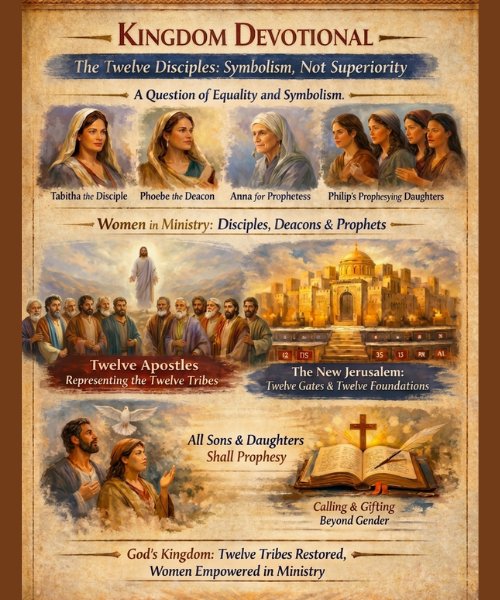
Kingdom Devotional – The Twelve Apostles – Symbolism, Not Superiority
End Times Series – Part 24: Revelation 19 – Heaven’s Celebration and Christ’s Return
Introduction: From Judgment to Joy to Victory
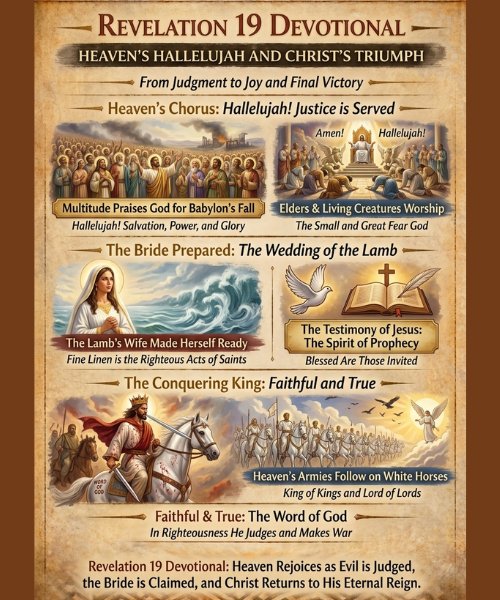
Revelation 19 marks a dramatic shift in tone and perspective. After the sobering judgment of Babylon in chapter 18, heaven erupts in worship and celebration. The chapter opens with the sound of a vast multitude praising God for His righteous judgments, transitions to the announcement of the Wedding Supper of the Lamb, and culminates in the glorious return of Christ as the conquering King.
This chapter answers three profound questions: What does heaven celebrate? What is the church’s ultimate destiny? And how does human history reach its climax? The answers reveal a God who is both just and merciful, a Bride made ready for her Groom, and a King who returns to establish His eternal reign.
1. Heaven’s Hallelujah Chorus (Revelation 19:1-3 WEB)
“After these things I heard something like a loud voice of a great multitude in heaven, saying, ‘Hallelujah! Salvation, power, and glory belong to our God; for his judgments are true and righteous. For he has judged the great prostitute who corrupted the earth with her sexual immorality, and he has avenged the blood of his servants at her hand.’ A second said, ‘Hallelujah! Her smoke goes up forever and ever.'”
Explanation:
“After these things”: This connects directly to Revelation 18 and Babylon’s fall. The sequence is important – judgment first, then celebration. Heaven doesn’t rejoice in suffering but in righteousness being established.
“A loud voice of a great multitude in heaven”: The Greek describes a sound like ochlos pollou (ὄχλου πολλοῦ) – an enormous crowd. This is the redeemed host of all ages, now gathered before God’s throne. Their voices unite in a volume that fills heaven itself.
“Hallelujah!”: This Hebrew word (hallelu-Yah) means “Praise Yahweh!” or “Praise the LORD!” Remarkably, this is the only place in the entire New Testament where “Hallelujah” appears, and it occurs four times in this chapter (vv. 1, 3, 4, 6). The word that has echoed through Israel’s worship for millennia now becomes the anthem of heaven’s final celebration.
“Salvation, power, and glory belong to our God”: These three attributes are ascribed to God alone. Salvation is His work, power is His alone, and glory belongs exclusively to Him. The doxology declares God’s complete sovereignty over history.
“His judgments are true and righteous”: God’s justice is never arbitrary or excessive. Every judgment is alēthinai (ἀληθιναί – “true, genuine”) and dikaiai (δίκαιαι – “righteous, just”). This is crucial: God’s judgment of Babylon wasn’t vindictive but the necessary expression of His holy character.
“He has judged the great prostitute who corrupted the earth”: Babylon’s corruption was global. The verb “corrupted” (phtheirō) means to ruin, destroy, or defile. She didn’t just sin – she spread spiritual poison throughout the earth.
“He has avenged the blood of his servants at her hand”: This fulfills the cry of the martyrs in Revelation 6:10: “How long, O Lord, until you judge and avenge our blood?” God’s patience has limits. He remembers every drop of innocent blood, and justice will be served.
“Her smoke goes up forever and ever”: The present tense indicates ongoing, permanent destruction. This echoes Isaiah 34:10‘s prophecy about Edom: “Its smoke will go up forever.” Babylon’s judgment is final and irreversible.
Kingdom insight: Heaven celebrates God’s justice, not because the redeemed are vindictive, but because righteousness has been established. When evil is finally judged, the moral order of the universe is set right. The martyrs’ blood is vindicated, and God’s holiness is demonstrated. This is why praise is the appropriate response.
2. The Twenty-Four Elders and Living Creatures Worship (Revelation 19:4-5 WEB)
“The twenty-four elders and the four living creatures fell down and worshiped God who sits on the throne, saying, ‘Amen! Hallelujah!’ A voice came from the throne, saying, ‘Give praise to our God, all you his servants, you who fear him, the small and the great!'”
Explanation:
“The twenty-four elders and the four living creatures”: These figures represent the redeemed people of God (twelve tribes + twelve apostles = twenty-four) and the entirety of creation (four living creatures). Together, they symbolize all of God’s works – both redemption and creation – joining in worship.
“Fell down and worshiped God who sits on the throne”: Physical prostration expresses complete submission and reverence. They don’t worship the judgment itself, but God whose character demands justice.
“Amen! Hallelujah!”: “Amen” means “so be it” or “it is true” – affirming everything the multitude just declared. “Hallelujah” adds their own praise. This is responsive, antiphonal worship – one group praises, another affirms and echoes.
“A voice came from the throne”: The source is unclear – possibly an angel near the throne or even the voice of Christ Himself. The voice issues a command to all creation.
“Give praise to our God, all you his servants”: This is a universal call. Every servant of God, regardless of status, is invited to join the worship.
“You who fear him, the small and the great”: The “small and great” indicates that in God’s Kingdom, there is no hierarchy in worship. The least significant believer and the greatest saint have equal access to praise God. The ground is level at the foot of the throne.
Kingdom lesson: Worship in heaven is corporate, responsive, and all-inclusive. The elders, living creatures, martyrs, angels, and all the redeemed join in unified praise. True worship transcends individual expression and becomes a symphony of voices acknowledging God’s worthiness.
3. The Wedding of the Lamb Announced (Revelation 19:6-8 WEB)
“I heard something like the voice of a great multitude, and like the voice of many waters, and like the voice of mighty thunders, saying, ‘Hallelujah! For the Lord our God, the Almighty, reigns! Let’s rejoice and be exceedingly glad, and let’s give the glory to him. For the wedding of the Lamb has come, and his wife has made herself ready.’ It was given to her that she would array herself in bright, pure, fine linen, for the fine linen is the righteous acts of the saints.”
Explanation:
“Like the voice of a great multitude, and like the voice of many waters, and like the voice of mighty thunders”: John uses three metaphors to describe the indescribable volume and power of this worship. It’s like a massive crowd, a roaring waterfall, and rolling thunder all at once. This is the crescendo of history’s worship.
“Hallelujah! For the Lord our God, the Almighty, reigns!”: The third “Hallelujah” celebrates God’s eternal reign. The Greek pantokratōr (παντοκράτωρ – “Almighty”) appears nine times in Revelation, emphasizing God’s absolute sovereignty over all things.
“Let’s rejoice and be exceedingly glad”: The Greek agalliōmetha (ἀγαλλιώμεθα) means to exult with extreme joy. This isn’t quiet contentment but explosive celebration.
“For the wedding of the Lamb has come”: This is the moment all of redemptive history has been building toward. The “Lamb” is Christ (John 1:29), who sacrificed Himself. Now He takes His Bride – the church – in eternal union.
“His wife has made herself ready”: The Bride isn’t passive. She has prepared herself through faithfulness, holiness, and perseverance. The verb hētoimasen (ἡτοίμασεν) indicates intentional, active preparation.
“It was given to her that she would array herself in bright, pure, fine linen”: The clothing is both a gift and a result. God provides the garment, but it represents something real about the Bride’s character.
“The fine linen is the righteous acts of the saints”: This is the key. The Greek dikaiōmata (δικαιώματα) means “righteous deeds” or “acts of righteousness.” The Bride’s wedding dress is woven from the faithful obedience and good works of the saints throughout history. This doesn’t earn salvation but demonstrates the genuineness of faith (James 2:17).
Kingdom insight: The church is both Bride and Body – united to Christ in intimate relationship and organic connection. The wedding imagery emphasizes love, covenant, and consummation. The Lamb who was slain now receives His reward: a Bride who has remained faithful through persecution, temptation, and tribulation. The wedding garment shows that our choices in this life matter eternally.
4. Blessed Are Those Invited (Revelation 19:9-10 WEB)
“He said to me, ‘Write, “Blessed are those who are invited to the wedding supper of the Lamb.”‘ He said to me, ‘These are true words of God.’ I fell down before his feet to worship him. He said to me, ‘Look! Don’t do it! I am a fellow bondservant with you and with your brothers who hold the testimony of Jesus. Worship God, for the testimony of Jesus is the Spirit of Prophecy.'”
Explanation:
“Blessed are those who are invited to the wedding supper of the Lamb”: This is the fourth beatitude in Revelation (1:3; 14:13; 16:15). The “wedding supper” is the celebratory feast following the wedding ceremony – the eternal fellowship between Christ and His people. To be invited is the highest privilege imaginable.
“These are true words of God”: The angel emphasizes the certainty of this promise. In a book filled with visions and symbols, this stands as an unshakeable guarantee: the wedding supper will happen.
“I fell down before his feet to worship him”: John’s response is understandable but wrong. Overwhelmed by the glory of the messenger, he mistakes the servant for the Master.
“Look! Don’t do it!”: The angel’s rebuke is sharp and immediate. The Greek hora mē (ὅρα μή) is an urgent warning: “Watch out! Stop!”
“I am a fellow bondservant with you”: The angel identifies himself as a syndoulos (σύνδουλος) – a co-slave, fellow servant. Both angel and human serve the same Master. This humility is stunning.
“And with your brothers who hold the testimony of Jesus”: All believers share the same status – servants who testify about Jesus. There is no hierarchy that justifies worshiping created beings.
“Worship God”: The command is absolute. Only God deserves worship (Matthew 4:10). This corrects any tendency to elevate angels, saints, or any other created being.
“For the testimony of Jesus is the Spirit of Prophecy”: This dense phrase means that the essence of all true prophecy is to bear witness to Jesus. Prophecy’s purpose is to point to Christ, reveal Christ, and glorify Christ. Any “prophecy” that doesn’t testify about Jesus isn’t from the Holy Spirit.
Kingdom application: We must guard against misplaced worship. Whether it’s angels, religious leaders, traditions, or experiences – nothing and no one deserves the worship that belongs to God alone. Even the most glorious messenger is still a fellow servant. Keep your eyes on Jesus.
5. The Rider on the White Horse (Revelation 19:11-13 WEB)
“I saw the heaven opened, and behold, a white horse, and he who sat on it is called Faithful and True. In righteousness he judges and makes war. His eyes are a flame of fire, and on his head are many crowns. He has names written and a name written which no one knows but he himself. He is clothed in a garment sprinkled with blood. His name is called ‘The Word of God.'”
Explanation:
“I saw the heaven opened”: This is the same phrase used at Jesus’s baptism (Matthew 3:16) and Stephen’s martyrdom (Acts 7:56). Heaven opens to reveal divine intervention in human history. This is the Second Coming.
“A white horse”: White symbolizes victory, purity, and conquest. But unlike the false rider on a white horse in Revelation 6:2, this is the true Conqueror.
“He who sat on it is called Faithful and True”: These two titles appear together in Revelation 3:14 referring to Christ. Pistos (πιστός – “Faithful”) means utterly reliable and trustworthy. Alēthinos (ἀληθινός – “True”) means genuine and real. Everything Jesus promised, He delivers. Every Word He spoke is truth.
“In righteousness he judges and makes war”: The Greek krinei (κρίνει – “judges”) and polemei (πολεμεῖ – “makes war”) show that Christ’s military campaign is judicial. This isn’t conquest for power but the execution of righteous judgment. His war is just.
“His eyes are a flame of fire”: This repeats the description from Revelation 1:14 and 2:18. Eyes like fire penetrate all deception, see every hidden thing, and consume all that is false. Nothing escapes His gaze.
“On his head are many crowns”: The Greek diadēmata (διαδήματα) refers to royal crowns, not victory wreaths. These are symbols of sovereign rule. “Many crowns” indicates universal dominion – He rules over all kingdoms, all nations, all realms.
“He has names written”: In ancient culture, names revealed nature and authority. Christ has multiple names because His nature is inexhaustible.
“A name written which no one knows but he himself”: There remains something mysterious and unknowable about Christ. Even in full revelation, He transcends complete human comprehension. This preserves His transcendence.
“Clothed in a garment sprinkled with blood”: This could refer to His own sacrificial blood (the cross) or the blood of His enemies (judgment). Most likely, it’s both – He conquered through His death and now conquers His enemies in judgment.
“His name is called ‘The Word of God'”: This echoes John 1:1: “In the beginning was the Word, and the Word was with God, and the Word was God.” Christ is God’s ultimate revelation and communication. He is the Logos (Λόγος) – the divine reason, wisdom, and creative power made flesh.
Kingdom insight: The Christ who returns is the same Jesus who walked on earth, but now fully revealed in glory and power. He is both the sacrificial Lamb (ch. 5) and the conquering Lion (ch. 5). He died for sinners and returns to judge the unrepentant. Both truths are essential to who He is.
6. The Armies of Heaven and the Sword from His Mouth (Revelation 19:14-16 WEB)
“The armies which are in heaven, clothed in white, pure, fine linen, followed him on white horses. Out of his mouth proceeds a sharp, double-edged sword that with it he should strike the nations. He will rule them with an iron rod. He treads the wine press of the fierceness of the wrath of God, the Almighty. He has on his garment and on his thigh a name written, ‘KING OF KINGS AND LORD OF LORDS.'”
Explanation:
“The armies which are in heaven, clothed in white, pure, fine linen”: These are the redeemed saints (the same fine linen from v. 8) and possibly angels. They follow Christ, but notice – they don’t fight. Christ alone wages this war.
“Followed him on white horses”: They accompany the King in His victory procession. Their white horses symbolize that they share in His triumph.
“Out of his mouth proceeds a sharp, double-edged sword”: This is not a literal weapon. The sword is His Word – the Word that created the universe (Genesis 1:3), the word that sustains all things (Hebrews 1:3), and the Word that judges (Hebrews 4:12). He defeats His enemies simply by speaking.
“That with it he should strike the nations”: The verb pataxē (πατάξῃ) means to strike down or smite. Christ’s Word alone is sufficient to destroy all opposition.
“He will rule them with an iron rod”: This quotes Psalm 2:9, a messianic psalm. The “iron rod” (rhabdō sidēra) symbolizes unbreakable, absolute authority. There will be no rebellion, no resistance, no compromise in His Kingdom.
“He treads the wine press of the fierceness of the wrath of God”: This imagery comes from Isaiah 63:1-6, where God tramples His enemies like grapes in a winepress. The “fierceness of the wrath” is the accumulated judgment against all unrepented sin.
“KING OF KINGS AND LORD OF LORDS”: This is the supreme title. Every earthly king bows to Him. Every lord acknowledges Him. Caesar claimed to be lord – Christ is Lord of lords. Emperors claimed ultimate authority – Christ is King of kings. This title appears on His garment and His thigh, visible to all, declaring His absolute supremacy.
Kingdom lesson: Christ needs no army to fight for Him. His Word alone is sufficient to defeat all enemies. The saints accompany Him not as warriors but as witnesses to His victory. The battle is the Lord’s, and the outcome is certain.
7. The Invitation to the Great Supper of God (Revelation 19:17-18 WEB)
“I saw an angel standing in the sun. He cried with a loud voice, saying to all the birds that fly in the sky, ‘Come! Be gathered together to the great supper of God, that you may eat the flesh of kings, the flesh of captains, the flesh of mighty men, and the flesh of horses and of those who sit on them, and the flesh of all men, both free and slave, small and great.'”
Explanation:
“An angel standing in the sun”: The sun’s position gives the angel maximum visibility – every creature can see and hear him. This is a universal announcement.
“To all the birds that fly in the sky”: These are carrion birds – vultures, ravens, birds of prey that feed on corpses. This is deliberately grotesque imagery.
“The great supper of God”: This stands in horrific contrast to “the wedding supper of the Lamb” (v. 9). There are two suppers in Revelation 19 – one is a celebration of life and union, the other a feast on death and judgment. Every human will attend one or the other.
“Eat the flesh of kings… captains… mighty men… horses… all men, both free and slave, small and great”: The list emphasizes that judgment falls on all who oppose God, regardless of status. Kings and slaves, powerful and weak, all who reject Christ will face the same end.
Kingdom insight: This gruesome imagery echoes Ezekiel 39:17-20, where birds feast on the enemies of God after a great battle. It’s a sobering picture of what awaits those who persist in rebellion against God. The invitation to the birds is God’s way of saying: the battle is already won, the outcome certain – prepare for the aftermath.
8. The Final Battle and the Beast’s Defeat (Revelation 19:19-21 WEB)
“I saw the beast, the kings of the earth, and their armies, gathered together to make war against him who sat on the horse and against his army. The beast was taken, and with him the false prophet who worked the signs in his sight, with which he deceived those who had received the mark of the beast and those who worshiped his image. These two were thrown alive into the lake of fire that burns with sulfur. The rest were killed with the sword of him who sat on the horse, the sword which came out of his mouth. So all the birds were filled with their flesh.”
Explanation:
“The beast, the kings of the earth, and their armies, gathered together to make war”: This is the climactic showdown – all earthly powers unite in one final rebellion against God. They actually believe they can defeat the returning Christ.
“Against him who sat on the horse and against his army”: The futility is staggering. Created beings attempting to overthrow the Creator. Finite powers attacking the Infinite. Darkness trying to extinguish the Light.
“The beast was taken, and with him the false prophet”: Note: there’s no battle described. John sees them gathered for war, and then immediately – they sare captured. Christ’s appearance alone is sufficient. The beast (political/military power) and the false prophet (religious deception) are seized without resistance.
“Who worked the signs in his sight, with which he deceived”: The false prophet performed counterfeit miracles to lead people to worship the beast and receive his mark. Deception, not force, was his primary weapon.
“These two were thrown alive into the lake of fire that burns with sulfur”: This is the first mention of beings cast into the lake of fire. They go directly there, bypassing death and judgment. The lake of fire is the final destination for all evil (Revelation 20:10, 14-15; 21:8). “Sulfur” (theiō) indicates burning, torment, and permanence.
“The rest were killed with the sword of him who sat on the horse”: The followers of the beast are destroyed by Christ’s spoken Word. Again, no physical battle – just the Word proceeding from His mouth.
“All the birds were filled with their flesh”: The grotesque prophecy is fulfilled. This is the “great supper of God” – judgment, not celebration.
Kingdom lesson: There is no actual battle at Christ’s return. The forces of evil gather, but they are defeated instantaneously. Human pride may imagine resistance is possible, but the reality is that Christ’s enemies are crushed by a Word. The outcome was never in doubt.
Key Takeaways from Revelation 19
- Heaven celebrates God’s righteous judgments: The four “Hallelujahs” show that the redeemed worship God for His justice, not just His mercy. Both attributes deserve praise.
- The wedding of the Lamb is the culmination of redemption: Christ receives His Bride – the church – dressed in the righteous acts of the saints. Our faithfulness in this life becomes our wedding garment.
- Only God deserves worship: Even glorious angels refuse worship and point us to God alone. Guard against misplaced devotion.
- Christ returns as both Savior and Judge: The Lamb who died for sinners returns as the Rider on the white horse who judges in righteousness. Both are true.
- Christ’s word alone defeats His enemies: No physical battle is needed. His spoken Word is sufficient to destroy all opposition and establish His Kingdom.
- There are two suppers in Revelation 19: The wedding supper of the Lamb (blessing) and the great supper of God (judgment). Every person will attend one.
- The beast and false prophet are defeated instantly: Their capture and judgment happen without resistance. Evil’s power is no match for Christ’s glory.
- The outcome of history is certain: Christ wins. His Kingdom is established. His enemies are judged. The Bride is celebrated. This is the inevitable end of the story.
Closing Prayer
Heavenly Father, thank You for the glorious vision of Revelation 19. Help us join heaven’s worship, celebrating Your righteous judgments and anticipating the wedding supper of the Lamb. Make us ready as the Bride of Christ, clothed in righteousness through faithful obedience.
Keep our eyes fixed on Jesus – Faithful and True, the Word of God, King of Kings and Lord of Lords. May we worship You alone and live in light of His certain return. In Jesus’ name, Amen.
If you have been blessed by this issue of Kingdom Living Insights, please share it with others. Many thanks. God bless you!
Pin it!

Find more Kingdom Living Insights issues here

Welcome to Wisdom From Heaven, my Kingdom-focused online ministry rooted in Scripture.
My mission is to help you and your family live faithfully in God’s Kingdom through devotionals, Christian creative resources, expressive & therapeutic arts, the classics, Kingdom Ministry training, Christian online income ideas, and creation wonders. Through these devotional-style resources, I support your spiritual growth and provide guidance for Kingdom living in areas such as health and wellness, work, finances, relationships, marriage, family life, and parenting – always in alignment with the Word of God.
I’m a disciple and servant of Jesus Christ (Prophetic and Pastoral Scribe) sharing the Gospel online. I’m also a wife, mom, teacher, author, Christian Life Coach, Creative Entrepreneur, and Online Business Coach.
ABOUT OUR MINISTRY
We are a non-denominational Bible-believing Christian Ministry trained and equipped at the Christian Leaders Institute and Axx Bible College. Even though our Ministry is based on God's Word, the Bible, you need to approach our teachings like the Bereans and always study the Bible yourself to see if what we teach is aligned with what is written in the Bible.
Now the Berean Jews were of more noble character than those in Thessalonica, for they received the message with great eagerness and examined the Scriptures every day to see if what Paul said was true. Acts 17:11 NIV
We are only humans who 'stumble in many ways' (James 3:2) and we only 'know in part and we prophesy in part' (1 Corinthians 13:9).
LEGAL DISCLAIMER
The content provided on this blog is for educational and informational purposes only. The blog owner, Janet Giessl, also known under her anointed pen name Janetta Setherah, is a Certified Christian Life Coach and Ordained Minister with the Christian Leaders Alliance and holds degrees in Education and Christian Leadership, along with credentials in Bible, Ministry, Philosophy, and Theology. However, Janet is not a medical doctor, licensed therapist or health care professional. The information presented on this platform is not intended to treat, cure, diagnose, or prevent any disease. It is essential to understand that the content offered here is not a substitute for professional advice, whether medical, legal, financial, or from any other professional field.
Spiritual matters and personal well-being are deeply personal and can have profound effects on individuals. We strongly recommend seeking guidance from qualified professionals and prayerfully considering your own circumstances when making significant decisions in your life. The content on this blog is meant to offer insights and inspiration based on biblical principles, but it is not a replacement for professional assistance or personalized advice.
Always consult with appropriate professionals for your specific needs and circumstances.
NOTICE OF COPYRIGHT FOR QUOTING BIBLE VERSES FROM ESV
Scripture quotations are from the ESV® Bible (The Holy Bible, English Standard Version®), © 2001 by Crossway, a publishing ministry of Good News Publishers. ESV Text Edition: 2025. The ESV text may not be quoted in any publication made available to the public by a Creative Commons license. The ESV may not be translated in whole or in part into any other language. Used by permission. All rights reserved.
NOTICE OF COPYRIGHT FOR QUOTING BIBLE VERSES FROM WEB
The World English Bible (WEB) is a Public Domain (no copyright) Modern English translation of the Holy Bible. That means that you may freely copy it in any form, including electronic and print formats. The World English Bible is based on the American Standard Version of the Holy Bible first published in 1901, the Biblia Hebraica Stutgartensa Old Testament, and the Greek Majority Text New Testament. It is in draft form, and currently being edited for accuracy and readability.
