Introduction
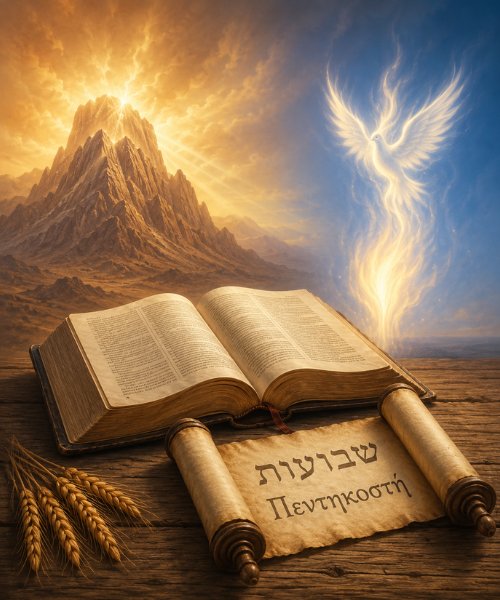
This is the first day of a short devotional series leading up to Pentecost. We begin not with the New Testament alone, but with Shavuot, the Jewish feast that lies behind the Christian celebration of Pentecost. In this series, I want to walk with you through the way the Bible itself connects the Old and the New Testament. When we study the New Testament in light of its Jewish roots, especially the biblical feasts like Shavuot, we begin to see the story of God more clearly, and we understand the New Testament promises more deeply. Pentecost was not an isolated Christian event; it happened to Jewish believers in Jerusalem, on the Jewish feast of Shavuot, the Feast of Weeks. As we move from Shavuot to Pentecost, we are learning to read the Bible whole, honoring the Jewish context and seeing how the Old Testament patterns and celebrations point forward to the outpouring of the Holy Spirit in the New.
Shavuot as Harvest and Covenant
Shavuot is one of the great biblical feasts, woven into the heart of God’s story with His people. The word “Shavuot” means “Weeks” in Hebrew, which is why this feast is also called the “Feast of Weeks” in English. It is known by several other names in Scripture and tradition: the “Feast of Harvest,” the “Feast of First Fruits,” and sometimes simply the “Day of the First Fruits.” [Ex 23:16; Ex 34:22; Lev 23:15–17]
Shavuot is celebrated seven weeks (fifty days) after the wave‑sheaf offering at Passover, marking the end of the counting of the Omer. The word “Omer” originally refers to an ancient measure of grain, but it has come to symbolize the spiritual counting of days between deliverance and revelation: from the Exodus at Passover to the giving of the Law at Sinai. In this way, Shavuot is not only a harvest festival of the first fruits of the wheat, but also a season of remembrance and anticipation, as God’s people look back to what He has done and look forward to what He is about to speak and pour out. In the New Testament, this same fifty‑day timing appears again as Pentecost, the day when the Holy Spirit is poured out on the Church – so Shavuot quietly points us toward the fullness of God’s covenant, written not only on stone, but on the heart.
In Scripture, we see that God Himself appoints this feast:
Exodus 23:16 (WEB)
And the feast of harvest, the first fruits of your labors, which you sow in the field; and the feast of ingathering, at the end of the year, when you gather in your labors out of the field.
Exodus 34:22 (WEB)
“You shall observe the feast of weeks with the first fruits of wheat harvest, and the feast of harvest at the year’s end.
Leviticus 23:15‑17 (WEB)
“‘You shall count from the next day after the Sabbath, from the day that you brought the sheaf of the wave offering: seven Sabbaths shall be completed. The next day after the seventh Sabbath you shall count fifty days; and you shall offer a new meal offering to Yahweh. You shall bring out of your habitations two loaves of bread for a wave offering made of two tenths of an ephah of fine flour. They shall be baked with yeast, for first fruits to Yahweh.
These verses reveal that Shavuot is not only about wheat – it is about time, memory, and covenant. Israel is commanded to count the days from the wave‑sheaf at Passover to the first‑fruits at Shavuot, learning to live in a rhythm of remembering what God has done and offering what He has produced.
Later Jewish tradition, and much Christian reflection, connects Shavuot with the giving of the Torah at Mount Sinai, fifty days after the Exodus. In Exodus 19, the people arrive at Sinai:
Exodus 19:4‑6 (WEB)
‘You have seen what I did to the Egyptians, and how I bore you on eagles’ wings, and brought you to myself. Now therefore, if you will indeed obey my voice and keep my covenant, then you shall be my own possession from among all peoples; for all the earth is mine; and you shall be to me a kingdom of priests and a holy nation.’ These are the words which you shall speak to the children of Israel.”
At Sinai, God is not only giving commands; He is establishing a covenant relationship with Israel. He calls them “a kingdom of priests and a holy nation” – a people set apart who are to represent His holiness to the world. The Law is not arbitrary; it is the guardrail of relationship, showing Israel how to walk in holiness before a holy God.
But the true depth of Shavuot is seen when we read the prophets. Centuries later, God promises that He will not only speak the Law from the outside, but will write it from the inside:
Jeremiah 31:33 (WEB)
“But this is the covenant that I will make with the house of Israel after those days,” says Yahweh:
“I will put my law in their inward parts,
and I will write it in their heart.
I will be their God,
and they shall be my people.
Ezekiel 36:26‑27 (WEB)
I will also give you a new heart, and I will put a new spirit within you. I will take away the stony heart out of your flesh, and I will give you a heart of flesh. I will put my Spirit within you, and cause you to walk in my statutes. You will keep my ordinances and do them.
These passages reveal the inner heart problem of the old covenant:
- At Sinai, the Law was written on tablets of stone, outside the people.
- At Sinai, the people heard the voice of God and said, “All that Yahweh has spoken we will do,” yet they failed again and again. [Ex 19:8; 32:1‑8]
- The prophets show that what humanity truly needs is not just commands, but a new heart and a new Spirit that can love and obey God from within.
How Shavuot connects to Pentecost in Acts
Now enter Pentecost. In the New Testament, the same 50‑day timing is still in view, but now the Spirit of God descends to fulfill what the prophets foresaw. The word “Pentecost” means “fiftieth day,” the same timing as the Feast of Weeks.
On that day:
Acts 2:1‑4 (WEB)
Now when the day of Pentecost had come, they were all with one accord in one place. Suddenly there came from the sky a sound like the rushing of a mighty wind, and it filled all the house where they were sitting. Tongues like fire appeared and were distributed to them, and one sat on each of them. They were all filled with the Holy Spirit and began to speak with other languages, as the Spirit gave them the ability to speak.
Peter then explains this miracle in light of the prophetic promise:
Acts 2:17‑18 (WEB quoting Joel)
‘It will be in the last days, says God,
that I will pour out my Spirit on all flesh.
Your sons and your daughters will prophesy.
Your young men will see visions.
Your old men will dream dreams.
Yes, and on my servants and on my handmaidens in those days,
I will pour out my Spirit, and they will prophesy.
Here is the deep continuity between Shavuot and Pentecost:
- At Shavuot, the first fruits of the wheat are offered; at Pentecost, the first fruits of the Spirit are poured out.
- At Sinai, the Law is written on stone tablets outside the people; at Pentecost, the Spirit writes the Law on the hearts of believers. [Ezek 36:26‑27; Jer 31:33;]
- At Sinai, Israel becomes a covenant people through words from the mountain; at Pentecost, the Church is born as a new‑covenant family through the Spirit within. [Ex 19‑20; Acts 2;]
In this way, Shavuot points forward to Pentecost, and Pentecost fulfills Shavuot:
- Shavuot: First fruits of the harvest, the Torah given at Sinai.
- Pentecost: First fruits of the Spirit, the new‑covenant law written on the heart. [Ezek 36:26‑27; Jer 31:33; Acts 2;]
Reflection and prayer
As you walk through this season, ask yourself:
- Where in my life am I still trying to obey God from the outside, like the Law carved on stone, rather than from the inside, like the Spirit written on my heart?
- How can I learn to listen to the inner voice of the Spirit more than the outer pressure of rules or routine?
The pattern of Scripture is this:
-
Passover → the Lamb slain (our deliverance in Christ). [1 Cor 5:7;]
-
First Fruits → Christ rising as the first‑fruits of those who sleep. [1 Cor 15:20‑23;]
-
Shavuot / Pentecost → the Spirit poured out, the first fruits of the Church, the Law written on the heart. [Acts 2; Ezek 36:26‑27; Jer 31:33;]
Prayer
Heavenly Father,
thank You that on Shavuot You taught Your people to offer the first fruits of the harvest, and on Pentecost You gave us the first fruits of Your Spirit. I confess that often I try to obey You from the outside, like the Law carved on stone, and I fail. I ask You to give me a new heart and a new Spirit, like Ezekiel and Jeremiah foretold. Write Your Law on my heart, that I may love Your commands and walk in them with joy. Renew my reverence for Your Word, and teach me to walk in the Spirit, so that my life may bear the fruit of Your presence. In Jesus’ name. Amen.