Shavuot/Pentecost Devotional Series – How Shavuot Points to Pentecost

  1. Home
  2. /
  3. Blog
  4. /
  5. Shavuot-Pentecost Devotional
  6. /
  7. Shavuot/Pentecost Devotional Series –...

This site includes links from a number of different display ads/affiliate programs. When you click on a link and make a purchase, we may earn a commission. Please be aware that some of the display ads may not be appropriate for Christians.
 

shavuot pentecost devotional image

Introduction

Yesterday we began with Shavuot as a feast of harvest, Weeks, and first fruits, a season of counting the Omer from Passover to the giving of the Law. Today we move into the heart of Shavuot’s meaning as a covenant feast: the day when God meets His people at Mount Sinai and establishes a covenant relationship with them. In this way, Shavuot is not only about wheat; it is about God’s presence, His holiness, and His promise to dwell with His people.


Shavuot as the covenant at Sinai

Although the word “Shavuot” itself focuses on weeks and harvest, Jewish tradition long links this feast to the giving of the Torah at Mount Sinai, fifty days after the Exodus. In Exodus 19, the people arrive at the mountain:

Exodus 19:4–6 (WEB) ‘You have seen what I did to the Egyptians, and how I bore you on eagles’ wings, and brought you to myself. Now therefore, if you will indeed obey my voice and keep my covenant, then you shall be my own possession from among all peoples; for all the earth is mine; and you shall be to me a kingdom of priests and a holy nation.’ These are the words which you shall speak to the children of Israel.”

Here, God is not only rescuing Israel from slavery; He is calling them into a special relationship. He uses three powerful images:

  • “My own possession” – Israel belongs to God in a way that other nations do not.

  • “A kingdom of priests” – they are to stand between God and the world, mediating His holiness and His blessing.

  • “A holy nation” – they are set apart to reflect God’s character, not just to enjoy His favor.

This is the covenant heart of Shavuot.


The Law on stone and the voice of God

At Sinai, the Law is given in a way that leaves no one untouched. God speaks from the mountain with thunder, lightning, and a thick cloud, and the people hear the voice of God Himself:

Exodus 20:1–2 (WEB) God spoke all these words, saying, “I am Yahweh your God, who brought you out of the land of Egypt, out of the house of bondage.

The Ten Commandments are not an abstract list; they are the words of the covenant God who redeemed His people. The people respond:

Exodus 19:8 (WEB)

All the people answered together, and said, “All that Yahweh has spoken we will do.” Moses reported the words of the people to Yahweh.

On the surface, this sounds beautiful, but the story of Israel will show that the human heart cannot keep such a covenant by sheer willpower. The Law is written on tablets of stone, outside the people, and the people are left standing at the foot of a mountain, terrified by the holiness they have encountered.


The deeper longing: a heart that can obey

The prophet Jeremiah looks forward to a day when something deeper will happen:

Jeremiah 31:33 (WEB) This is the covenant that I will make with the house of Israel after those days, declares the Lord: I will put my law in their minds, and write it on their hearts. I will be their God, and they will be my people.”

And the prophet Ezekiel adds:

Ezekiel 36:26–27 (WEB) I will also give you a new heart, and I will put a new spirit within you. I will take away the stony heart out of your flesh, and I will give you a heart of flesh. I will put my Spirit within you, and cause you to walk in my statutes. You will keep my ordinances and do them.

Here is the deep problem Shavuot at Sinai reveals: humanity needs more than commandments; we need a new heart and a new Spirit that can love and obey God from within. The Law on stone shows us God’s holiness; it does not change our hearts by itself.


How Sinai points to Pentecost and to relationship with God

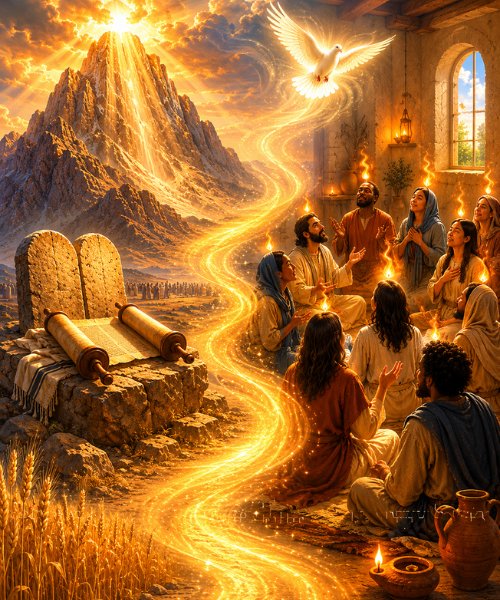
Now fast‑forward to Pentecost. In the New Testament, the same fifty‑day pattern appears again, but now the Spirit of God descends:

Acts 2:1–4 (WEB) Now when the day of Pentecost had come, they were all with one accord in one place. Suddenly there came from the sky a sound like the rushing of a mighty wind, and it filled all the house where they were sitting. Tongues like fire appeared and were distributed to them, and one sat on each of them. They were all filled with the Holy Spirit and began to speak with other languages, as the Spirit gave them the ability to speak.

Where Sinai gave the Law in thunder and stone, Pentecost gives the Spirit in fire and speech. Where Israel stood afar and trembled, the disciples are filled and drawn near. Where the Old‑Testament covenant was written on tablets, the New‑Testament covenant is written on hearts by the Spirit.

Crucially, Pentecost is about relationship with God. At Sinai, the people encountered God’s presence with awe and fear at the mountain, standing at a distance and hearing His voice externally. At Pentecost, God does not only speak from afar; He comes near by His Spirit to dwell within His people, making covenant life a matter of relationship with God from the inside out.

In this way, the Shavuot‑covenant at Sinai points ahead to the Pentecost‑covenant in the Spirit:

  • At Sinai, God says, “You shall be my people.”

  • At Pentecost, God says, “I will put my Spirit within you and cause you to walk in my statutes.”

  • The same pattern repeats: Passover → First Fruits → Shavuot/Pentecost, moving from deliverance, to resurrection, to empowered obedience by the Spirit.


Reflection and prayer

As you walk through this day, ask yourself:

  • Where in my life am I still standing at the foot of the mountain, obeying from fear or duty, rather than from a heart that loves God?
  • How can I learn to receive the Spirit’s strength, so that my obedience flows from a heart that has been changed, not just a will that is strained?
 

Prayer

Heavenly Father, thank You that at Sinai You met Your people with Your holiness and called them Your own. Thank You that at Pentecost You meet Your people with Your Spirit and write Your Law on our hearts. I confess that often my heart is still hard, and my obedience is outward only. I ask You to give me a new heart and a new Spirit, like the prophets promised. Help me to walk in Your statutes, not by my own strength, but by the power of Your Spirit. Let my life reflect the holiness of the covenant You have made with me, and let me know You not only as a distant voice on the mountain, but as a living, dwelling presence in me. In Jesus’ name. Amen.

If you have been blessed by this devotional, please share it with others. Many thanks. God bless you!

Pin it!

shavuot pinterest image


More in this series

  1. Home
  2. /
  3. Blog
  4. /
  5. Shavuot-Pentecost Devotional
  6. /
  7. Shavuot/Pentecost Devotional Series –...


ABOUT OUR MINISTRY

We are a non-denominational Bible-believing Christian Ministry trained and equipped at the Christian Leaders Institute and Axx Bible College. Even though our Ministry is based on God's Word, the Bible, you need to approach our teachings like the Bereans and always study the Bible yourself to see if what we teach is aligned with what is written in the Bible.  

Now the Berean Jews were of more noble character than those in Thessalonica, for they received the message with great eagerness and examined the Scriptures every day to see if what Paul said was true. Acts 17:11 NIV  

We are only humans who 'stumble in many ways' (James 3:2) and we only 'know in part and we prophesy in part' (1 Corinthians 13:9).
wisdomfromheaven donation


LEGAL DISCLAIMER

The content provided on this blog is for educational and informational purposes only. The blog owner, Janet Giessl, also known under her anointed pen name Janetta Setherah, is a Certified Christian Life Coach and Ordained Minister with the Christian Leaders Alliance and holds degrees in Education and Christian Leadership, along with credentials in Bible, Ministry, Philosophy, and Theology. However, Janet is not a medical doctor, licensed therapist or health care professional. The information presented on this platform is not intended to treat, cure, diagnose, or prevent any disease. It is essential to understand that the content offered here is not a substitute for professional advice, whether medical, legal, financial, or from any other professional field.

Spiritual matters and personal well-being are deeply personal and can have profound effects on individuals. We strongly recommend seeking guidance from qualified professionals and prayerfully considering your own circumstances when making significant decisions in your life. The content on this blog is meant to offer insights and inspiration based on biblical principles, but it is not a replacement for professional assistance or personalized advice.

Always consult with appropriate professionals for your specific needs and circumstances.


NOTICE OF COPYRIGHT FOR QUOTING BIBLE VERSES FROM ESV

Scripture quotations are from the ESV® Bible (The Holy Bible, English Standard Version®), © 2001 by Crossway, a publishing ministry of Good News Publishers. ESV Text Edition: 2025. The ESV text may not be quoted in any publication made available to the public by a Creative Commons license. The ESV may not be translated in whole or in part into any other language. Used by permission. All rights reserved.

NOTICE OF COPYRIGHT FOR QUOTING BIBLE VERSES FROM WEB

The World English Bible (WEB) is a Public Domain (no copyright) Modern English translation of the Holy Bible. That means that you may freely copy it in any form, including electronic and print formats. The World English Bible is based on the American Standard Version of the Holy Bible first published in 1901, the Biblia Hebraica Stutgartensa Old Testament, and the Greek Majority Text New Testament. It is in draft form, and currently being edited for accuracy and readability.