Shavuot/Pentecost Devotional Series – From Physical Harvest to Spiritual Harvest

  1. Home
  2. /
  3. Blog
  4. /
  5. Shavuot-Pentecost Devotional
  6. /
  7. Shavuot/Pentecost Devotional Series –...

This site includes links from a number of different display ads/affiliate programs. When you click on a link and make a purchase, we may earn a commission. Please be aware that some of the display ads may not be appropriate for Christians.
 

shavuot pentecost devotional image

Introduction

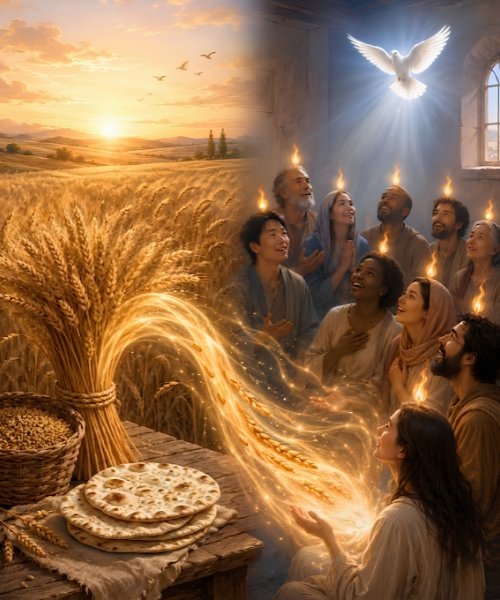
So far we have seen Shavuot as a harvest feast and Shavuot as a covenant‑giving feast at Sinai. Today we focus on a beautiful contrast: Shavuot is the first‑fruits of a physical harvest of wheat, while Pentecost is the first‑fruits of a spiritual harvest of souls. This shows how God’s pattern in the Old Testament, harvest from the land, points forward to the greater harvest He brings in the New Testament from the hearts of people.


Shavuot as the first‑fruits of the physical harvest

In the Old Testament, Shavuot is the Feast of Harvest, the Feast of Weeks, and the Day of the First Fruits, when Israel brings the first sheaves of wheat and the first fruits of the land to the Temple. This is not a symbolic idea; it is a real, physical harvest that comes from the soil, the rain, and the farmer’s labor – all under God’s blessing.

These verses describe the feast in the World English Bible (WEB) wording as you would read on Bible Gateway:

Exodus 23:16 (WEB) And the feast of harvest, the first fruits of your labors, which you sow in the field; and the feast of ingathering, at the end of the year, when you gather in your labors out of the field.

Exodus 34:22 (WEB) “You shall observe the feast of weeks with the first fruits of wheat harvest, and the feast of harvest at the year’s end.

Numbers 28:26 (WEB) “‘Also in the day of the first fruits, when you offer a new meal offering to Yahweh in your feast of weeks, you shall have a holy convocation. You shall do no regular work;

At Shavuot, the people offer actual wheat, bread, and the first fruits of their fields to the Lord, saying, in effect:

  • Lord, You gave the seed, the growth, and the strength to work the land; we bring You the first and best of what You have produced.

  • The harvest belongs to You, not to us.

This is a physical, tangible act of gratitude. The first‑fruits of the wheat are not a metaphor; they are real grain that fills granaries and stomachs. The counting of the Omer turns the 49 days between Passover and Shavuot into a season of anticipation for this earthly harvest, a reminder that God’s provision is concrete, visible, and daily.


Pentecost as the first‑fruits of the spiritual harvest

In the New Testament, the same pattern of first‑fruits appears again, but now in the realm of the Spirit. Pentecost is not about wheat in the fields; it is about souls in the Church.

On the day of Pentecost, the Spirit descends with wind and fire:

Acts 2:1–4 (WEB) Now when the day of Pentecost had come, they were all with one accord in one place. Suddenly there came from the sky a sound like the rushing of a mighty wind, and it filled all the house where they were sitting. Tongues like fire appeared and were distributed to them, and one sat on each of them. They were all filled with the Holy Spirit and began to speak with other languages, as the Spirit gave them the ability to speak.

Peter preaches, and the response is immediate:

Acts 2:41 (WEB) Then those who gladly received his word were baptized. There were added that day about three thousand souls.

This is the first‑fruits of the spiritual harvest – not grain, but people. The first‑fruits at Shavuot filled the Temple with sheaves and loaves; the first‑fruits at Pentecost fill the Church with believers. The harvest God wants is not only what grows from the earth, but what grows from the heart – lives surrendered to Him through the power of the Spirit.


The difference: from physical harvest to spiritual harvest

The key difference is this:

  • At Shavuot, the harvest is physical: wheat, bread, and the first fruits of the land are offered to God. The first‑fruits represent the beginning of an earthly harvest that feeds bodies and fills storehouses. [Ex 23:16; Ex 34:22; Num 28:26;]

  • At Pentecost, the harvest is spiritual: souls, hearts, and lives are gathered into the Church. The first‑fruits represent the beginning of a heavenly harvest that feeds spirits, fills the Church, and prepares the way for the final ingathering at the end of the age. [Acts 2:41;]

In other words:

  • Shavuot: First‑fruits of what God brings forth from the soil.

  • Pentecost: First‑fruits of what God brings forth from the heart.

Both are gifts from God’s hand, but Pentecost shows that the greater harvest is not bread alone, but people alive to God by the Spirit.


Reflection and prayer

As you walk through this day, ask yourself:

  • Where in my life do I only think about God’s provision for physical needs, and neglect His desire for the spiritual harvest – my own heart and the hearts of others?

  • How can I see the financial, material, and earthly blessings I receive as signs of God’s goodness that point me toward the greater harvest of souls?

Prayer

Heavenly Father, thank You that at Shavuot Your people bring the first fruits of the wheat harvest as a physical offering of gratitude, and at Pentecost You bring the first fruits of the Spirit’s spiritual harvest of souls into Your Church. Help me to honor You with the first fruits of my time, my income, and my resources, just as Israel did in the fields. But even more, stir my heart to long for the spiritual harvest – first in my own life, and then in the lives of others. May my obedience, my words, and my worship bear fruit that endures for eternity. In Jesus’ name. Amen.

If you have been blessed by this devotional, please share it with others. Many thanks. God bless you!

Pin it!

shavuot pinterest image


More in this series

  1. Home
  2. /
  3. Blog
  4. /
  5. Shavuot-Pentecost Devotional
  6. /
  7. Shavuot/Pentecost Devotional Series –...


ABOUT OUR MINISTRY

We are a non-denominational Bible-believing Christian Ministry trained and equipped at the Christian Leaders Institute and Axx Bible College. Even though our Ministry is based on God's Word, the Bible, you need to approach our teachings like the Bereans and always study the Bible yourself to see if what we teach is aligned with what is written in the Bible.  

Now the Berean Jews were of more noble character than those in Thessalonica, for they received the message with great eagerness and examined the Scriptures every day to see if what Paul said was true. Acts 17:11 NIV  

We are only humans who 'stumble in many ways' (James 3:2) and we only 'know in part and we prophesy in part' (1 Corinthians 13:9).
wisdomfromheaven donation


LEGAL DISCLAIMER

The content provided on this blog is for educational and informational purposes only. The blog owner, Janet Giessl, also known under her anointed pen name Janetta Setherah, is a Certified Christian Life Coach and Ordained Minister with the Christian Leaders Alliance and holds degrees in Education and Christian Leadership, along with credentials in Bible, Ministry, Philosophy, and Theology. However, Janet is not a medical doctor, licensed therapist or health care professional. The information presented on this platform is not intended to treat, cure, diagnose, or prevent any disease. It is essential to understand that the content offered here is not a substitute for professional advice, whether medical, legal, financial, or from any other professional field.

Spiritual matters and personal well-being are deeply personal and can have profound effects on individuals. We strongly recommend seeking guidance from qualified professionals and prayerfully considering your own circumstances when making significant decisions in your life. The content on this blog is meant to offer insights and inspiration based on biblical principles, but it is not a replacement for professional assistance or personalized advice.

Always consult with appropriate professionals for your specific needs and circumstances.


NOTICE OF COPYRIGHT FOR QUOTING BIBLE VERSES FROM ESV

Scripture quotations are from the ESV® Bible (The Holy Bible, English Standard Version®), © 2001 by Crossway, a publishing ministry of Good News Publishers. ESV Text Edition: 2025. The ESV text may not be quoted in any publication made available to the public by a Creative Commons license. The ESV may not be translated in whole or in part into any other language. Used by permission. All rights reserved.

NOTICE OF COPYRIGHT FOR QUOTING BIBLE VERSES FROM WEB

The World English Bible (WEB) is a Public Domain (no copyright) Modern English translation of the Holy Bible. That means that you may freely copy it in any form, including electronic and print formats. The World English Bible is based on the American Standard Version of the Holy Bible first published in 1901, the Biblia Hebraica Stutgartensa Old Testament, and the Greek Majority Text New Testament. It is in draft form, and currently being edited for accuracy and readability.