This is the final day of this short devotional series from Shavuot to Pentecost. We began by looking at Shavuot in its Old Testament and Jewish context – as the Feast of Weeks, the harvest of first fruits, and the feast later associated with the giving of the Law at Sinai. Today we arrive at Pentecost, the New Testament fulfillment of that feast, when God pours out His Holy Spirit on His people and opens a new-covenant life of salvation, relationship, and power.
What Pentecost means
The word Pentecost means “fiftieth,” because it comes fifty days after Passover/First Fruits and corresponds to the biblical Feast of Weeks, Shavuot. This means Pentecost is not a disconnected Christian celebration, but part of the same biblical pattern God established long before in Israel’s calendar.
In the Old Testament, Shavuot marked the first fruits of the wheat harvest and, in Jewish tradition, came to be associated with the giving of the Torah at Sinai. In the New Testament, Pentecost becomes the day when God gives not stone tablets, but the Holy Spirit; not merely words heard from the outside, but God’s own presence dwelling within His people.
This is one of the deepest connections between Shavuot and Pentecost: at Sinai, God formed a covenant people by His Word; at Pentecost, God forms a Spirit-filled people by His indwelling presence. What was external at Sinai becomes internal at Pentecost, fulfilling the promise that God would write His ways on the heart and put His Spirit within His people.
What happened in Acts 2
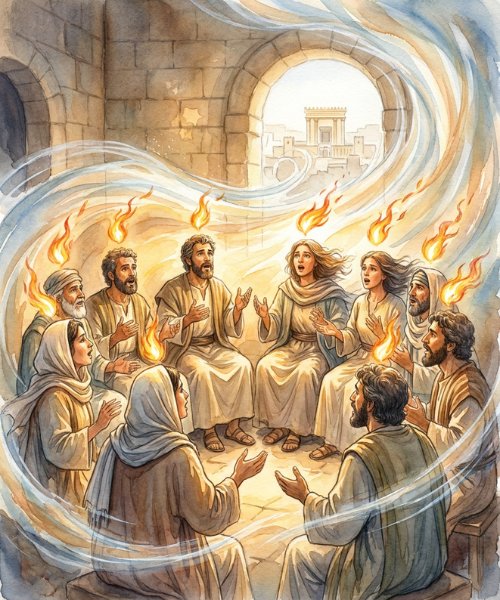
Acts 2 opens with these words: “Now when the day of Pentecost had come, they were all with one accord in one place. Suddenly there came from the sky a sound like the rushing of a mighty wind, and it filled all the house where they were sitting. Tongues like fire appeared and were distributed to them, and one sat on each of them. They were all filled with the Holy Spirit and began to speak with other languages, as the Spirit gave them the ability to speak.”
Several things happen here at once. There is the sound of wind, the appearance of fire, the filling of the Holy Spirit, and the disciples speaking in other languages. These signs matter because they reveal both the holiness and the nearness of God: wind recalls the breath of God, fire recalls His holy presence, and the many languages show that the good news is breaking outward to the nations.
Acts 2 also says that Jews from many nations were staying in Jerusalem, and the crowd was astonished because each person heard the disciples speaking in his own language. So the tongues in Acts 2 are not presented as random speech, but as Spirit-given languages that make known “the mighty works of God” across ethnic and linguistic barriers. In this way, Pentecost is both an outpouring of the Spirit and a sign that the Gospel is for all peoples.
Peter’s sermon and the Gospel
Peter stands up and explains that this is not drunkenness, but the fulfillment of prophecy. He quotes Joel:
‘It will be in the last days, says God,
that I will pour out my Spirit on all flesh.
Your sons and your daughters will prophesy.
Your young men will see visions.
Your old men will dream dreams.
Yes, and on my servants and on my handmaidens in those days,
I will pour out my Spirit, and they will prophesy.
Acts 2:17-18 WEB
That passage is central to Pentecost because it shows that the Holy Spirit is not reserved for a few special leaders. Sons and daughters, old and young, servants and handmaids are all included in the scope of God’s promise. Pentecost reveals a new-covenant generosity: God is drawing near to all kinds of people and making them participants in His life and witness.
Peter then turns from the sign to the Savior. He proclaims Jesus’ life, death, resurrection, and exaltation, and explains that the risen Christ has received the promised Holy Spirit from the Father and has poured out “this, which you now see and hear.” (Acts 2:32–33 WEB) In other words, Pentecost is not mainly about an experience; it is about the enthroned Jesus giving the Spirit to His people.
When the crowd is cut to the heart and asks what they should do, Peter answers, “Repent and be baptized, every one of you, in the name of Jesus Christ for the forgiveness of sins, and you will receive the gift of the Holy Spirit. For the promise is to you and to your children, and to all who are far off, even as many as the Lord our God will call to himself.” (Acts 2:38-39) Then Acts records the result: “Then those who gladly received his word were baptized. There were added that day about three thousand souls.” (Acts 2:41 WEB) So Pentecost is not only the day of dramatic signs, but also the day of repentance, forgiveness, baptism, and the birth of the Church.
The Holy Spirit: not a force, but God
Pentecost teaches that the Holy Spirit is not merely a force, an atmosphere, or a spiritual energy. He is a divine Person, not an impersonal power. Jesus speaks of Him as One who is sent by the Father, who remains with believers, and who will be in them. Acts says the disciples spoke “as the Spirit gave them the ability to speak,” (Acts 2:4 WEB) which shows the Spirit acting personally and actively, not mechanically.
In Christian faith, the Holy Spirit is the third Person of the Trinity – fully God, together with the Father and the Son. So at Pentecost, believers do not merely receive power from God; they receive the indwelling presence of God Himself in the Holy Spirit.
The Holy Spirit and salvation
Pentecost also teaches that the Holy Spirit is not an optional part of the Christian life. The Spirit is essential to Christian salvation and life. Paul says, “But if any man doesn’t have the Spirit of Christ, he is not his.” That means no one belongs to Christ apart from the indwelling work of the Holy Spirit.
This is important because some people think of the Holy Spirit only in terms of gifts, power, or unusual manifestations. But Scripture shows that the Spirit is first of all the One who makes a person alive to God, joins that person to Christ, and brings the reality of salvation inwardly into the heart. Titus says that God “saved us through the washing of regeneration and renewing by the Holy Spirit,” (Titus 3:5 WEB) showing that the Spirit is active in the saving work itself, not only in what follows after conversion.
So Pentecost is not only about empowerment for ministry; it is also about the gift of God’s presence in salvation. Without the Holy Spirit, there is no true new birth, no real belonging to Christ, and no inward participation in the life of the New Covenant.
What Pentecost means today
For believers today, Pentecost means that God does not remain distant. Jesus promised, “I will pray to the Father, and he will give you another Counselor, that he may be with you forever: the Spirit of truth, whom the world can’t receive, for it doesn’t see him and doesn’t know him. You know him, for he lives with you and will be in you.” (John 14:16-17 WEB) At Sinai, God’s people encountered His holiness from outside themselves, standing at the mountain in awe. At Pentecost, God comes near and dwells within His people by the Holy Spirit.
This also fulfills the Old Testament hope expressed in Ezekiel: “I will also give you a new heart, and I will put a new spirit within you. I will take away the stony heart out of your flesh, and I will give you a heart of flesh. I will put my Spirit within you, and cause you to walk in my statutes. You will keep my ordinances and do them.” (Ezekiel 36:26-27 WEB) The Holy Spirit is therefore not only the source of power, but also the source of holiness, obedience, comfort, conviction, witness, and assurance.
Pentecost means:
- God gives His Spirit to dwell in His people, not merely to visit them.
- The Spirit makes salvation real inwardly by bringing regeneration and union with Christ.
- The Spirit empowers witness, as seen in Peter’s bold preaching.
- The Spirit creates a new community marked by repentance, baptism, fellowship, prayer, and devotion to the apostles’ teaching.
- The Spirit begins a worldwide harvest, gathering people from many nations into one body in Christ.
Pentecost also reminds believers that Christianity is not merely a moral code or an external religion. It is life with God through the indwelling Holy Spirit. The same Spirit who came with wind and fire still gives life, convicts of sin, reveals Christ, strengthens obedience, and forms believers into the people of God.
Reflection and prayer
Pentecost asks more than whether a person admires the story in Acts 2. It asks whether that person has truly received the Holy Spirit through faith in Christ and is living in relationship with God through His indwelling presence. It asks whether salvation is being understood not only as forgiveness from the outside, but also as renewal from the inside by the Spirit of God.
Prayer
Heavenly Father, thank You for the gift of Pentecost and for pouring out Your Holy Spirit through Jesus Christ. Thank You that You do not remain distant, but come near and dwell within Your people. Thank You that the Holy Spirit is not merely power, but Your own divine presence – the Spirit who is fully God with the Father and the Son. Thank You that salvation is not only forgiveness of sins, but also new birth, renewal, and life in the Holy Spirit. Fill us again with Your Spirit, write Your ways on our hearts, make us bold in witness, steady in truth, and tender in obedience. Let the same Spirit who filled the disciples draw us into deeper fellowship with You and form in us a life that reflects Jesus Christ.