This site includes links from a number of different display ads/affiliate programs. When you click on a link and make a purchase, we may earn a commission. Please be aware that some of the display ads may not be appropriate for Christians.
Bible Passages
Matthew 27:57–66 (WEB)
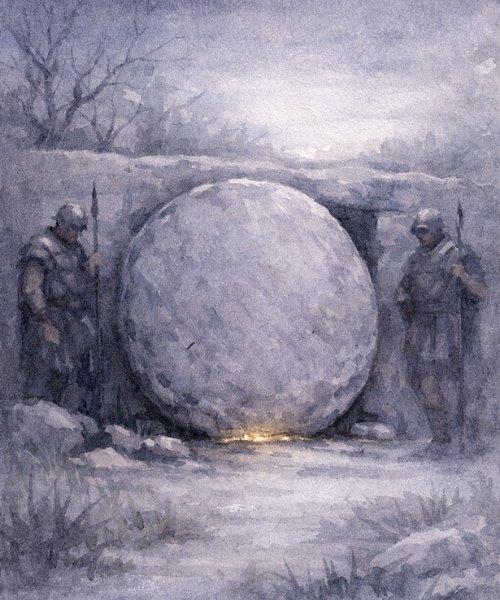
When evening had come, a rich man from Arimathaea, named Joseph, who himself was also Jesus’ disciple, came. He went to Pilate and asked for Jesus’ body. Then Pilate commanded the body to be given up. Joseph took the body and wrapped it in a clean linen cloth and laid it in his own new tomb, which he had cut out in the rock. He rolled a large stone against the door of the tomb and departed. Mary Magdalene was there, and the other Mary, sitting opposite the tomb.
Now on the next day, which was the day after the Preparation Day, the chief priests and the Pharisees were gathered together to Pilate, saying, “Sir, we remember what that deceiver said while he was still alive: ‘After three days I will rise again.’ Command therefore that the tomb be made secure until the third day, lest perhaps his disciples come at night and steal him away, and tell the people, ‘He is risen from the dead;’ and the last deception will be worse than the first.” Pilate said to them, “You have a guard. Go, make it as secure as you can.” So they went with the guard and made the tomb secure, sealing the stone.
1 Peter 3:18–20 (WEB)
Because Christ also suffered for sins once, the righteous for the unrighteous, that he might bring you to God, being put to death in the flesh but made alive in the spirit, in which he also went and preached to the spirits in prison, who before were disobedient, when God waited patiently in the days of Noah while the ark was being built.
Ephesians 4:8–10 (WEB)
Therefore he says, “When he ascended on high, he led captivity captive, and gave gifts to men.” Now this, “he ascended” — what is it but that he also first descended into the lower parts of the earth? He who descended is the one who also ascended far above all the heavens, that he might fill all things.
What Is Silent Saturday?
Silent Saturday is the seventh day of Holy Week, the day between the crucifixion and the resurrection. Jesus was in the tomb. The disciples were scattered, grieving, and hiding behind locked doors. The chief priests and Pharisees went to Pilate to request a guard for the tomb. From the outside it looked like everything was over. It is called Silent Saturday because it is a day of waiting and apparent absence – the day when heaven seemed to say nothing at all. But silence is not the same as inactivity. And God’s apparent absence is not the same as His abandonment.
Devotional
The disciples did not know it was Silent Saturday.
They had no name for it. They had no framework for it. What they had was the raw reality of the day after the crucifixion. Their Rabbi was dead, their hopes had collapsed, and the Sabbath had begun. Jewish law required rest. So they rested, in grief and confusion and fear, with nowhere to go and nothing to do. The women who had watched the burial knew where the tomb was and planned to return after the Sabbath with spices to properly prepare the body. That was all there was. A plan to anoint a dead man.
Peter had denied Jesus three times before the rooster crowed, exactly as Jesus had said he would. Judas had already gone out and hanged himself. The rest of the disciples had fled at the arrest. John had stood at the cross, but the others had scattered. Now they were behind locked doors, afraid that what had happened to Jesus might happen to them.
This is the landscape of Silent Saturday. Grief. Fear. Confusion. The complete apparent failure of everything they had believed and followed for three years.
Meanwhile the chief priests and Pharisees went to Pilate. Their concern was practical. They remembered Jesus had said He would rise after three days, and they wanted to make sure the tomb was secured so the disciples could not steal the body and claim a resurrection. Pilate gave them a guard and they sealed the stone. From their perspective they were closing the last chapter of a problem. The tomb was sealed. The matter was settled. The threat was contained.
They were more right than they knew about the significance of what was in that tomb. And more wrong than they could have imagined about their ability to contain it.
While Jesus’ body lay in the tomb, the Scriptures give us a glimpse of what was happening in the unseen realm. Peter writes that Jesus, though put to death in the body, was made alive in the spirit, and that in that state He went and preached to the spirits who were held in prison. Paul writes in Ephesians that before Jesus ascended to heaven He first descended into the lower parts of the earth, and that when He ascended He brought captives with Him.
What does this mean? In the Old Testament, when people died they went to a place called Sheol in Hebrew or Hades in Greek – the realm of the dead. This was not the place of eternal punishment. It was simply where the dead went. Everyone went there, both the righteous and the unrighteous, because the full payment for sin had not yet been made. Even the righteous people of the Old Testament, Abraham, Moses, David, the prophets, could not yet enter fully into God’s presence. They died in faith but they were waiting. Luke 16 describes this waiting place as Abraham’s bosom – a place of comfort and rest, but still within the realm of the dead.
Jesus entered that realm on Silent Saturday. The Apostles’ Creed refers to this when it says He descended into hell – using the word hell to mean Hades, the realm of the dead, not the place of eternal punishment.
But He did not go empty-handed and He did not stay. Because the debt of sin had now been fully paid on the cross, Jesus went to where the righteous dead had been waiting and He brought them out. He led them to Paradise into the full presence of God, which is why Paul writes that He “led captivity captive.” Those who had died in faith throughout the entire Old Testament were now free to enter what they had been waiting for, because the cross had made it possible. Death had taken Jesus in. It was the worst mistake death ever made.
For the disciples none of this was visible. All they had was Saturday.
There is something important in that for us. Silent Saturday is not just a historical day between two events. It is a description of a season that every believer passes through at some point – the time between a promise and its fulfillment, the period after something has died and before the new thing has come, the days when God appears to be silent and the tomb appears to be sealed and the situation appears to be finished.
The disciples had heard Jesus say He would rise on the third day. He had told them more than once. But on Saturday those words were not producing faith. They were buried under the weight of everything they had watched happen on Friday. What they knew in their heads had been overwhelmed by what they had seen with their eyes. They were not waiting in confident expectation. They were hiding in grief.
God did not rebuke them for that. He did not send an angel on Saturday to remind them of what Jesus had said. He let Saturday be Saturday. He let the silence be silent. He let the stone stay sealed and the guard stay posted and the Sabbath run its full course.
Because Sunday was coming, not because the disciples had maintained their faith through Saturday, but because of what Jesus had already done and what the Father had already planned. The resurrection was not going to happen because someone believed hard enough. It was going to happen because it was what God had determined before the foundation of the world. The sealed tomb and the posted guard and the disciples’ collapsed faith were not obstacles to it. They were simply the setting in which it would be made all the more undeniable.
Silent Saturday asks something of us that is genuinely difficult. It asks us to trust God in the silence. Not the performing, speaking, miracle-working God of Palm Sunday or Holy Monday, but the God who is present and active even when nothing visible is happening, even when the stone is sealed and the situation looks finished and the wait stretches on without explanation.
The disciples thought Saturday was the end. It was actually the last hours before everything changed.
Reflection Questions
The disciples were hiding in fear and grief on Saturday, even though Jesus had told them He would rise. Have you ever been in a season where what you knew about God was overwhelmed by what you were experiencing? What did that feel like?
God let Saturday be Saturday. He did not intervene to comfort the disciples or remind them of what Jesus had said. What does it tell you about God that He sometimes allows a full season of silence and waiting without explanation?
The chief priests and Pharisees sealed the tomb to prevent what they feared most from happening. Have you ever tried to seal off an area of your life from God’s intervention? What happened?
Peter writes that Jesus was active in the unseen realm on the day He appeared to be silent and defeated. How does this change the way you think about the seasons in your own life when God seems absent or inactive?
Silent Saturday was not the end, it was the last hours before everything changed. Is there a situation in your life right now that feels like Saturday? What would it mean to hold on through the silence to Sunday?
Prayer
Lord, Silent Saturday is hard to sit in. The disciples were hiding. The tomb was sealed. Everything looked finished. And You were silent – at least from where they were standing. Teach us to trust You in our own Saturdays – the seasons between what has died and what has not yet come, the times when we cannot hear You and cannot see what You are doing and the stone in front of our situation looks immovable. You were not absent on that Saturday. You were not defeated. You were doing something no one could see and no one could stop. Help us to remember that when our own Saturdays stretch long. You are not silent because You have abandoned us. You are at work in ways we cannot yet see. Give us the faith to wait. Sunday is coming. Amen.
If you have been blessed by this devotional, please share it with others. Many thanks. God bless you!
Welcome to Wisdom From Heaven, my Kingdom-focused online ministry rooted in Scripture.
My mission is to help you and your family live faithfully in God’s Kingdom through devotionals, Christian creative resources, expressive & therapeutic arts, the classics, Kingdom Ministry training, Christian online income ideas, and creation wonders. Through these devotional-style resources, I support your spiritual growth and provide guidance for Kingdom living in areas such as health and wellness, work, finances, relationships, marriage, family life, and parenting – always in alignment with the Word of God.
I’m a disciple and servant of Jesus Christ (Prophetic and Pastoral Scribe) sharing the Gospel online. I’m also a wife, mom, teacher, author, Christian Life Coach, Creative Entrepreneur, and Online Business Coach.
We are a non-denominational Bible-believing Christian Ministry trained and equipped at the Christian Leaders Institute and Axx Bible College. Even though our Ministry is based on God's Word, the Bible, you need to approach our teachings like the Bereans and always study the Bible yourself to see if what we teach is aligned with what is written in the Bible.
Now the Berean Jews were of more noble character than those in Thessalonica, for they received the message with great eagerness and examined the Scriptures every day to see if what Paul said was true.Acts 17:11 NIV
We are only humans who 'stumble in many ways'(James 3:2) and we only 'know in part and we prophesy in part'(1 Corinthians 13:9).
LEGAL DISCLAIMER
The content provided on this blog is for educational and informational purposes only. The blog owner, Janet Giessl, also known under her anointed pen name Janetta Setherah, is a Certified Christian Life Coach and Ordained Minister with the Christian Leaders Alliance and holds degrees in Education and Christian Leadership, along with credentials in Bible, Ministry, Philosophy, and Theology. However, Janet is not a medical doctor, licensed therapist or health care professional. The information presented on this platform is not intended to treat, cure, diagnose, or prevent any disease. It is essential to understand that the content offered here is not a substitute for professional advice, whether medical, legal, financial, or from any other professional field.
Spiritual matters and personal well-being are deeply personal and can have profound effects on individuals. We strongly recommend seeking guidance from qualified professionals and prayerfully considering your own circumstances when making significant decisions in your life. The content on this blog is meant to offer insights and inspiration based on biblical principles, but it is not a replacement for professional assistance or personalized advice.
Always consult with appropriate professionals for your specific needs and circumstances.
NOTICE OF COPYRIGHT FOR QUOTING BIBLE VERSES FROM ESV
NOTICE OF COPYRIGHT FOR QUOTING BIBLE VERSES FROM WEB
The World English Bible (WEB) is a Public Domain (no copyright) Modern English translation of the Holy Bible. That means that you may freely copy it in any form, including electronic and print formats. The World English Bible is based on the American Standard Version of the Holy Bible first published in 1901, the Biblia Hebraica Stutgartensa Old Testament, and the Greek Majority Text New Testament. It is in draft form, and currently being edited for accuracy and readability.