Matthew 26:47–50 (WEB)
While he was still speaking, behold, Judas, one of the twelve, came, and with him a great multitude with swords and clubs, from the chief priests and elders of the people. Now he who betrayed him gave them a sign, saying, “Whoever I kiss, he is the one. Seize him.” Immediately he came to Jesus and said, “Greetings, Rabbi!” and kissed him. Jesus said to him, “Friend, why are you here?”
Luke 23:1–4, 13–16, 20–24 (WEB)
The whole company of them rose up and brought him before Pilate. They began to accuse him, saying, “We found this man perverting our nation, forbidding paying taxes to Caesar, and saying that he himself is Christ, a king.” Pilate asked him, “Are you the King of the Jews?” He answered him, “So you say.” Pilate said to the chief priests and the multitudes, “I find no basis for a charge against this man.”
Pilate called together the chief priests and the rulers and the people, and said to them, “You brought this man to me as one that perverts the people, and behold, I, having examined him before you, found no basis for a charge against this man concerning the things you accuse him of. Neither has Herod, for I sent you to him, and see, nothing worthy of death has been done by him. I will therefore chastise him and release him.”
Pilate spoke to them again, wanting to release Jesus, but they shouted, saying, “Crucify! Crucify him!” He said to them the third time, “Why? What evil has this man done? I have found no capital crime in him. I will therefore chastise him and release him.” But they were urgent with loud voices, asking that he might be crucified. Their voices and the voices of the chief priests prevailed. Pilate decreed that what they asked for should be done.
Mark 15:22–27 (WEB)
They brought him to the place called Golgotha, which is, being interpreted, “The place of a skull.” They offered him wine mixed with myrrh to drink, but he didn’t take it. They crucified him and divided his garments among them, casting lots on them, what each should take. It was the third hour when they crucified him. The superscription of his accusation was written over him: “THE KING OF THE JEWS.” With him they crucified two robbers, one on his right hand and one on his left.
Luke 23:34 (WEB)
Jesus said, “Father, forgive them, for they don’t know what they are doing.”
Luke 23:42–43 (WEB)
He said to Jesus, “Lord, remember me when you come into your Kingdom.” Jesus said to him, “Most certainly I tell you, today you will be with me in Paradise.”
John 19:26–27 (WEB)
Therefore when Jesus saw his mother, and the disciple whom he loved standing there, he said to his mother, “Woman, behold your son!” Then he said to the disciple, “Behold, your mother!” From that hour the disciple took her to his own home.
Matthew 27:45–46 (WEB)
Now from the sixth hour there was darkness over all the land until the ninth hour. About the ninth hour Jesus cried with a loud voice, saying, “Eli, Eli, lima sabachthani?” That is, “My God, my God, why have you forsaken me?”
John 19:28–30 (WEB)
After this, Jesus, seeing that all things were now finished, that the Scripture might be fulfilled, said, “I am thirsty.” Now a vessel full of vinegar was set there, so they put a sponge full of the vinegar on hyssop and held it at his mouth. When Jesus therefore had received the vinegar, he said, “It is finished.” He bowed his head and gave up his spirit.
Luke 23:46 (WEB)
Jesus, crying with a loud voice, said, “Father, into your hands I commit my spirit.” Having said this, he breathed his last.
Matthew 27:50–54 (WEB)
Jesus cried out again with a loud voice and yielded up his spirit. Behold, the veil of the temple was torn in two from the top to the bottom. The earth quaked and the rocks were split. The tombs were opened, and many bodies of the saints who had fallen asleep were raised. Coming out of the tombs after his resurrection, they entered into the holy city and appeared to many. Now the centurion and those who were with him watching Jesus, when they saw the earthquake and the things that were done, were greatly afraid, saying, “Truly this was the Son of God.”
John 19:38–42 (WEB)
After these things, Joseph of Arimathaea, being a disciple of Jesus, but secretly for fear of the Jews, asked of Pilate that he might take away Jesus’ body. Pilate gave him permission. He came therefore and took away his body. Nicodemus, who at first came to Jesus by night, also came bringing a mixture of myrrh and aloes, about a hundred liters. So they took Jesus’ body and bound it in linen cloth with the spices, as the custom of the Jews is to bury. Now in the place where he was crucified there was a garden. In the garden was a new tomb in which no man had yet been laid. Then because of the Jews’ Preparation Day, since the tomb was nearby, they laid Jesus there.
What Is Good Friday?
Good Friday is the sixth day of Holy Week. It marks the day Jesus was arrested, tried, crucified, and buried. It is the day at the center of the entire Christian faith – the day the Son of God died for the sins of the world. The name Good Friday can seem strange given what happened on that day. The goodness is not in the suffering itself but in what the suffering accomplished – the permanent, complete forgiveness and atonement of sin and the restoration of the relationship between God and humanity that had been broken since the fall in Genesis 3. Everything in the Old Testament, every sacrifice, every Passover lamb, every covenant, pointed toward this day.
Devotional
Good Friday begins in a garden and ends in a tomb.
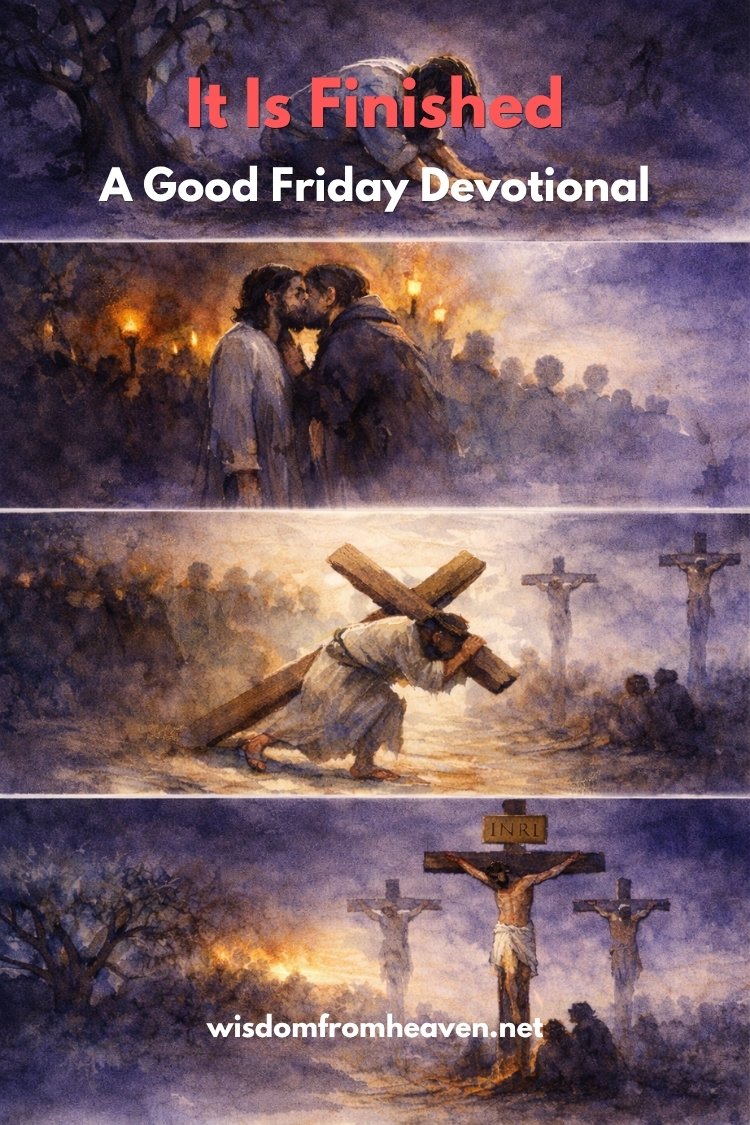
After the Last Supper Jesus took His disciples to Gethsemane, a garden on the Mount of Olives where He often went to pray. He asked Peter, James, and John to stay with Him and watch while He prayed. Luke tells us He was in such anguish that His sweat became like drops of blood. He prayed that if it were possible the cup might pass from Him, but surrendered to the Father’s will. When He returned to the disciples He found them sleeping. He woke them three times. The third time Judas arrived with a crowd carrying swords and clubs, sent by the chief priests and elders.
Judas identified Jesus with a kiss. Jesus’ response to the man who was betraying Him was a single question: “Friend, why are you here?” He was arrested and taken away while His disciples fled into the night.
He was brought first to the high priest Caiaphas where the religious leaders had assembled. They looked for false testimony against Him and could not agree on any. Finally the high priest asked Him directly: “Are you the Christ, the Son of God?” Jesus answered “You have said it.” The high priest tore his robes and declared it blasphemy. They condemned Him to death.
In the morning they brought Him to Pontius Pilate, the Roman governor, because they did not have the authority to carry out an execution themselves. Pilate examined Jesus and found no basis for a charge against Him. He sent Him to Herod Antipas, who was in Jerusalem for Passover, and Herod also found nothing worthy of death. Jesus was sent back to Pilate.
Pilate tried three times to release Jesus. He offered to release one prisoner as was the custom at Passover. The crowd chose Barabbas, a convicted murderer, over Jesus. Pilate had Jesus flogged, hoping it would satisfy the crowd. It did not. The crowd and the chief priests kept shouting “Crucify him.” Pilate, unwilling to risk a riot, handed Jesus over to be crucified.
The soldiers took Jesus and dressed Him in a purple robe, placed a crown of thorns on His head, and mocked Him as a king. They beat Him and spat on Him. Then they led Him out to be crucified.
He was brought to Golgotha, the Place of the Skull, outside the city walls of Jerusalem. This was standard Roman practice. Crucifixions were carried out in public places as a visible deterrent. Rome used crucifixion specifically for slaves, criminals, and those who threatened Roman authority. It was designed to be both painful and humiliating, a death in full public view, slow and agonizing, stripped of all dignity.
They crucified Him at the third hour, nine in the morning. A sign was placed above His head reading “THE KING OF THE JEWS.” Two criminals were crucified alongside Him, one on each side.
From the cross Jesus spoke seven times.
His first words were not a cry of pain or an accusation. They were a prayer for the people who were crucifying Him: “Father, forgive them, for they don’t know what they are doing.” Luke 23:34 (WEB). This was not a passive or resigned forgiveness. It was active intercession – Jesus asking the Father to forgive the very people driving the nails, in the moment they were doing it.
One of the criminals crucified beside Him mocked Him. The other rebuked the first and turned to Jesus: “Lord, remember me when you come into your Kingdom.” Jesus answered: “Most certainly I tell you, today you will be with me in Paradise.” Luke 23:43 (WEB). In the middle of His own suffering He stopped to receive a dying man into His Kingdom.
John records that Jesus looked down from the cross and saw His mother Mary standing with John, the disciple He loved. He spoke to her and to John, placing His mother in John’s care. “Woman, behold your son.” “Behold, your mother.” John 19:26–27 (WEB). Even in His final hours He was taking care of the people He loved.
At the sixth hour, noon, darkness fell over the whole land. It lasted three hours. At the ninth hour, the hour of the afternoon Temple sacrifice, Jesus cried out with a loud voice in Aramaic: “Eli, Eli, lima sabachthani?” – “My God, my God, why have you forsaken me?” Matthew 27:46 (WEB). These are the opening words of Psalm 22, a psalm of David that describes exactly what was happening at the cross – the suffering, the mockery, the dividing of garments, the bone-deep anguish. Jesus was not simply expressing despair. He was identifying Himself with the psalm and pointing those who had ears to hear toward its resolution which ends in vindication, praise, and the declaration that God has not despised or scorned the suffering of the afflicted one.
Then He said “I am thirsty.” John 19:28 (WEB). A sponge soaked in vinegar was lifted to His mouth on a hyssop branch, the same plant used to apply the blood of the Passover lamb to the doorposts in Egypt. Every detail was speaking.
Then He said: “It is finished.” John 19:30 (WEB). The Greek word is tetelestai – a single word that means completed, accomplished, paid in full. It was a word used in the ancient world to mark a debt that had been completely settled. Jesus was not saying it is over in the sense of defeat. He was declaring that everything the Father had sent Him to do had been fully accomplished. The sacrifice was complete. The debt of sin was paid. Nothing remained to be done.
Finally, He prayed His final prayer: “Father, into your hands I commit my spirit.” Luke 23:46 (WEB). And He breathed His last.
At the moment of His death three things happened simultaneously. The veil of the Temple was torn in two from top to bottom. This was not a small curtain. It was the thick heavy veil that separated the Holy Place from the Holy of Holies – the innermost chamber of the Temple where God’s presence dwelt, the place only the High Priest could enter once a year on Yom Kippur. It was torn from top to bottom, from God’s side downward, signaling that the barrier between God and humanity had been removed. Direct access to God was now open to every person through Jesus. The earth shook. Rocks split. Tombs opened. A Roman centurion who had watched the entire crucifixion said: “Truly this was the Son of God.”
Because it was the day of Preparation, the day before the Sabbath, the body needed to be buried quickly. Joseph of Arimathea, a member of the Jewish council who had become a secret disciple of Jesus, went to Pilate and asked for the body. Nicodemus, the Pharisee and member of the Sanhedrin who had come to Jesus by night in John 3, came with about a hundred liters of myrrh and aloes. Together they wrapped Jesus’ body in linen with the spices according to Jewish burial custom and placed Him in a new tomb in a nearby garden.
The stone was rolled across the entrance. The Sabbath began. And the disciples had no idea what was coming.
Good Friday is not the end of the story. But it is essential to sit in it fully before moving to what comes next. The resurrection means nothing if the crucifixion is minimized. The cross is not a tragedy God redeemed. It is the very means by which God accomplished what nothing else could – the complete forgiveness and atonement of sin, the defeat of death, and the permanent restoration of the relationship between the Creator and His creation.
Tetelestai. It is finished. Paid in full.
Reflection Questions
- Jesus’ first words from the cross were a prayer of forgiveness for the people crucifying Him. What does this tell you about the nature of the forgiveness He offers you?
- The criminal on the cross had nothing to offer Jesus – no good works, no religious history, no time left to change his life. Jesus received him into Paradise on the spot. What does this tell you about how salvation works?
- The Temple veil was torn from top to bottom at the moment of Jesus’ death. What does it mean for your daily life that direct access to God is now fully open to you?
- Jesus said “It is finished” – tetelestai – paid in full. Is there anything in your life that you are still trying to add to what Jesus already completed on the cross?
- Joseph of Arimathea and Nicodemus had both been secret disciples. At the moment of greatest risk, after the crucifixion, when following Jesus was most dangerous, they stepped forward openly. What does their example say to you about the cost and the moment of open commitment to Jesus?
Prayer
Lord Jesus, we do not come to Good Friday lightly. You were arrested, falsely accused, beaten, mocked, and crucified. You hung on the cross for hours. You prayed for the people killing You. You received a dying criminal into Your Kingdom. You cared for Your mother. You cried out in the darkness. And then You said it is finished, paid in full, and You gave up Your spirit. The veil was torn. The debt was settled. The way to God was opened. We have no words adequate for what You did on that cross. We only know that it was for us – for our sin, our separation from God, our death. Thank You. Not as a casual expression but as the deepest response we have. Thank You. Help us never to treat what You did as ordinary or familiar. Let the cross remain what it is – the most significant moment in human history, the place where everything changed. Amen.