Bible Passages
Matthew 28:1–8 (WEB)
Now after the Sabbath, as it began to dawn on the first day of the week, Mary Magdalene and the other Mary came to see the tomb. Behold, there was a great earthquake, for an angel of the Lord descended from the sky and came and rolled away the stone from the door and sat on it. His appearance was like lightning, and his clothing was white as snow. For fear of him, the guards shook, and became like dead men. The angel answered the women, “Don’t be afraid, for I know that you seek Jesus, who has been crucified. He is not here, for he has risen, just like he said. Come, see the place where the Lord was lying. Go quickly and tell his disciples, ‘He has risen from the dead, and behold, he goes before you into Galilee; there you will see him.’ Behold, I have told you.” They departed quickly from the tomb with fear and great joy, and ran to bring his disciples word.
John 20:1–18 (WEB)
Now on the first day of the week, Mary Magdalene went early, while it was still dark, to the tomb, and saw that the stone had been taken away from the tomb. Therefore she ran and came to Simon Peter and to the other disciple whom Jesus loved, and said to them, “They have taken away the Lord out of the tomb, and we don’t know where they have laid him.” Therefore Peter and the other disciple went out, and they went toward the tomb. They both ran together. The other disciple outran Peter and came to the tomb first. Stooping and looking in, he saw the linen cloths lying, yet he didn’t enter in. Then Simon Peter came, following him, and entered into the tomb. He saw the linen cloths lying, and the cloth that had been on his head, not lying with the linen cloths, but rolled up in a place by itself. So then the other disciple who came first to the tomb also entered in, and he saw and believed. For as yet they didn’t know the Scripture, that he must rise from the dead. So the disciples went away again to their own homes. But Mary was standing outside at the tomb weeping. So as she wept, she stooped and looked into the tomb, and she saw two angels in white sitting, one at the head and one at the feet, where the body of Jesus had lain. They asked her, “Woman, why are you weeping?” She said to them, “Because they have taken away my Lord, and I don’t know where they have laid him.” When she had said this, she turned around and saw Jesus standing, and didn’t know that it was Jesus. Jesus said to her, “Woman, why are you weeping? Who are you looking for?” She, supposing him to be the gardener, said to him, “Sir, if you have carried him away, tell me where you have laid him, and I will take him away.” Jesus said to her, “Mary.” She turned and said to him, “Rabboni!” which is to say, “Teacher!” Jesus said to her, “Don’t hold me, for I haven’t yet ascended to my Father; but go to my brothers and tell them, ‘I am ascending to my Father and your Father, to my God and your God.'” Mary Magdalene came and told the disciples that she had seen the Lord, and that he had said these things to her.
Luke 24:13–35 (WEB)
Behold, two of them were going that very day to a village named Emmaus, which was sixty stadia from Jerusalem. They talked with each other about all of these things which had happened. While they talked and questioned together, Jesus himself came near, and went with them. But their eyes were kept from recognizing him. He said to them, “What are these words that you are exchanging with one another as you walk?” They stood still, looking sad. One of them, named Cleopas, answered him, “Are you the only stranger in Jerusalem who doesn’t know the things which have happened there in these days?” He said to them, “What things?” They said to him, “The things concerning Jesus the Nazarene, who was a prophet mighty in deed and word before God and all the people; and how the chief priests and our rulers delivered him up to be condemned to death, and crucified him. But we were hoping that it was he who would redeem Israel. Yes, and besides all this, it is now the third day since these things happened.” As he sat at the table with them, he took the bread and gave thanks. Breaking it, he gave it to them. Their eyes were opened and they recognized him, and he vanished from their sight. They said to one another, “Weren’t our hearts burning within us while he spoke to us along the way, while he opened the scriptures to us?” They rose up that very hour, returned to Jerusalem, and found the eleven gathered together, and those who were with them, saying, “The Lord is risen indeed, and has appeared to Simon!”
John 20:19–29 (WEB)
When therefore it was evening on that day, the first day of the week, and when the doors were locked where the disciples were assembled, for fear of the Jews, Jesus came and stood in the middle of them and said to them, “Peace be with you.” When he had said this, he showed them his hands and his side. The disciples therefore were glad when they saw the Lord. Jesus therefore said to them again, “Peace be with you. As the Father has sent me, even so I send you.” When he had said this, he breathed on them and said to them, “Receive the Holy Spirit.” But Thomas, one of the twelve, called Didymus, wasn’t with them when Jesus came. The other disciples therefore said to him, “We have seen the Lord.” But he said to them, “Unless I see in his hands the print of the nails, and put my hand into his side, I will not believe.” After eight days again his disciples were inside and Thomas was with them. Jesus came, the doors being locked, and stood in the middle, and said, “Peace be with you.” Then he said to Thomas, “Reach here your finger, and see my hands. Reach here your hand, and put it into my side. Don’t be unbelieving, but believing.” Thomas answered him, “My Lord and my God!” Jesus said to him, “Because you have seen me, you have believed. Blessed are those who have not seen, and have believed.”
What Is Easter Sunday?
Easter Sunday, also called Resurrection Sunday, is the eighth and final day of Holy Week and the most important day in the entire Christian calendar. It is the day Jesus rose from the dead, exactly as He had said He would. The resurrection is not one event among many in the life of Jesus. It is the event that confirms everything He said and everything He did. Without the resurrection, the cross is simply a tragic death. With it, the cross is the turning point of all human history. Paul writes in 1 Corinthians 15:17: “If Christ has not been raised, your faith is vain.” The resurrection is the foundation on which everything else in the Christian faith stands.
Devotional
Early on the first day of the week, while it was still dark, the women came to the tomb.
They came to finish the burial preparations that the Sabbath had interrupted. They were not coming to witness a resurrection. They were coming to anoint a dead body. Mary Magdalene, Mary the mother of James, Salome, and others made their way to the garden tomb carrying spices, wondering among themselves who would roll away the heavy stone at the entrance.
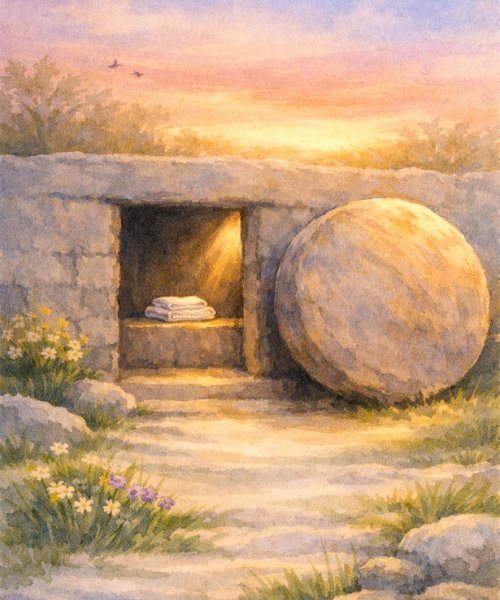
The stone was already gone.
Matthew records that an angel of the Lord had descended and rolled it back – not to let Jesus out, but to let the witnesses in. Jesus did not need the stone moved to rise from the dead. The stone was moved so that people could see that the tomb was empty.
The angel’s message to the women was direct: “Don’t be afraid, for I know that you seek Jesus, who has been crucified. He is not here, for he has risen, just like he said.” Then came the invitation: “Come, see the place where the Lord was lying.” And then the commission: “Go quickly and tell his disciples.”
Mary Magdalene ran to tell Peter and John. John outran Peter to the tomb, stooped and looked in, and saw the linen burial cloths lying there but did not go in. Peter went straight in. He saw the cloths lying there and the cloth that had been around Jesus’ head rolled up separately and set aside. John entered after him, saw the same thing, and believed. Peter and John then went back to their homes.
Mary stayed at the tomb, weeping.
She looked into the tomb and saw two angels sitting where the body of Jesus had been – one at the head, one at the feet. They asked her why she was weeping. She said because they had taken her Lord and she did not know where they had put Him. She turned around and saw a figure standing there. She did not recognize Him. She assumed He was the gardener and asked if He had moved the body.
Then He said her name. “Mary.”
One word. She recognized Him immediately and turned to Him – “Rabboni” – Teacher. This is one of the most personal moments in all of the Gospels. The risen Jesus did not first appear to the high priest or to Pilate or to the religious leaders. He appeared to a woman who had stayed at the tomb weeping because she could not find Him. He called her by name. And He sent her – the first witness of the resurrection – to tell the others.
Later that same day two disciples were walking from Jerusalem to a village called Emmaus, about seven miles away. They were talking through everything that had happened – the arrest, the crucifixion, the reports from the women about the empty tomb. A stranger fell into step beside them and asked what they were discussing. They stopped walking, their faces full of grief. One of them, Cleopas, explained everything – who Jesus had been, what they had hoped, and how those hopes had been crushed. “We were hoping that it was he who would redeem Israel,” he said. Three days had passed and they did not know what to make of any of it.
The stranger walked with them all the way to Emmaus, explaining the Scriptures to them along the road – showing them how everything Moses and the prophets had written had pointed toward exactly what had just happened. When they reached the village they invited Him to stay and eat with them. He took the bread, gave thanks, broke it, and gave it to them.
Their eyes were opened. They recognized Him. And He vanished.
They said to each other: “Weren’t our hearts burning within us while he spoke to us along the way?” They got up immediately and walked the seven miles back to Jerusalem to tell the others.
That evening the disciples were gathered behind locked doors, afraid. Jesus came and stood among them. The locked doors were not an obstacle. He stood in the middle of them and said: “Peace be with you.” He showed them His hands and His side. The disciples saw the Lord and were filled with joy. He breathed on them and said: “Receive the Holy Spirit.”
Thomas was not there that evening. When the others told him they had seen the Lord he refused to believe it. “Unless I see the print of the nails in his hands and put my hand into his side, I will not believe.” Eight days later Jesus appeared again. Thomas was there this time. Jesus went directly to him and said: “Reach here your finger, and see my hands. Reach here your hand, and put it into my side. Don’t be unbelieving, but believing.” Thomas answered: “My Lord and my God.” Jesus said to him: “Because you have seen me, you have believed. Blessed are those who have not seen, and have believed.”
That last statement is for us. We were not in the garden. We did not hear our name spoken by the risen Jesus on that first morning. We were not in the upper room when He showed the disciples His hands. We have not put our fingers in the nail prints the way Thomas did. We belong to the category Jesus described – those who have not seen and yet have believed. And He called that faith blessed.
The resurrection changes everything it touches. It confirmed that Jesus was exactly who He said He was. It validated every claim He made and every promise He gave. It proved that the cross was not a defeat but an accomplishment – that death had been defeated, that sin’s penalty had been fully paid, and that the life He promised to those who believe in Him is real and permanent.
The tomb was empty. It is still empty. That is the foundation of everything.
Reflection Questions
- Mary Magdalene stayed at the tomb weeping while others went home. Jesus appeared to her first and called her by name. What does it mean to you that the risen Jesus sees the ones who stay and seeks out those who are grieving?
- The two disciples on the road to Emmaus recognized Jesus in the breaking of the bread. Are there moments in your own life where you have recognized Jesus’ presence only in hindsight after the moment had passed?
- Thomas refused to believe without physical evidence and Jesus did not rebuke him for his doubt. He gave him exactly what he needed. How does Jesus’ response to Thomas’s doubt speak to the doubts you carry?
- Jesus said “Blessed are those who have not seen and have believed.” What does it mean to you personally to be included in that category?
- The resurrection is the foundation of the entire Christian faith. How does the reality of the resurrection, that Jesus literally rose from the dead, change the way you live your daily life?
Prayer
Lord Jesus, You rose from the dead. The tomb is empty. Death could not hold You and the stone could not contain You and the guards could not prevent what the Father had determined from before the foundation of the world. You appeared to Mary and called her by name because You know each one of us by name. You walked beside two grieving disciples and opened the Scriptures to them because You do not leave us alone in our confusion and grief. You stood among Your frightened disciples behind locked doors and said peace be with you because Your first instinct toward Your broken, scattered, fearful people was not rebuke but peace. You went directly to Thomas and gave him exactly what he needed to believe because Your love is patient and personal and does not give up on the ones who struggle to believe.
We love You, Lord Jesus. Not because we are always faithful or consistent or strong in faith but because You first loved us. Your love for us is far beyond anything we could ever deserve or fully comprehend. You went to the cross for us. You rose from the dead for us. You appeared again and again to people who had doubted You, denied You, and hidden from You, not because they deserved it, but because Your love has no limit and no end.
That is the love we are responding to today. Let the reality of Your resurrection be the foundation on which everything in our lives is built. And let our love for You grow deeper with every day we live on this side of the empty tomb. Amen.