This site includes links from a number of different display ads/affiliate programs. When you click on a link and make a purchase, we may earn a commission. Please be aware that some of the display ads may not be appropriate for Christians.
Enhance Your Bible Study with Sketchnoting: A Creative Approach to Deepening Your Faith

Sketchnoting, the art of creating visual notes, has gained popularity in various fields for its ability to enhance comprehension and retention of information. But did you know that this creative method can also transform your Bible study, devotional time, and sermon listening into a more engaging and insightful experience? In this blog post, we will explore how sketchnoting can enrich your spiritual journey, provide practical tips to get started, and share inspiring examples to ignite your creativity.
What is Sketchnoting?

Sketchnoting is a form of note-taking that combines text with drawings, symbols, and other visual elements. Unlike traditional linear notes, sketchnotes capture information in a way that is visually stimulating and easy to recall. This method is particularly effective for visual learners and anyone looking to add a new dimension to their note-taking practice.
Why Sketchnote During Bible Study or Sermons?

- Enhanced Engagement: Sketchnoting requires active listening and processing, which helps you stay engaged with the material.
- Improved Retention: Visual notes are easier to remember than plain text. The combination of words and images aids in better memory recall.
- Deeper Understanding: Creating visual representations of concepts can lead to deeper insights and a more profound understanding of the scriptures.
- Personal Connection: Sketchnotes are unique to the individual, allowing you to personalize your study and make it more meaningful.
Getting Started with Sketchnoting in Bible Study
1. Gather Your Supplies
You don’t need fancy tools to start sketchnoting. Here’s a simple list to get you going:
- Notebook or Sketchbook: Choose one with blank or dotted pages.
- Pens and Pencils: Use fine-liners, markers, or colored pencils. Different colors can help highlight key points.
- Optional Tools: Highlighters, sticky notes, or stencils can add variety to your sketchnotes.


2. Start with Simple Shapes and Icons

Begin by practicing basic shapes and icons that you can use frequently. Hearts for love, crosses for faith, arrows for direction, and lightbulbs for ideas are a few examples. These simple drawings can make your notes visually appealing without requiring advanced artistic skills.
3. Develop Your Own Symbols and Visual Vocabulary
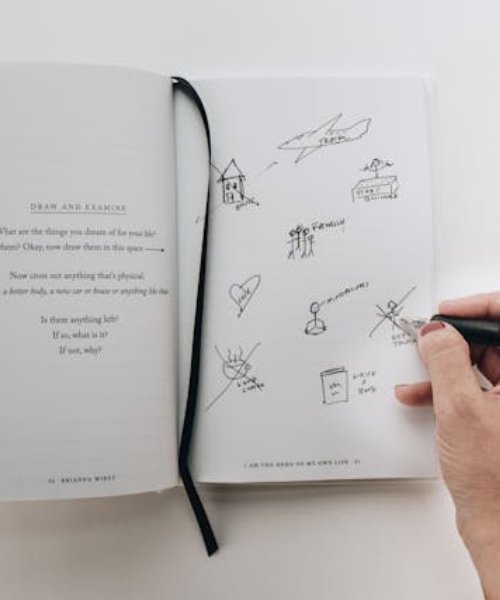
As you get more comfortable, start developing your own symbols and shorthand. Personal symbols can make your notes more intuitive and tailored to your understanding.
4. Listen, Reflect, and Draw

While reading a passage, listening to a sermon, or engaging in devotional time, jot down key points, quotes, and reflections. Use your visual vocabulary to represent these ideas graphically. Don’t worry about perfection; focus on capturing the essence of the message.
5. Use Space and Layout Creatively

Experiment with different layouts. You can create mind maps, flowcharts, or doodle in the margins. The goal is to make your notes dynamic and easy to revisit.
Practical Tips for Effective Sketchnoting
- Highlight Scripture References: Use bold text or color to make scripture references stand out.
- Summarize Key Points: Distill long passages or sermons into concise summaries.
- Incorporate Quotes: Capture powerful quotes or verses that resonate with you.
- Add Personal Reflections: Jot down your thoughts and feelings as you study.
- Review and Revise: Sketchnotes are living documents. Feel free to revisit and revise them as you gain more insights.
Inspiring Examples of Bible Study Sketchnotes
To get inspired, check out these examples of how others have used sketchnoting in their spiritual practices:
- Scripture Journals: Combine verse-by-verse study with visual notes and reflections.
- Sermon Notes: Capture the main points of a sermon with a mix of text and illustrations.
- Devotional Art: Create beautiful, meditative art based on your daily devotional readings.





Conclusion
Sketchnoting is a powerful tool that can transform your Bible study, devotional time, and sermon listening. By combining creativity with reflection, you can gain deeper insights, improve retention, and make your spiritual journey more engaging. So grab your pens and start sketchnoting today – you might just discover a new favorite way to connect with your faith! Happy sketchnoting!
Pin to Pinterest! 

Welcome to Wisdom From Heaven, my Kingdom-focused online ministry rooted in Scripture.
My mission is to help you and your family live faithfully in God’s Kingdom through devotionals, Christian creative resources, expressive & therapeutic arts, the classics, Kingdom Ministry training, Christian online income ideas, and creation wonders. Through these devotional-style resources, I support your spiritual growth and provide guidance for Kingdom living in areas such as health and wellness, work, finances, relationships, marriage, family life, and parenting – always in alignment with the Word of God.
I’m a disciple and servant of Jesus Christ (Prophetic and Pastoral Scribe) sharing the Gospel online. I’m also a wife, mom, teacher, author, Christian Life Coach, Creative Entrepreneur, and Online Business Coach.
ABOUT OUR MINISTRY
We are a non-denominational Bible-believing Christian Ministry trained and equipped at the Christian Leaders Institute and Axx Bible College. Even though our Ministry is based on God's Word, the Bible, you need to approach our teachings like the Bereans and always study the Bible yourself to see if what we teach is aligned with what is written in the Bible.
Now the Berean Jews were of more noble character than those in Thessalonica, for they received the message with great eagerness and examined the Scriptures every day to see if what Paul said was true. Acts 17:11 NIV
We are only humans who 'stumble in many ways' (James 3:2) and we only 'know in part and we prophesy in part' (1 Corinthians 13:9).

LEGAL DISCLAIMER
The content provided on this blog is for educational and informational purposes only. The blog owner, Janet Giessl, also known under her anointed pen name Janetta Setherah, is a Certified Christian Life Coach and Ordained Minister with the Christian Leaders Alliance and holds degrees in Education and Christian Leadership, along with credentials in Bible, Ministry, Philosophy, and Theology. However, Janet is not a medical doctor, licensed therapist or health care professional. The information presented on this platform is not intended to treat, cure, diagnose, or prevent any disease. It is essential to understand that the content offered here is not a substitute for professional advice, whether medical, legal, financial, or from any other professional field.
Spiritual matters and personal well-being are deeply personal and can have profound effects on individuals. We strongly recommend seeking guidance from qualified professionals and prayerfully considering your own circumstances when making significant decisions in your life. The content on this blog is meant to offer insights and inspiration based on biblical principles, but it is not a replacement for professional assistance or personalized advice.
Always consult with appropriate professionals for your specific needs and circumstances.
NOTICE OF COPYRIGHT FOR QUOTING BIBLE VERSES FROM ESV
Scripture quotations are from the ESV® Bible (The Holy Bible, English Standard Version®), © 2001 by Crossway, a publishing ministry of Good News Publishers. ESV Text Edition: 2025. The ESV text may not be quoted in any publication made available to the public by a Creative Commons license. The ESV may not be translated in whole or in part into any other language. Used by permission. All rights reserved.
NOTICE OF COPYRIGHT FOR QUOTING BIBLE VERSES FROM WEB
The World English Bible (WEB) is a Public Domain (no copyright) Modern English translation of the Holy Bible. That means that you may freely copy it in any form, including electronic and print formats. The World English Bible is based on the American Standard Version of the Holy Bible first published in 1901, the Biblia Hebraica Stutgartensa Old Testament, and the Greek Majority Text New Testament. It is in draft form, and currently being edited for accuracy and readability.
