
Kingdom Living Insights – Biblical Virtues Series – Love and Selfishness

  1. Home
  2. /
  3. Blog
  4. /
  5. Kingdom Living Insights
  6. /
  7. Kingdom Living Insights –...

This site includes links from a number of different display ads/affiliate programs. When you click on a link and make a purchase, we may earn a commission. Please be aware that some of the display ads may not be appropriate for Christians.

In this series, we are looking at the godly qualities, the biblical virtues, that the Lord wants to form in us as we follow Him. These are not just nice ideas, but real fruit that grows in a heart that is walking with the Holy Spirit. The opposite of these virtues are what Scripture calls the works of the flesh, sins, and evil attitudes.

In the first post, I used the word “vices” because that’s a term many Christians are familiar with. But going forward, I want to stick closer to the Bible’s own language. So I will be speaking of virtues and the works of the flesh / sins / evil attitudes, just as the New Testament does.


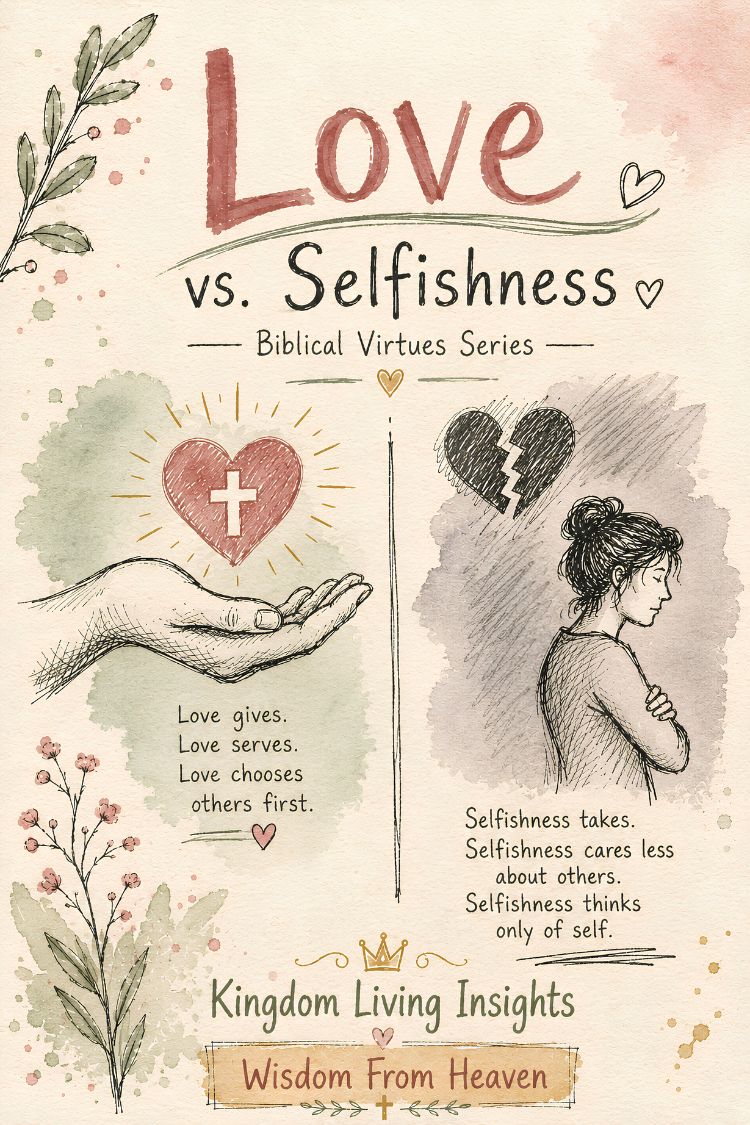
Love versus Selfishness

I chose love and selfishness for this next post because love is listed first as fruit of the Spirit, and selfishness is behind so much of the tension and hurt we experience every day.

When the Bible talks about love, it’s describing far more than a warm emotion. It’s a way of living that actively seeks the good of others, even when it’s inconvenient or costly. Selfishness does the opposite: it makes everything revolve around us – our plans, our comfort, our preferences – and quietly pushes God and other people to the edges.

The original languages of Scripture give us a richer picture of what love really is.

In Hebrew, the main word for love is ahavah (אַהֲבָה). It’s a broad word that can describe love for God, love for other people, and even romantic love. Another key Hebrew word is chesed (חֶסֶד), often translated as “loving-kindness” or “steadfast love.” This word carries the idea of loyal, covenant love – the kind of love God shows His people and never lets go of.

In Greek, there are several words for love, each with its own meaning:

  • Agape (ἀγάπη) is self-giving, unconditional love. It’s the love God has for us and the love He calls us to live out. This is the love described in 1 Corinthians 13.

  • Philia (φιλία) is the love between close friends – warm, loyal, and affectionate.

  • Storge (στοργή) is family love, the natural bond between parents and children or among siblings.

  • Eros (ἔρως) is romantic or passionate love. Although this word doesn’t appear in the New Testament, the Bible still honors love between husband and wife.

When the New Testament speaks of love as fruit of the Spirit, it’s primarily pointing to agape, the kind of love that gives without demanding anything back.

We see this spelled out in 1 Corinthians 13:4–7 (WEB): Love is patient and is kind. Love doesn’t envy. Love doesn’t brag, is not proud, doesn’t behave itself inappropriately, doesn’t seek its own way, is not provoked, takes no account of evil; doesn’t rejoice in unrighteousness, but rejoices with the truth; bears all things, believes all things, hopes all things, and endures all things.

That line – “doesn’t seek its own way” – is almost a direct opposite of selfishness. Selfishness is all about “my way.” Love asks, “How can I serve? What is best for the other person?”

Galatians 5:22–23 begins its list of the Spirit’s fruit with love: But the fruit of the Spirit is love, joy, peace, patience, kindness, goodness, faith, gentleness, and self-control. Against such things there is no law. This tells us that true love is not something we manufacture. It grows in us as we walk with the Holy Spirit and let Him shape our hearts.

Selfishness, on the other hand, shows up in many small, everyday ways: insisting on our own preferences, getting irritated when things don’t go our way, holding back help when it would cost us something, or using people for our own benefit. James 4:1–3 explains that fights and quarrels come from selfish desires battling within us, and that we often ask God for things with wrong motives, simply to spend them on our own pleasures.

1 John 3:17 gives a very direct challenge: But whoever has the world’s goods and sees his brother in need, then closes his heart of compassion against him, how does God’s love remain in him? If we see someone in need and turn away because we want to keep our time, money, or comfort for ourselves, that’s selfishness, not love.

The encouraging part is this: we don’t have to produce this kind of love on our own. As we spend time with God, read His Word, and yield to the Holy Spirit, He gradually forms agape love in us. Step by step, He teaches us to lay down selfishness and choose love in real, ordinary situations.

Love shows up in quiet, practical ways: listening without interrupting, serving without needing recognition, giving when it would be easier to keep, forgiving when we could hold a grudge, and putting others’ needs ahead of our own preferences.

Reflection question

Where do you notice selfishness showing up in your life right now – in your relationships, how you use your time and money, or even in your prayers? And where might God be inviting you to choose agape love instead?

Prayer

Heavenly Father, thank You for loving me first with Your agape love. I lay down my selfish desires before You. Teach me to love like Jesus: patiently, kindly, and without always seeking my own way. Let Your love flow through me to the people around me. In Jesus’ name, we pray. Amen.

If you have been blessed by this Kingdom Living Insights issue, please share it with others. Many thanks. God bless you!

Pin it!
kingdom living insights


Find more Kingdom Living Insights issues here

  1. Home
  2. /
  3. Blog
  4. /
  5. Kingdom Living Insights
  6. /
  7. Kingdom Living Insights –...


ABOUT OUR MINISTRY

We are a non-denominational Bible-believing Christian Ministry trained and equipped at the Christian Leaders Institute and Axx Bible College. Even though our Ministry is based on God's Word, the Bible, you need to approach our teachings like the Bereans and always study the Bible yourself to see if what we teach is aligned with what is written in the Bible.  

Now the Berean Jews were of more noble character than those in Thessalonica, for they received the message with great eagerness and examined the Scriptures every day to see if what Paul said was true. Acts 17:11 NIV  

We are only humans who 'stumble in many ways' (James 3:2) and we only 'know in part and we prophesy in part' (1 Corinthians 13:9).

wisdomfromheaven donation


LEGAL DISCLAIMER

The content provided on this blog is for educational and informational purposes only. The blog owner, Janet Giessl, also known under her anointed pen name Janetta Setherah, is a Certified Christian Life Coach and Ordained Minister with the Christian Leaders Alliance and holds degrees in Education and Christian Leadership, along with credentials in Bible, Ministry, Philosophy, and Theology. However, Janet is not a medical doctor, licensed therapist or health care professional. The information presented on this platform is not intended to treat, cure, diagnose, or prevent any disease. It is essential to understand that the content offered here is not a substitute for professional advice, whether medical, legal, financial, or from any other professional field.

Spiritual matters and personal well-being are deeply personal and can have profound effects on individuals. We strongly recommend seeking guidance from qualified professionals and prayerfully considering your own circumstances when making significant decisions in your life. The content on this blog is meant to offer insights and inspiration based on biblical principles, but it is not a replacement for professional assistance or personalized advice.

Always consult with appropriate professionals for your specific needs and circumstances.


NOTICE OF COPYRIGHT FOR QUOTING BIBLE VERSES FROM ESV

Scripture quotations are from the ESV® Bible (The Holy Bible, English Standard Version®), © 2001 by Crossway, a publishing ministry of Good News Publishers. ESV Text Edition: 2025. The ESV text may not be quoted in any publication made available to the public by a Creative Commons license. The ESV may not be translated in whole or in part into any other language. Used by permission. All rights reserved.

NOTICE OF COPYRIGHT FOR QUOTING BIBLE VERSES FROM WEB

The World English Bible (WEB) is a Public Domain (no copyright) Modern English translation of the Holy Bible. That means that you may freely copy it in any form, including electronic and print formats. The World English Bible is based on the American Standard Version of the Holy Bible first published in 1901, the Biblia Hebraica Stutgartensa Old Testament, and the Greek Majority Text New Testament. It is in draft form, and currently being edited for accuracy and readability.