Bible Passages
Matthew 21:23–27 (WEB)
When he had come into the temple, the chief priests and the elders of the people came to him as he was teaching, and said, “By what authority do you do these things? Who gave you this authority?”
Jesus answered them, “I also will ask you one question, which if you tell me, I likewise will tell you by what authority I do these things. The baptism of John — where was it from? From heaven or from men?”
They reasoned with themselves, saying, “If we say, ‘From heaven,’ he will ask us, ‘Why then did you not believe him?’ But if we say, ‘From men,’ we fear the multitude, for all hold John as a prophet.” So they answered Jesus and said, “We don’t know.”
He also said to them, “Neither will I tell you by what authority I do these things.”
Mark 11:27–33 (WEB)
They came again to Jerusalem, and as he was walking in the temple, the chief priests, the scribes, and the elders came to him, and they began saying to him, “By what authority do you do these things? Or who gave you this authority to do these things?”
Jesus said to them, “I will ask you one question. Answer me, and I will tell you by what authority I do these things. The baptism of John — was it from heaven, or from men? Answer me.”
They reasoned with themselves, saying, “If we say, ‘From heaven,’ he will say, ‘Why then did you not believe him?’ If we say, ‘From men'”— they feared the people, for all held John to really be a prophet. So they answered Jesus, “We don’t know.”
Jesus said to them, “Neither will I tell you by what authority I do these things.”
What Is Holy Tuesday?
Holy Tuesday is the third day of Holy Week. Jesus returned to the Temple in Jerusalem, and it became the most confrontational day of His public ministry. The religious leaders – the chief priests, the scribes, and the elders – came to Him while He was teaching and challenged His authority directly. What followed was a series of questions and exchanges that exposed the true condition of Israel’s religious leadership. The challenge about authority was the opening move, and the way Jesus handled it set the tone for everything that followed.
Devotional
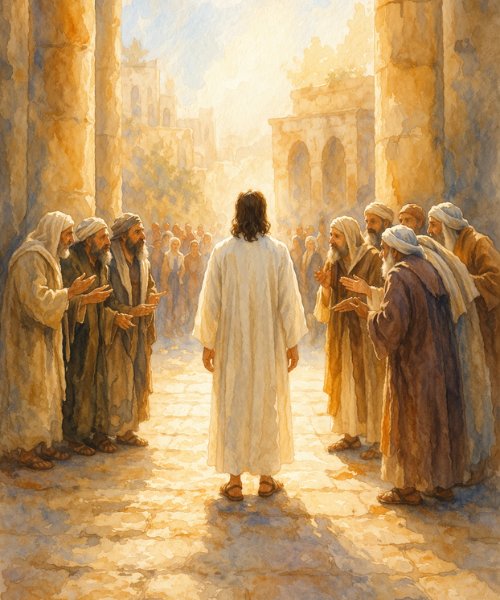
The religious leaders came to Jesus in the Temple with what sounded like a straightforward question. “By what authority do you do these things? Who gave you this authority?”
On the surface this looked like a reasonable inquiry. Jesus had entered Jerusalem to public acclaim two days earlier. The day before He had overturned the tables in the Temple courts. He was now back in the Temple, teaching. The chief priests, scribes, and elders were the recognized authorities over Temple life and Jewish religious practice. Questioning someone who was acting with what appeared to be prophetic or messianic authority was within their role.
But their question was not an honest one. They were not asking because they genuinely wanted to know where Jesus got His authority. They were asking because they wanted to discredit Him or trap Him. If He claimed divine authority they could charge Him with blasphemy. If He admitted to acting on His own authority they could dismiss Him as a self-appointed teacher with no legitimate standing. Either way they intended to use His answer against Him.
Jesus saw exactly what they were doing.
His response was not evasion. It was a counter-question that went straight to the heart of their problem. “The baptism of John – where was it from? From heaven or from men?”
This was a precise and deliberate question. John the Baptist had been widely recognized by the people of Israel as a true prophet. He had also specifically pointed to Jesus, identifying Him as the one who was coming after him – the one whose sandal he was not worthy to carry. If the religious leaders acknowledged that John’s baptism was from heaven, they would have to explain why they had not believed John’s testimony about Jesus. If they denied that John’s baptism was from heaven, they risked turning the crowd against them, because the people held John as a genuine prophet.
They were stuck. And they knew it.
They did not answer Jesus because they could not answer honestly without dismantling their own position. So they said “We don’t know.” And Jesus refused to answer their question.
This exchange reveals something important about how Jesus dealt with dishonest questioning. He did not owe an answer to people who were not genuinely seeking truth. They had already made up their minds about Him. Giving them an answer would only have given them ammunition. Jesus was not being evasive – He was being discerning. He understood that some questions are not really questions at all. They are traps dressed up as inquiries.
There is something deeper here as well. The religious leaders’ inability to answer Jesus’ question about John was not simply a political problem. It exposed a spiritual one. They had not believed John. They had not responded to his message of repentance. They had watched his ministry, evaluated it, and kept their distance. And now the one John had pointed to was standing in front of them, and they still would not commit to an honest answer.
Their question about authority was actually beside the point. The real issue was not what authority Jesus had. The real issue was that they had already refused the evidence God had placed in front of them. John had come preparing the way, calling Israel to repentance, pointing directly to Jesus. The chief priests and elders had ignored him. Now Jesus Himself was standing in their Temple, teaching and healing and cleansing the courts, and they were asking for credentials.
When people are not willing to respond to what God has already shown them, more information does not help. Jesus understood this. Giving them a direct answer about His authority would not have opened their eyes. It would only have given them something else to argue about. The problem was not a lack of information. The problem was a hardened heart.
This pattern appears throughout the Gospels. Jesus consistently engaged honest questions with full and generous answers. When genuine seekers came to Him – Nicodemus coming at night, the woman at the well, the disciples asking about prayer – He engaged them fully and openly. But when questions came from people whose minds were already closed, He often responded with a question of His own that exposed the real issue beneath the surface.
The religious leaders left the Temple that day without the answer they came for. But the question Jesus asked them did not go away. “The baptism of John — was it from heaven or from men?” Every person who encounters Jesus eventually has to answer a version of that question. Where does He come from? Who is He? What will you do with what God has already shown you?
Those are not questions Jesus forces an answer to. But they are questions that every honest heart has to face.
Reflection Questions
- The religious leaders’ question about authority was not honest – they were looking for a trap, not an answer. How do you approach Jesus with your own questions? Are they coming from genuine seeking or from a desire to maintain control?
- Jesus did not answer their question because they were not willing to answer His. Is there something God has already shown you that you have not yet honestly responded to?
- The religious leaders could not answer Jesus’ question about John without it costing them something. Is there a truth about Jesus that you find difficult to acknowledge because of what it would require of you?
- Jesus engaged genuine seekers openly and fully but did not give dishonest questioners the answer they wanted. What does this tell you about how He responds to the condition of the heart behind a question?
- The real problem of the religious leaders was not a lack of information – it was that they had not responded to what God had already given them. How does this challenge the way you think about your own spiritual life?
Prayer
Lord Jesus, You saw through the religious leaders’ question to what was really behind it. You see through ours too. Forgive us for the times we have approached You with questions that were not really about seeking truth – questions designed to keep You at a distance or to avoid what You have already made clear. Give us honest hearts. Where You have already shown us something and we have not responded, give us the courage to respond. We do not want to be people who ask the right questions for the wrong reasons. We want to be genuine seekers. Speak to us, Lord. We are listening. Amen.