Bible Passages
Mark 11:12–17 (WEB)
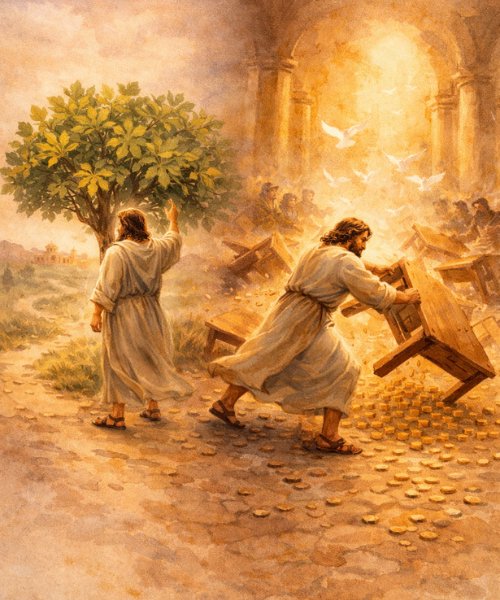
The next day, when they had come out from Bethany, he was hungry. Seeing a fig tree afar off having leaves, he came to see if perhaps he might find anything on it. When he came to it, he found nothing but leaves, for it was not the season for figs. Jesus told it, “May no one ever eat fruit from you again!” and his disciples heard it.
They came to Jerusalem, and Jesus entered into the temple, and began to throw out those who sold and those who bought in the temple, and overthrew the tables of the money changers, and the seats of those who sold the doves. He would not allow anyone to carry a container through the temple. He taught, saying to them, “Isn’t it written, ‘My house will be called a house of prayer for all the nations?’ But you have made it a den of robbers!”
Matthew 21:18–22 (WEB)
Now in the morning, as he returned to the city, he was hungry. Seeing a fig tree by the road, he came to it and found nothing on it but leaves. He said to it, “Let there be no fruit from you forever!” The fig tree immediately withered away. When the disciples saw it, they marveled, saying, “How did the fig tree immediately wither away?” Jesus answered them, “Most certainly I tell you, if you have faith and don’t doubt, you will not only do what was done to the fig tree, but even if you told this mountain, ‘Be taken up and cast into the sea,’ it would be done. All things, whatever you ask in prayer, believing, you will receive.”
Mark 11:22–25 (WEB)
Jesus answered them, “Have faith in God. Most certainly I tell you, whoever may tell this mountain, ‘Be taken up and cast into the sea,’ and doesn’t doubt in his heart, but believes that what he says is happening, he shall have whatever he says. Therefore I tell you, all things whatever you pray and ask for, believe that you have received them, and you shall have them. Whenever you stand praying, forgive, if you have anything against anyone; so that your Father, who is in heaven, may also forgive you your transgressions.”
What Is Holy Monday?
Holy Monday is the second day of Holy Week. Jesus and the disciples had spent the night in Bethany – a small village on the eastern slope of the Mount of Olives where He regularly stayed with Mary, Martha, and Lazarus. On the walk back into Jerusalem that morning, He cursed a fig tree. Then He walked into the Temple and overturned the money changers’ tables. The disciples witnessed both events without fully understanding either one. They were not connecting the dots yet. They were simply watching.
Devotional
The disciples did not understand what Jesus was doing that Monday morning.
They watched Him curse a fig tree on the side of the road. The tree had leaves but no fruit. Mark notes it was not even the season for figs. Jesus declared that no one would ever eat fruit from it again. The disciples heard Him say it and kept walking. No explanation was given and no one asked for one.
The next morning Peter noticed the tree had completely withered overnight. His response was not theological – it was simple amazement. “Rabbi, look! The fig tree you cursed has withered away.” Jesus used the moment to teach briefly about faith and prayer. He told them that genuine faith – faith without doubt – has real power in prayer. Mark adds one more detail: that prayer also requires a forgiving heart toward others. “Whenever you stand praying, forgive, if you have anything against anyone.” Mark 11:25 (WEB). Jesus was pointing His disciples toward what real, fruit-bearing faith looks like – not outward religious performance, but genuine trust in God paired with a clean heart. That understanding would deepen after the resurrection when the Holy Spirit helped them piece together everything they had witnessed.
To understand what Jesus was doing with the fig tree itself, we need to look at how it is used throughout the Hebrew Scriptures. The fig tree was a specific and consistent symbol for the nation of Israel and her covenant relationship with God. When the prophets wanted to speak about Israel’s spiritual condition – her faithfulness or her failure before God – they used the the fig tree as a symbol.
Jeremiah 24 records God showing the prophet two baskets of figs placed before the Temple. The good figs represented the faithful remnant of Israel. The bad figs represented those who had turned away from God. In Hosea 9:10 God says: “I found Israel like grapes in the wilderness. I saw your fathers as the first ripe figs in the fig tree at its first season.” Joel 1:7 describes God’s judgment on Israel using the image of a fig tree stripped bare. In Micah 4:4 the restoration of Israel is pictured as every person sitting under their own vine and fig tree. The connection between the fig tree and the nation of Israel runs consistently through the prophetic books.
So when Jesus approached that fig tree covered in leaves and found nothing growing on it, He was not simply responding to a tree. He was enacting a prophetic statement about Israel. The tree looked like it should have fruit. It was full of leaves – all the outward signs were there. But when He came close enough to look, there was nothing. That gap between appearance and reality was exactly what He was about to confront in the Temple.
Jesus had strong words for religious hypocrisy throughout His ministry. In Matthew 23 He rebuked the scribes and Pharisees directly, calling them out for doing everything for outward show while neglecting what actually mattered to God. He said: “Woe to you, scribes and Pharisees, hypocrites! For you are like whitened tombs, which outwardly appear beautiful, but inwardly are full of dead men’s bones and of all uncleanness.” Matthew 23:27 (WEB). This was not a minor concern for Jesus. He returned to it repeatedly because it represented one of the most serious dangers in religious life – looking right before others while being unchanged before God.
The fig tree was a living picture of exactly this. Leaves without fruit. Outward religious appearance without the inner reality to match it.
The Temple that morning was full of activity. It was Passover week and Jerusalem was packed. Jewish communities from Egypt, Mesopotamia, Rome, and across the diaspora had traveled to Jerusalem to fulfill the Torah’s requirement to appear before God at the appointed feasts. The city normally held around eighty thousand people but during Passover it hosted several hundred thousand. The Temple was the center of everything.
Herod’s Temple was one of the great structures of the ancient world. The Temple complex was organized in a series of courts moving inward toward the Holy of Holies. The Court of the Gentiles was the outermost court and the only area where non-Jews could legally enter. It was specifically designed as the place where people outside Israel’s covenant could come to seek God and pray. This was not an afterthought. It was intentional. God’s plan had always included the nations. Isaiah 56:7 made this clear: “My house will be called a house of prayer for all nations.” The Temple was meant to be a place where any person, Jew or Gentile, could draw near to God.
That court had become a marketplace.
Money changers set up tables there because Roman coins bearing Caesar’s image were considered idolatrous and could not be used to pay the Temple tax. Pilgrims needed to exchange their foreign currency for Tyrian shekels. Animal merchants were there because sacrificial animals had to meet strict purity standards and purchasing an approved animal on-site was more practical than traveling with one. The priestly leadership had approved the whole arrangement. There were reasonable, practical justifications for all of it.
But what had been approved as a practical accommodation had grown into something that directly harmed the people the Court of the Gentiles was designed to serve. The noise, the crowds, the buying and selling, the movement of animals and money – all of it had filled the one space in the entire Temple complex where a non-Jewish person could come to worship God. A God-fearer from Rome or Alexandria who had traveled weeks to stand quietly before the God of Israel arrived at the Temple and found no room to do so. The space meant to welcome them had been taken from them. They had been effectively shut out, not by official decree but by the practical reality of what that court had become.
This is what made Jesus angry. It was not simply that commerce was happening in a holy place. It was that the religious establishment had allowed and profited from a system that made it harder for people to reach God. The ones being turned away were the very people Isaiah’s prophecy had promised a place to. The house of prayer for all nations had stopped functioning as one.
When Jesus overturned the tables He quoted two prophets. First Isaiah 56:7, “My house will be called a house of prayer for all nations.” He was standing in the Court of the Gentiles when He quoted it, making the point impossible to miss. The very space Isaiah’s prophecy had described as a place of prayer for all nations had been turned into a commercial exchange. Then He quoted Jeremiah 7:11, “den of robbers.” That phrase would have landed hard on everyone listening. Jeremiah 7 was one of the most well-known prophetic indictments of the Temple in all of Israel’s Scriptures, a passage where God warned Israel not to trust in the physical building while their covenant life had emptied out. Jesus was not making a new accusation. He was pointing to words the religious leaders already knew and showing them that what Jeremiah had warned about had come to pass in their own generation.
The Temple had become the very thing Jeremiah had warned about, a place where people took comfort in religious infrastructure while the substance of their covenant life with God had drained away. The priests and religious leaders were maintaining a system. They were not cultivating a living relationship with God or serving the people that system was meant to reach.
Mark deliberately frames the Temple cleansing between the two fig tree moments – the cursing on the way in and the withered tree discovered on the way back. This is intentional. The two events were not separate. They were one statement. Israel, represented by the fig tree, was full of religious appearance but not producing the fruit God required. The Temple, which was meant to be the heart of Israel’s covenant life and a house of prayer for all nations, had become an obstacle to the very people it was meant to welcome. Same problem. Two locations. One indictment.
The disciples did not connect these things at the time. They were witnesses before they were interpreters. That is often how it works. God is patient with the process. The meaning came later.
This is not only Israel’s story. It becomes a question for every believer. Jesus is consistent on this point throughout the Gospels – He is not impressed by outward religious performance. He looks at what is actually growing. It is possible to attend church faithfully, use the right vocabulary, serve in ministry, and know correct doctrine, while the inner life before God remains shallow or unchanged. That is the condition the fig tree represents. That is what Jesus walked toward and would not leave alone.
The fruit God looks for is not more religious activity. In John 15:4-5 Jesus says: “Remain in me, and I in you. As the branch can’t bear fruit by itself unless it remains in the vine, so neither can you, unless you remain in me. I am the vine. You are the branches. He who remains in me and I in him bears much fruit, for apart from me you can do nothing.” The fruit comes from genuine connection to Him – not from maintaining the appearance of that connection.
Reflection Questions
- The fig tree was a consistent biblical symbol for the nation of Israel. Knowing that, how does the cursing of the fig tree change the weight of what Jesus was doing that Monday morning?
- Jesus was angry that the religious establishment had turned the Court of the Gentiles into a marketplace, making it difficult for non-Jews to worship God. Are there ways today – in churches or in our own lives – where religious systems or habits make it harder rather than easier for people to reach God?
- Jesus connected effective prayer to a forgiving heart. Is there anyone you are holding unforgiveness toward that may be affecting your prayer life?
- The Temple system drifted into its compromised state through practical, reasonable decisions made over time. How do you guard against that kind of gradual drift in your own walk with God?
- Jesus is not interested in outward religious performance. He looks at what is actually growing on the inside. What does genuine, fruit-bearing faith look like in your daily life?
Prayer
Lord Jesus, You were angry when religion got in the way of people reaching God. You overturned the tables. You quoted the prophets. You would not allow a system built in Your Father’s name to shut out the very people it was meant to serve. Forgive us for the ways we have done the same – building religious habits and structures that look right on the outside while the inside has gone unchanged. Search us honestly. Where we have substituted performance for genuine relationship with You, convict us. Where we are holding unforgiveness that is blocking our prayers, show us and give us the grace to let it go. Teach us what it means to remain in You – not just to look like we do. Grow in us the fruit that only comes from genuine connection to You. Amen.