Bible Passages
Matthew 26:6–16 (WEB)
Now when Jesus was in Bethany, in the house of Simon the leper, a woman came to him having an alabaster jar of very expensive ointment, and she poured it on his head as he sat at the table. But when his disciples saw this, they were indignant, saying, “Why this waste? For this ointment might have been sold for much, and given to the poor.” But Jesus, knowing this, said to them, “Why do you trouble the woman? For she has done a good work for me. For you always have the poor with you, but you don’t always have me. For in pouring this ointment on my body, she did it to prepare me for burial. Most certainly I tell you, wherever this Good News is preached in the whole world, what this woman has done will also be spoken of as a memorial of her.” Then one of the twelve, who was called Judas Iscariot, went to the chief priests and said, “What are you willing to give me to deliver him to you?” They weighed out for him thirty pieces of silver. From that time he sought opportunity to betray him.
Mark 14:3–11 (WEB)
While he was at Bethany, in the house of Simon the leper, as he sat at the table, a woman came having an alabaster jar of ointment of pure nard — very costly. She broke the jar and poured it over his head. But there were some who were indignant among themselves, saying, “Why has this ointment been wasted? For this ointment might have been sold for more than three hundred denarii, and given to the poor.” So they grumbled against her. But Jesus said, “Leave her alone. Why do you trouble her? She has done a good work for me. For you always have the poor with you, and whenever you want to, you can do them good; but you will not always have me. She has done what she could. She has anointed my body beforehand for the burial. Most certainly I tell you, wherever this Good News may be preached throughout the whole world, that which this woman has done will also be spoken of for a memorial of her.” Judas Iscariot, who was one of the twelve, went away to the chief priests, that he might deliver him to them.
Luke 22:3–6 (WEB)
Satan entered into Judas, who was surnamed Iscariot, who was numbered with the twelve. He went away and talked with the chief priests and captains about how he might deliver him to them. They were glad and agreed to give him money. He consented and sought an opportunity to deliver him to them in the absence of the multitude.
What Is Holy Wednesday?
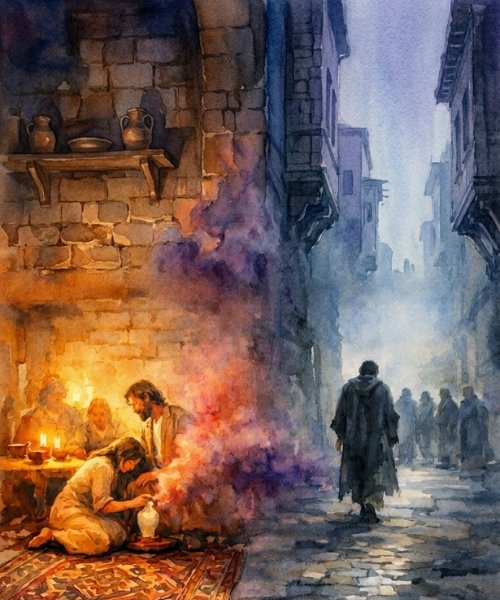
Holy Wednesday is the fourth day of Holy Week. It is sometimes called Spy Wednesday because it is the day Judas Iscariot went to the chief priests to arrange the betrayal of Jesus. The Gospels place this event in close connection with the anointing at Bethany – a moment of extraordinary devotion that stands in sharp contrast to what Judas did immediately after. Together these two events sit at the center of Holy Week as a picture of two completely different responses to Jesus.
Devotional
Two things happened in close succession on Holy Wednesday that could not be more different from each other.
In Bethany, a woman broke open an alabaster jar of pure nard, an expensive perfume worth roughly a year’s wages, and poured it over Jesus’ head. It was an extravagant, sacrificial act of devotion. The disciples reacted with indignation. They saw waste. Jesus saw worship. He told them she had done a beautiful thing and that she had anointed His body for burial. He said that wherever the Gospel would be preached in the whole world, what she had done would be remembered.
Then Judas left and went to the chief priests to arrange a price for handing Jesus over.
Matthew places these two accounts side by side deliberately. The contrast is stark. In one house a woman gave everything she had to honor Jesus. In the same night one of His own twelve went to His enemies to sell Him.
To understand what Judas did we need to understand who he was. He was not an outsider or a casual follower. He was one of the twelve disciples – the inner circle that had walked with Jesus through His entire ministry. He had heard every teaching. He had witnessed every miracle. He had been sent out with the others to preach the Kingdom and heal the sick. He had been trusted with the group’s finances as their treasurer. He was present at every significant moment of Jesus’ ministry.
And yet he went to the chief priests and asked what they were willing to pay.
They offered him thirty pieces of silver. This was not a large sum. It was the price set in the Old Testament law for a gored slave – the compensation paid when a slave was accidentally killed. Exodus 21:32 specifies this amount. Zechariah 11:12-13 also uses the same figure in a passage describing the valuing of a shepherd – calling it the price they set on him, a paltry sum. Judas agreed to it. From that point he began looking for the right moment to hand Jesus over quietly, away from the crowds.
Luke adds a detail the other Gospel writers do not include. He says that Satan entered Judas before he went to the chief priests. This is a significant statement. It does not remove Judas’s responsibility for what he did – Luke is clear that Judas made the choice, went to the chief priests, and agreed to the arrangement. But it shows that something more was at work than simply a man making a bad decision for money. Judas had opened a door, and the enemy had walked through it.
The Scriptures do not tell us exactly what brought Judas to this point. Various explanations have been offered over the centuries – greed, disappointment that Jesus was not the political messiah he expected, disillusionment, or some combination of these. John’s Gospel notes that Judas had been stealing from the common purse for some time, which shows that whatever his outward role among the disciples, something had been wrong in his heart for a while. The betrayal did not come from nowhere. It was the visible end of a process that had been developing quietly.
This is one of the most sobering aspects of Holy Wednesday. Judas did not start out as a traitor. He started out as a disciple. He was called by Jesus, walked with Jesus, and served alongside the others. The deterioration of his heart happened gradually and invisibly until it reached the point where he was willing to hand Jesus over for thirty pieces of silver.
The woman who poured out the perfume is not named in Matthew or Mark. Judas is named in every account. She is remembered for her devotion. He is remembered for his betrayal. Both were in the presence of Jesus. Both had to decide what He was worth to them.
That is the question Holy Wednesday places in front of every believer. Not in a dramatic or theatrical sense, but in the ordinary, daily sense. What is Jesus worth to you? Not what you say He is worth – but what your choices, your priorities, and the condition of your heart actually show He is worth.
The woman broke her most valuable possession and gave it all. Judas put a price on the one he called Rabbi and walked away with thirty coins.
Reflection Questions
- The woman’s extravagant act of devotion stood in direct contrast to Judas’s betrayal. What does genuine devotion to Jesus look like in your own life – not in dramatic gestures but in the everyday choices you make?
- Judas had been with Jesus throughout His entire ministry and still arrived at this point. How does this challenge any assumption that proximity to religious life or knowledge of Scripture is enough to protect a person’s heart?
- Luke says Satan entered Judas before he went to the chief priests. Judas still made the choice. What does this tell you about the relationship between spiritual vulnerability and personal responsibility?
- The deterioration of Judas’s heart happened gradually over time. What habits or practices help you guard the condition of your own heart before God?
- Both the woman and Judas had to decide what Jesus was worth to them. How would you honestly answer that question for yourself today?
Prayer
Lord Jesus, Holy Wednesday is a sobering day. A woman gave everything she had to honor You, and one of Your own twelve put a price on Your life and walked away. Both had been in Your presence. Both made a choice. Search our hearts, Lord. Show us honestly what we believe You are worth, not by what we say but by how we live, what we prioritize, and what we are willing to give up for You. Guard us against the kind of gradual drift that took Judas from disciple to betrayer. Keep us close to You, not just in knowledge or in religious activity, but in genuine devotion. You are worth more than we can give. Help us to give what we can, and mean it. Amen.