Bible Passages
Zechariah 9:9 (WEB)
“Rejoice greatly, daughter of Zion! Shout, daughter of Jerusalem! Behold, your King comes to you! He is righteous, and having salvation; lowly, and riding on a donkey, even on a colt, the foal of a donkey.”
Matthew 21:1–9 (WEB)
When they drew near to Jerusalem and came to Bethphage, to the Mount of Olives, then Jesus sent two disciples, saying to them, “Go into the village that is opposite you, and immediately you will find a donkey tied, and a colt with her. Untie them and bring them to me. If anyone says anything to you, you shall say, ‘The Lord needs them,’ and immediately he will send them.”
This happened that it might be fulfilled which was spoken through the prophet, saying, “Tell the daughter of Zion, behold, your King comes to you, humble, and riding on a donkey, on a colt, the foal of a donkey.”
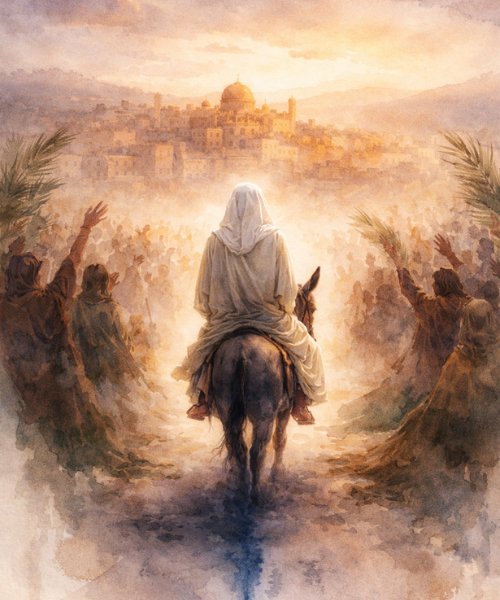
The disciples went and did just as Jesus commanded them, and brought the donkey and the colt and put their clothes on them; and he sat on them. A very great multitude spread their clothes on the road. Others cut branches from the trees and spread them on the road. The multitudes who went before him, and those who followed, kept shouting, “Hosanna to the son of David! Blessed is he who comes in the name of the Lord! Hosanna in the highest!”
Luke 19:41–44 (WEB)
When he drew near, he saw the city and wept over it, saying, “If you, even you, had known today the things which belong to your peace! But now they are hidden from your eyes. For the days will come on you when your enemies will throw up a barricade against you, surround you, hem you in on every side, and will dash you to the ground — you and your children within you. They will not leave in you one stone on another, because you didn’t know the time of your visitation.”
What Is Palm Sunday?
Palm Sunday opens Holy Week – the final and most consequential week of Jesus’ earthly ministry. It marks the day Jesus rode into Jerusalem on a donkey, fulfilling Zechariah’s five-hundred-year-old prophecy of a King arriving not in conquest but in humility. The crowds threw down cloaks and palm branches – a red-carpet welcome fit for a liberating hero – and filled the air with shouts of “Hosanna,” meaning “Save us now.” But Luke’s Gospel records something the other accounts leave us to feel between the lines: in the middle of all that celebration, Jesus wept. The most acclaimed moment of His public ministry was, for Him, one of the most grievous.
Devotional
There were two processions entering Jerusalem that day.
One came from the east – a rabbi on a borrowed donkey, surrounded by fishermen and former tax collectors, welcomed by ordinary people waving branches cut from roadside trees. The other, historians suggest, came from the west – Pontius Pilate riding into the city with Roman cavalry, iron armor gleaming, war standards raised, a show of imperial force meant to remind Jewish pilgrims during Passover exactly who was in charge.
Two kings. Two processions. One city that didn’t fully recognize either one for what he was.
And the difference between them was announced before a single word was spoken – by the animal beneath each one.
In the ancient world, the horse was the animal of war. Kings rode horses into battle. Generals processed through conquered cities on horseback. The horse announced power, dominance, and the threat of violence. When a king entered a city on a horse, the message was unmistakable: I have conquered. Submit.
The donkey said something entirely different.
In the ancient Near East, the donkey was the animal of peace. When a king rode a donkey, it signaled that he came not to make war but to make peace – not to take from the people but to serve them. Solomon rode a donkey to his own coronation. Donkeys carried the burdens of ordinary families. They were the animal of the humble, the working, the everyday. There was nothing threatening about a donkey. There was nothing imperial about one either. Jesus chose it deliberately, and every person in that crowd who knew their Scripture understood exactly what He was saying before He opened His mouth.
But Matthew records a detail that most readers pass over: Jesus asked for both the donkey and the colt – the young foal, an animal that had never been ridden. An unbroken colt surrounded by a roaring crowd should have been impossible to manage. Yet in the presence of Jesus, this untrained animal carried the King of Kings through the noise and chaos without panic or rebellion. Creation itself submitted to its Creator. The colt that by every natural instinct should have bucked became still in the hands of the One who spoke the world into being.
There is a word in that colt for every believer. We come to Jesus unbroken in the wrong sense – untamed by grace, unfamiliar with surrender, easily spooked by the noise of the world. And yet He calls for us specifically. He says, in effect, “Go get that one – the one that has never been under a yoke, the one that seems unready. Bring it to me.” And when He takes the reins of a life, something impossible happens: the untamed becomes willing. Not by force, but by presence.
But here is what stops everything: when Jesus crested the Mount of Olives and Jerusalem came into full view – the gleaming Temple, the crowded streets, the city dressed for Passover – He didn’t raise His hand in triumph. He wept.
Not quiet tears. The Greek word Luke uses, eklaisen, means He wept aloud – the kind of broken, heaving grief that cannot be contained or composed. The crowd was still shouting Hosanna. Palm branches were still flying. And the one at the center of the celebration was in the grip of lamentation.
This was not sentiment. This was not a passing sorrow quickly overcome by the warmth of the crowd’s welcome. What Jesus expressed at that moment was the grief of a prophet who sees with devastating clarity what others cannot see at all. He was lamenting – mourning in the deep, biblical sense of the Word – over what was coming upon this city and its people.
He spoke it plainly: “The days will come on you when your enemies will throw up a barricade against you, surround you, hem you in on every side, and will dash you to the ground — you and your children within you. They will not leave in you one stone on another.”
This was not a vague warning. It was a precise prophecy. In 70 AD, Roman General Titus encircled Jerusalem exactly as Jesus described – the city was besieged, its population trapped, its Temple dismantled stone by stone until nothing of it remained standing. Josephus, the Jewish historian who witnessed it, recorded the devastation in harrowing detail. Jesus saw all of it from the Mount of Olives while the crowd below was still celebrating His arrival.
That is what He was weeping over. Not His own suffering ahead. Not the cross that awaited Him at the end of the week. He was lamenting the fate of a city and a people who had reached the moment of their visitation and would not recognize it. “If you, even you, had known today the things which belong to your peace — but now they are hidden from your eyes.” The window was closing. The hour was at hand. And they were waving palm branches.
The crowd’s Hosanna and Jesus’ lamentation occupied the same moment. The celebration was real. The grief was real. And they had almost nothing to do with one another because the crowd and their King were not seeing the same thing at all.
This is what makes Palm Sunday far more than a triumphal entry. It is a day of profound and terrible irony – the King arriving to save a people who did not understand what they needed saving from, mourning the judgment that their own blindness would bring upon them, riding forward into a week that would cost Him everything, while they celebrated a victory they had entirely misread.
Reflection Questions
- Jesus wept a lamentation over Jerusalem’s coming destruction even as the crowd celebrated around Him. What does it mean that He could see with such clarity what they could not? How does that change the way you read this passage?
- The crowd was sincere in their praise but entirely blind to the moment they were standing in. Is it possible to worship genuinely and still miss what God is actually doing? What safeguards against that kind of blindness?
- Jesus mourned not His own suffering but the judgment coming upon others. What does that kind of grief look like in the life of a believer today?
- The city did not recognize “the time of its visitation.” What does it mean to recognize a moment of divine visitation and what does it cost to miss one?
- He rode toward Jerusalem knowing what was ahead for the city and for Himself. What does it mean to you that He did not turn back?
Prayer
Lord Jesus, on this Palm Sunday we are sobered by what we find in this passage. You did not ride into Jerusalem swept up in the celebration – You rode in with a lament forming in Your chest and a prophecy on Your lips. You saw the destruction coming and You mourned it, even as the palms waved and the Hosannas rang out around You. Forgive us for the times we have celebrated what we do not understand and missed the weight of the moments we were standing in. Give us eyes to see what You see. Give us hearts that can grieve what grieves You. And give us the sobriety to recognize when You are moving in our midst, so that we do not stand at the edge of our own visitation waving branches at what we have imagined while missing entirely what You have come to do. Hosanna, Lord – but teach us what we are asking for. Amen.