Bible Passages
John 13:1–15 (WEB)
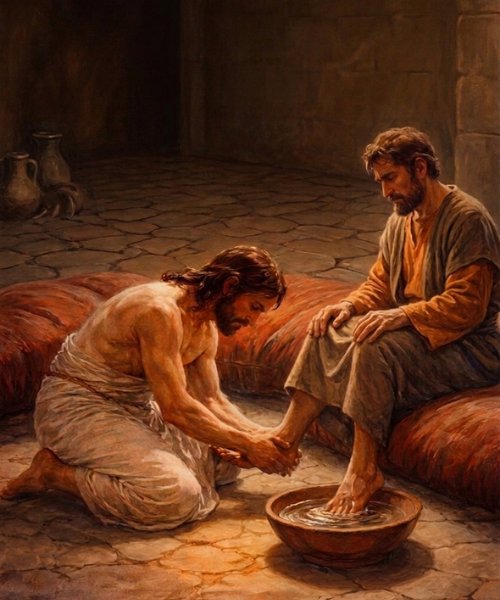
Now before the feast of the Passover, Jesus, knowing that his time had come that he would depart from this world to the Father, having loved his own who were in the world, he loved them to the end. During supper, the devil having already put into the heart of Judas Iscariot, Simon’s son, to betray him, Jesus, knowing that the Father had given all things into his hands, and that he came from God and was going to God, arose from supper, and laid aside his outer garments. He took a towel and wrapped a towel around his waist. Then he poured water into the basin, and began to wash the disciples’ feet and to wipe them with the towel that was wrapped around him.
Then he came to Simon Peter. Peter said to him, “Lord, do you wash my feet?” Jesus answered him, “You don’t know what I am doing now, but you will understand later.” Peter said to him, “You will never wash my feet!” Jesus answered him, “If I don’t wash you, you have no part with me.” Simon Peter said to him, “Lord, not my feet only, but also my hands and my head!” Jesus said to him, “Someone who has bathed only needs to have his feet washed, but is completely clean. You are clean, but not all of you.” For he knew him who would betray him, therefore he said, “You are not all clean.”
So when he had washed their feet, put his outer garments back on, and sat down again, he said to them, “Do you know what I have done to you? You call me, ‘Teacher’ and ‘Lord.’ You say so correctly, for so I am. If I then, the Lord and the Teacher, have washed your feet, you also ought to wash one another’s feet. For I have given you an example, that you also should do as I have done to you.”
Luke 22:14–20 (WEB)
When the hour had come, he sat down with the twelve apostles. He said to them, “I have earnestly desired to eat this Passover with you before I suffer, for I tell you, I will no longer by any means eat of it until it is fulfilled in God’s Kingdom.” He received a cup, and when he had given thanks, he said, “Take this and share it among yourselves, for I tell you, I will not drink at all again from the fruit of the vine, until God’s Kingdom comes.” He took bread, and when he had given thanks, he broke it and gave it to them, saying, “This is my body, which is given for you. Do this in memory of me.” Likewise, he took the cup after supper, saying, “This cup is the new covenant in my blood, which is poured out for you.”
John 13:34–35 (WEB)
“A new commandment I give to you, that you love one another. Just as I have loved you, you also love one another. By this everyone will know that you are my disciples, if you have love for one another.”
What Is Maundy Thursday?
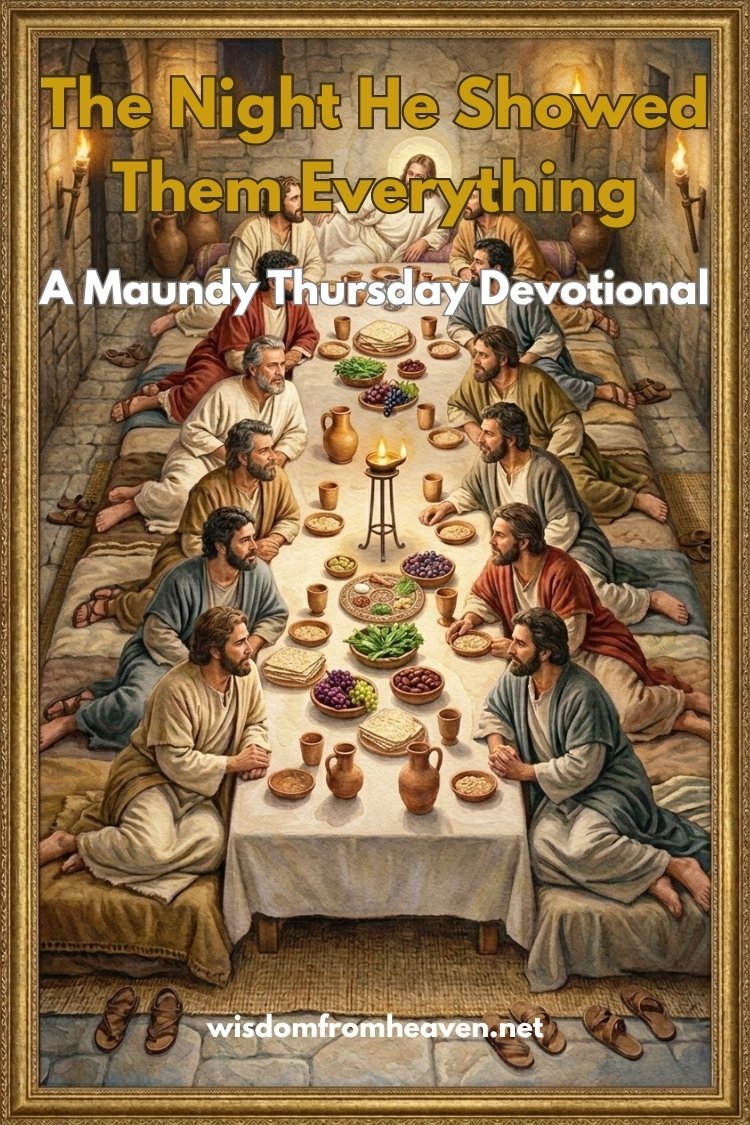
Maundy Thursday is the fifth day of Holy Week. It marks the night of the Last Supper – the final meal Jesus shared with His disciples before His arrest and crucifixion. The word Maundy comes from the Latin word mandatum, meaning commandment, referring to the new commandment Jesus gave His disciples that night. Three significant things happened in the upper room: Jesus washed His disciples’ feet, He instituted what we now call Communion or the Lord’s Supper, and He gave them a new commandment to love one another. Together these three acts form a complete picture of what life in His Kingdom is meant to look like.
Devotional
The Last Supper was a Passover meal.
This is important to understand. Passover, Pesach in Hebrew, was the most significant annual feast in the Jewish calendar. It commemorated the night God delivered Israel out of Egypt, when the blood of a lamb was placed on the doorposts of Israelite homes so that the angel of death would pass over them. Every element of the Passover meal carried meaning rooted in that story – the lamb, the unleavened bread, the bitter herbs, the cups of wine. The disciples gathered that evening knowing exactly what they were celebrating. They had observed Passover every year of their lives.
What they did not yet know was that the Passover was about to be fulfilled in the one sitting at the table with them.
Jesus knew. John tells us that He knew His hour had come, that He was going to the Father, and that the Father had placed all things in His hands. He knew Judas would betray Him that night. He knew Peter would deny Him before morning. He knew what was waiting for Him in the hours ahead. And knowing all of this, He got up from the table, wrapped a towel around His waist, and began to wash His disciples’ feet.
Foot washing in the first century was the work of the lowest household servant. Roads were unpaved and dusty. People wore sandals. Feet were dirty. When guests arrived at a home it was common for a servant to wash their feet. It was not a task anyone of higher standing would do voluntarily. The disciples would have understood immediately what Jesus was doing, and Peter’s reaction shows exactly how startling it was. “Lord, do you wash my feet?” The question carried the weight of everything that was wrong with the picture. This was their Rabbi, their Teacher, the one they had come to believe was the Messiah. And He was kneeling on the floor with a basin and a towel.
Jesus told Peter that he did not yet understand what was happening but that he would understand later. Then He told all of them why He had done it. He was giving them an example. If He, their Lord and Teacher, had washed their feet, they were to wash one another’s feet. The one with the greatest authority in the room had taken the lowest position. That was not an accident or a gesture of sentiment. It was a direct teaching about how the Kingdom of God operates. In this Kingdom the measure of greatness is not rank or position or authority. It is service.
After the foot washing they continued the Passover meal. When they came to the bread Jesus took it, broke it, gave thanks, and handed it to them saying: “This is my body, which is given for you. Do this in memory of me.” Then He took the cup and said: “This cup is the new covenant in my blood, which is poured out for you.”
Every word of this was loaded with meaning for a Jewish audience. The Passover meal was built around the story of deliverance through the blood of a lamb. Jesus was now reframing the entire meal around Himself. The bread was His body – given, broken. The cup was His blood – poured out – establishing a new covenant. The word covenant was not casual language. In the Hebrew Scriptures a covenant was a binding agreement between God and His people, sealed in blood. God had made covenants with Noah, with Abraham, with Moses at Sinai. Each one was a defining moment in Israel’s relationship with God. Jesus was announcing a new one, not written on stone tablets but sealed in His own blood, establishing a permanent and personal relationship between God and every person who would believe.
The disciples did not fully understand this yet. They were still inside the Passover meal, still processing what Jesus had just done with the basin and the towel. The full meaning of the bread and the cup would only become clear after the cross and the resurrection.
Then Jesus gave them the new commandment. “Love one another. Just as I have loved you, you also love one another. By this everyone will know that you are my disciples, if you have love for one another.”
The word Maundy comes directly from this moment. The commandment to love was not new in the sense that it had never been said before. Leviticus 19:18 already commanded love for your neighbor. What was new was the standard. Not love your neighbor as yourself. Love one another as I have loved you. Jesus had just washed their feet. He was about to lay down His life. That was the measure He was setting. And He told them that this love – visible, active, sacrificial love for one another – would be the thing that identified them to the world as His disciples. Not their theology. Not their religious practice. Their love.
These three things – the foot washing, the Communion, the new commandment – were not separate teachings. They were one complete picture. Jesus showed them what servant leadership looks like. He showed them what His sacrifice meant and gave them a way to remember it. And He told them how to live in light of it. The towel, the bread and cup, and the commandment to love all point in the same direction – toward a Kingdom that operates entirely differently from the world, where the greatest serves, where covenant is sealed in sacrifice, and where love is not a feeling but a way of life visible enough for the whole world to see.
Reflection Questions
- Jesus washed His disciples’ feet knowing exactly what the night ahead held for Him. What does it tell you about His character that His response to knowing all of this was to serve?
- Peter resisted having his feet washed. Are there areas of your life where you find it difficult to receive from Jesus – to accept His grace, His forgiveness, or His care?
- Jesus reframed the entire Passover meal around Himself. What does it mean to you personally that the new covenant is sealed in His blood – that your relationship with God is not based on your performance but on what He has done?
- The new commandment set the standard of love at “as I have loved you.” How does that standard challenge the way you love the people around you?
- Jesus said the world would recognize His disciples by their love for one another. Looking honestly at the church today and at your own life. Is that what the world sees?
Prayer
Lord Jesus, on the night You knew You would be betrayed You got down on Your knees and washed Your disciples’ feet. You broke the bread and passed the cup and told them to remember You. You gave them a commandment to love the way You loved. Everything You did that night pointed toward the cross and toward the kind of Kingdom You were building – one built on service, on sacrifice, and on love that costs something. Teach us to live in light of what You did in that upper room. Where we have made faith about rank or performance or appearance, correct us. Where we have kept love small and safe, stretch us. And when we take the bread and the cup, help us to truly remember – not just as a ritual but as a genuine encounter with what You gave for us. Amen.