- Home
- /
- Blog
- /
- Kingdom Living Insights
- /
- Kingdom Living Insights –...
This site includes links from a number of different display ads/affiliate programs. When you click on a link and make a purchase, we may earn a commission. Please be aware that some of the display ads may not be appropriate for Christians.
Kingdom Devotional – Does the Bible Teach That Women Should Primarily Care for Children and Household Chores?

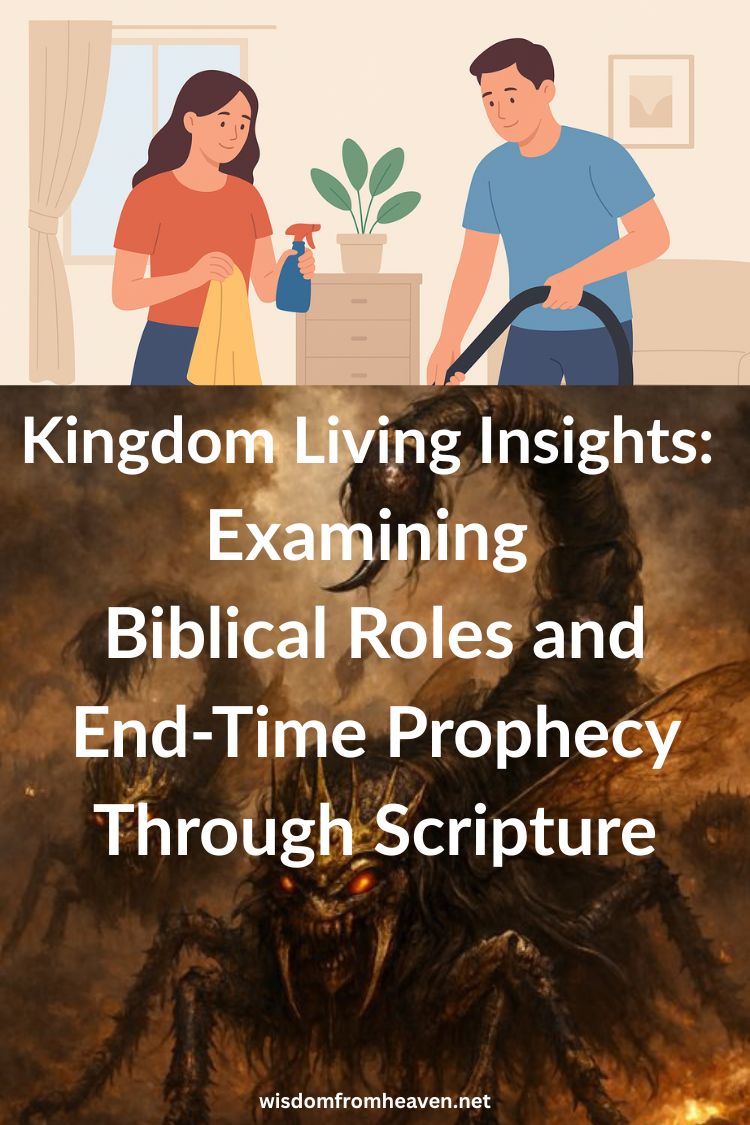
End Times Series – Part 14: The Woe Trumpets and the Unrepentant Heart

Revelation 9 is where judgment turns personal.
Up to this point, creation has been struck.
Now humanity itself is directly targeted.
This chapter covers the fifth and sixth trumpets, also called the first and second woes. What unfolds is not random destruction but restrained, purposeful judgment meant to expose what lives in the human heart when pressure reaches its peak.
The Fifth Trumpet: The First Woe
Revelation 9:1–2 ESV
“I saw a star fallen from heaven to earth, and he was given the key to the shaft of the bottomless pit.”
This is not a literal star. The language points to a being. A fallen one. He is given authority temporarily. Even here, nothing happens without permission.
When the pit is opened, smoke pours out like a furnace. The sun and air are darkened. What was hidden is now released.
The Locusts from the Abyss
Revelation 9:3–5 ESV
“Then from the smoke came locusts on the earth, and they were given power like the power of scorpions… They were told not to harm the grass… but only those people who do not have the seal of God on their foreheads.”
This detail is critical.
• These are not natural locusts
• They do not consume vegetation
• They do not kill
• They target people without God’s seal
This again confirms that God knows exactly who belongs to Him.
Their torment lasts five months. The pain is so intense that people seek death but cannot find it.
Revelation 9:6 ESV
“In those days people will seek death and will not find it.”
This is judgment that strips away false security without offering escape through death.
Their Appearance and Meaning
Revelation gives a terrifying description: crowns like gold, human faces, hair like women, teeth like lions, iron breastplates, wings that sound like chariots.
This imagery communicates dominance, intelligence, ferocity, and relentless movement. These beings are not symbolic of ordinary warfare or disease. They are supernatural instruments of judgment.
Their king is named.
Revelation 9:11 ESV
“They have as king over them the angel of the bottomless pit. His name in Hebrew is Abaddon, and in Greek he is called Apollyon.”
Both names mean Destroyer.
Even chaos has structure.
Even destruction has limits.
Even demons operate under command.
The Sixth Trumpet: The Second Woe
Revelation 9:13–15 ESV
“Release the four angels who are bound at the great river Euphrates.”
These are not the same angels from Revelation 7. These are bound, restrained, waiting for an appointed hour, day, month, and year.
Timing matters to God.
They lead an army numbering two hundred million released to kill a third of mankind. Whether literal, symbolic, or a combination, the scale is overwhelming.
Fire, Smoke, and Sulfur
Revelation 9:17–18 ESV
“By these three plagues a third of mankind was killed, by the fire and smoke and sulfur coming out of their mouths.”
Death now enters the picture on a massive scale.
A third of humanity dies.
Not through accident.
Not through famine.
But through unleashed judgment.
The Most Chilling Verse in the Chapter
Revelation 9:20–21 ESV
“The rest of mankind, who were not killed by these plagues, did not repent…”
This is the heart of Revelation 9.
Despite pain.
Despite loss.
Despite undeniable supernatural judgment.
They still do not repent.
Instead, they cling to:
• idol worship
• demon worship
• murder
• sorcery
• sexual immorality
• theft
Suffering alone does not produce repentance. A hardened heart will resist even when truth is undeniable.
What Revelation 9 Teaches Us
-
God’s people remain protected.
Those sealed by God are untouched by the first woe. -
Judgment exposes allegiance.
Under pressure, loyalty becomes visible. -
Evil is real, organized, and restrained by God.
Nothing operates outside His authority. -
Repentance is a heart issue, not a pain issue.
Pain can soften or harden. The difference is surrender.
A Final Word
Revelation 9 removes any illusion that humanity will naturally turn to God when things get bad enough.
Some will repent.
Many will not.
This chapter is not written to satisfy curiosity about demons or armies. It is written as a warning.
If the heart refuses grace, even judgment will not move it.
But for those who belong to Christ, the message is still steady and sure:
- You are sealed.
- You are known.
- You are not abandoned.
The woes are sounding.
The window for repentance is narrowing.
And the contrast between light and darkness has never been clearer.
If you have been blessed by this issue of Kingdom Living Insights, please share it with others. Many thanks. God bless you!
Pin it!
Find more Kingdom Living Insights issues here

Welcome to Wisdom From Heaven, my Kingdom-focused online ministry rooted in Scripture.
My mission is to help you and your family live faithfully in God’s Kingdom through devotionals, homeschool resources, expressive & therapeutic arts, the classics, Kingdom Ministry training, Christian online income ideas, and creation wonders. Through these devotional-style resources, I support your spiritual growth and provide guidance for Kingdom living in areas such as health and wellness, work, finances, relationships, marriage, family life, and parenting – always in alignment with the Word of God.
I’m a disciple and servant of Jesus Christ (Prophetic and Pastoral Scribe) sharing the Gospel online. I’m also a wife, mom, teacher, author, Christian Life Coach, Creative Entrepreneur, and Online Business Coach.
- Home
- /
- Blog
- /
- Kingdom Living Insights
- /
- Kingdom Living Insights –...
ABOUT OUR MINISTRY
We are a non-denominational Bible-believing Christian Ministry trained and equipped at the Christian Leaders Institute and Axx Bible College. Even though our Ministry is based on God's Word, the Bible, you need to approach our teachings like the Bereans and always study the Bible yourself to see if what we teach is aligned with what is written in the Bible.
Now the Berean Jews were of more noble character than those in Thessalonica, for they received the message with great eagerness and examined the Scriptures every day to see if what Paul said was true. Acts 17:11 NIV
We are only humans who 'stumble in many ways' (James 3:2) and we only 'know in part and we prophesy in part' (1 Corinthians 13:9).
LEGAL DISCLAIMER
The content provided on this blog is for educational and informational purposes only. The blog owner, Janet Giessl, also known under her anointed pen name Janetta Setherah, is a Certified Christian Life Coach and Ordained Minister with the Christian Leaders Alliance and holds degrees in Education and Christian Leadership, along with credentials in Bible, Ministry, Philosophy, and Theology. However, Janet is not a medical doctor, licensed therapist or health care professional. The information presented on this platform is not intended to treat, cure, diagnose, or prevent any disease. It is essential to understand that the content offered here is not a substitute for professional advice, whether medical, legal, financial, or from any other professional field.
Spiritual matters and personal well-being are deeply personal and can have profound effects on individuals. We strongly recommend seeking guidance from qualified professionals and prayerfully considering your own circumstances when making significant decisions in your life. The content on this blog is meant to offer insights and inspiration based on biblical principles, but it is not a replacement for professional assistance or personalized advice.
Always consult with appropriate professionals for your specific needs and circumstances.
NOTICE OF COPYRIGHT FOR QUOTING BIBLE VERSES FROM ESV
Scripture quotations are from the ESV® Bible (The Holy Bible, English Standard Version®), © 2001 by Crossway, a publishing ministry of Good News Publishers. ESV Text Edition: 2025. The ESV text may not be quoted in any publication made available to the public by a Creative Commons license. The ESV may not be translated in whole or in part into any other language. Used by permission. All rights reserved.
NOTICE OF COPYRIGHT FOR QUOTING BIBLE VERSES FROM WEB
The World English Bible (WEB) is a Public Domain (no copyright) Modern English translation of the Holy Bible. That means that you may freely copy it in any form, including electronic and print formats. The World English Bible is based on the American Standard Version of the Holy Bible first published in 1901, the Biblia Hebraica Stutgartensa Old Testament, and the Greek Majority Text New Testament. It is in draft form, and currently being edited for accuracy and readability.
